A kiss is a universal expression of love, affection, romance, and care. Whether it is a gentle kiss on the cheek, a romantic kiss between partners, or a loving kiss shared with family, this simple gesture can communicate feelings without words. However, the word for “kiss” varies across languages, cultures, and situations.
Learning kiss in different languages is a fun way to explore vocabulary, understand cultural traditions, and communicate affection with people from around the world. Some languages use different words for the act of kissing and the kiss itself, while others change the expression depending on the context.
In this guide, you will discover how to say “kiss” in languages, along with native translations, easy English pronunciations, real-life example sentences, and their English meanings.
Kiss in Different Languages: Quick Overview
The word “kiss” has several translations around the world. Here are a few popular examples:
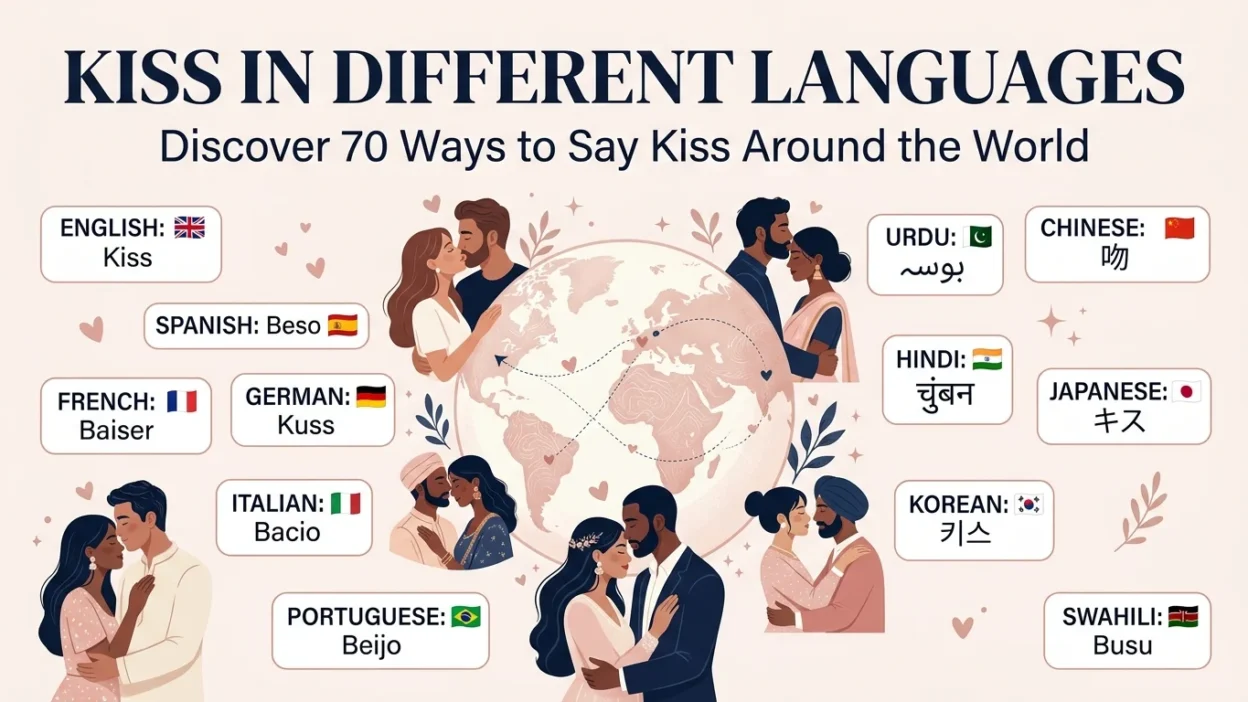
- Spanish: Beso
- French: Baiser
- German: Kuss
- Italian: Bacio
- Portuguese: Beijo
- Arabic: قُبْلَة
- Hindi: चुंबन
- Japanese: キス
- Korean: 키스
- Chinese: 吻
These words are useful starting points for understanding how different languages express affection. The precise wording may change depending on whether you mean a kiss as a noun or the act of kissing.
Kiss in Different Languages in All Languages
| Language | Native Phrase | Easy English Pronunciation | Example Sentence | English Meaning |
| English | Kiss | Kis | Give me a kiss. | Give me a kiss. |
| Spanish | Beso | BEH-soh | Quiero un beso. | I want a kiss. |
| French | Baiser | Beh-ZAY | Je veux un baiser. | I want a kiss. |
| German | Kuss | Koos | Ich gebe dir einen Kuss. | I give you a kiss. |
| Italian | Bacio | BAH-choh | Voglio un bacio. | I want a kiss. |
| Portuguese | Beijo | BAY-zhoo | Quero um beijo. | I want a kiss. |
| Dutch | Kus | Kuss | Geef me een kus. | Give me a kiss. |
| Afrikaans | Soen | Soon | Gee my ‘n soen. | Give me a kiss. |
| Swedish | Kyss | Shuss | Jag vill ha en kyss. | I want a kiss. |
| Norwegian | Kyss | Shiss | Jeg vil ha et kyss. | I want a kiss. |
| Danish | Kys | Kews | Jeg vil have et kys. | I want a kiss. |
| Finnish | Suudelma | SOO-dehl-mah | Haluan suudelman. | I want a kiss. |
| Icelandic | Koss | Koss | Ég vil fá koss. | I want a kiss. |
| Irish | Póg | Pohg | Tabhair póg dom. | Give me a kiss. |
| Welsh | Cusan | KEE-san | Rho gusan i mi. | Give me a kiss. |
| Polish | Pocałunek | Poh-tsah-WOO-nek | Chcę pocałunek. | I want a kiss. |
| Czech | Polibek | POH-lee-bek | Chci polibek. | I want a kiss. |
| Slovak | Bozk | Bosk | Chcem bozk. | I want a kiss. |
| Slovenian | Poljub | Poh-lyoob | Želim poljub. | I want a kiss. |
| Croatian | Poljubac | Poh-LYOO-bahts | Želim poljubac. | I want a kiss. |
| Serbian | Пољубац | POH-lyoo-bahts | Желим пољубац. | I want a kiss. |
| Bosnian | Poljubac | Poh-LYOO-bahts | Želim poljubac. | I want a kiss. |
| Bulgarian | Целувка | Tseh-LOOV-kah | Искам целувка. | I want a kiss. |
| Macedonian | Бакнеж | BAHK-nezh | Сакам бакнеж. | I want a kiss. |
| Russian | Поцелуй | Pah-tsih-LOOY | Я хочу поцелуй. | I want a kiss. |
| Ukrainian | Поцілунок | Poh-tsih-LOO-nok | Я хочу поцілунок. | I want a kiss. |
| Belarusian | Пацалунак | Pa-tsah-LOO-nak | Я хачу пацалунак. | I want a kiss. |
| Greek | Φιλί | Fee-LEE | Θέλω ένα φιλί. | I want a kiss. |
| Romanian | Sărut | Suh-ROOT | Vreau un sărut. | I want a kiss. |
| Hungarian | Csók | Chohk | Kérek egy csókot. | I want a kiss. |
| Albanian | Puthje | POOTH-yeh | Dua një puthje. | I want a kiss. |
| Lithuanian | Bučinys | BOO-chee-nees | Noriu bučinio. | I want a kiss. |
| Latvian | Skūpsts | Skoopsts | Es gribu skūpstu. | I want a kiss. |
| Estonian | Suudlus | SOOD-loos | Ma tahan suudlust. | I want a kiss. |
| Turkish | Öpücük | Uh-puh-JOOK | Bir öpücük istiyorum. | I want a kiss. |
| Azerbaijani | Öpüş | Uh-push | Bir öpüş istəyirəm. | I want a kiss. |
| Kazakh | Сүйіс | Soo-YEES | Мен сүйіс қалаймын. | I want a kiss. |
| Uzbek | O‘pich | Uh-pich | Men o‘pich xohlayman. | I want a kiss. |
| Kyrgyz | Өбүү | Uh-BUU | Мен өбүү каалайм. | I want a kiss. |
| Persian | بوسه | BOO-seh | من یک بوسه میخواهم. | I want a kiss. |
| Arabic | قُبْلَة | QOOB-lah | أريد قبلة. | I want a kiss. |
| Hebrew | נשיקה | Ne-shee-KAH | אני רוצה נשיקה. | I want a kiss. |
| Urdu | بوسہ | BOO-sah | مجھے ایک بوسہ چاہیے۔ | I want a kiss. |
| Hindi | चुंबन | CHOOM-ban | मुझे एक चुंबन चाहिए। | I want a kiss. |
| Bengali | চুমু | CHOO-moo | আমি একটি চুমু চাই। | I want a kiss. |
| Punjabi | ਚੁੰਮਣ | CHOOM-man | ਮੈਨੂੰ ਇੱਕ ਚੁੰਮਣ ਚਾਹੀਦਾ ਹੈ। | I want a kiss. |
| Gujarati | ચુંબન | CHOOM-ban | મારે એક ચુંબન જોઈએ. | I want a kiss. |
| Marathi | चुंबन | CHOOM-ban | मला एक चुंबन हवे आहे. | I want a kiss. |
| Nepali | चुम्बन | CHOOM-ban | मलाई एउटा चुम्बन चाहिन्छ। | I want a kiss. |
| Sinhala | හාදුව | HAA-doo-wah | මට හාදුවක් ඕනෑ. | I want a kiss. |
| Tamil | முத்தம் | MOOT-tham | எனக்கு ஒரு முத்தம் வேண்டும். | I want a kiss. |
| Telugu | ముద్దు | MOOD-doo | నాకు ఒక ముద్దు కావాలి. | I want a kiss. |
| Kannada | ಮುತ್ತು | MOOT-too | ನನಗೆ ಒಂದು ಮುತ್ತು ಬೇಕು. | I want a kiss. |
| Malayalam | ചുംബനം | CHOOM-ba-nam | എനിക്ക് ഒരു ചുംബനം വേണം. | I want a kiss. |
| Mandarin Chinese | 吻 | Wěn | 我想要一个吻。 | I want a kiss. |
| Japanese | キス | Kisu | キスがしたいです。 | I want to kiss. |
| Korean | 키스 | Ki-seu | 키스하고 싶어요. | I want to kiss. |
| Vietnamese | Nụ hôn | Noo hon | Tôi muốn một nụ hôn. | I want a kiss. |
| Thai | จูบ | Joop | ฉันอยากได้จูบ | I want a kiss. |
| Indonesian | Ciuman | Chee-oo-man | Aku ingin ciuman. | I want a kiss. |
| Malay | Ciuman | Chee-oo-man | Saya mahu ciuman. | I want a kiss. |
| Filipino | Halik | HAH-lik | Gusto ko ng halik. | I want a kiss. |
| Burmese | အနမ်း | Ah-nan | အနမ်းတစ်ခုလိုချင်တယ်။ | I want a kiss. |
| Khmer | ការថើប | Kah-thaep | ខ្ញុំចង់បានការថើប។ | I want a kiss. |
| Lao | ຈູບ | Joop | ຂ້ອຍຢາກໄດ້ຈູບ. | I want a kiss. |
| Swahili | Busu | BOO-soo | Nataka busu. | I want a kiss. |
| Amharic | መሳም | Meh-sam | መሳም እፈልጋለሁ። | I want a kiss. |
| Yoruba | Fẹnuko | Feh-noo-koh | Mo fẹ́ fẹ́nuko. | I want a kiss. |
| Hausa | Sumba | SOOM-bah | Ina son sumba. | I want a kiss. |
| Zulu | Ukuqabula | Oo-koo-qa-BOO-lah | Ngifuna ukuqabula. | I want to kiss. |
| Malagasy | Oroka | Oo-ROO-kah | Mila oroka aho. | I want a kiss. |
How to Say Kiss in Different Languages
To say “kiss” naturally in another language, it helps to understand whether you are talking about the kiss itself or asking someone to kiss you.
For example, Spanish uses beso for a kiss, while besar means “to kiss.” French uses baiser as a noun or verb depending on sentence structure, although the word can carry different connotations in modern French. In Japanese, キス is a common borrowed word for “kiss,” and キスする means “to kiss.”
When learning a new expression, pay attention to the complete sentence rather than memorising one word in isolation. This helps you use the translation naturally and respectfully.
Romantic Words for Kiss Around the World
Many languages have words associated with romantic affection. These expressions can be useful when writing a love message, learning a romantic phrase, or understanding a film or song.
- Spanish: Un beso — A kiss.
- French: Un baiser — A kiss.
- Italian: Un bacio — A kiss.
- Portuguese: Um beijo — A kiss.
- German: Ein Kuss — A kiss.
- Japanese: キス — Kiss.
- Korean: 키스 — Kiss.
- Mandarin Chinese: 一个吻 — A kiss.
- Hindi: एक चुंबन — A kiss.
- Urdu: ایک بوسہ — A kiss.
The best expression depends on the relationship and context. A romantic kiss, a greeting kiss, and a kiss shared between family members may be described differently across cultures.
Different Types of Kisses and Their Meanings
A kiss can communicate different emotions depending on the situation, relationship, and local customs.
Romantic Kiss
A romantic kiss is often shared between partners to express love, attraction, or affection. The language used to describe it may be more intimate than the general word for a kiss.
Kiss on the Cheek
A cheek kiss can be a friendly greeting or a sign of affection. In some countries, people greet friends or relatives with one or two cheek kisses, while other cultures prefer handshakes or verbal greetings.
Family Kiss
Parents may kiss children on the forehead or cheek to show care and reassurance. These gestures are often associated with warmth, comfort, and family affection.
Goodbye Kiss
A goodbye kiss can express love, friendship, or appreciation before someone leaves. The exact expression varies with the language and the relationship between the people.
Why Learning Kiss Translations Is Useful
Learning the word for “kiss” in other languages can help in several everyday situations.
- Travel: Understand common expressions and cultural practices when visiting another country.
- Relationships: Learn affectionate vocabulary for communicating with a partner who speaks another language.
- Language learning: Expand your vocabulary through familiar words and practical examples.
- Writing: Use suitable translations in stories, greeting cards, and personal messages.
- Cultural understanding: Discover how different communities express affection and greeting.
Remember that knowing a translation does not automatically mean that a gesture is appropriate in every situation. Cultural expectations and personal boundaries matter.
Tips for Pronouncing Kiss in Other Languages
Pronunciation can be challenging because different languages use sounds that may not exist in English. These simple tips can help you learn more accurately.
- Listen for the original sounds. English pronunciation guides are approximations, so they may not capture every detail.
- Practise the whole phrase. A word can sound different when it appears in a sentence.
- Pay attention to stress and tones. Some languages use stress or tone to distinguish words and meanings.
- Learn the writing system. Recognising native spelling can make the word easier to remember.
- Consider the context. Check whether the word refers to a kiss, the action of kissing, or a specific type of kiss.
Conclusion
The word “kiss” has many different forms across the world’s languages, from beso in Spanish to bacio in Italian and 吻 in Mandarin Chinese. Learning these translations can help you expand your vocabulary, communicate affection, and appreciate cultural differences.
Use this list of 70 languages as a starting point, and remember that the most natural expression depends on the sentence, relationship, and cultural context.
FAQs
1. How do you say kiss in different languages?
“Kiss” is beso in Spanish, baiser in French, Kuss in German, bacio in Italian, beijo in Portuguese, 吻 in Mandarin Chinese, and キス in Japanese.
2. What is the French word for kiss?
The French word is baiser when used as a noun meaning “a kiss.” The expression embrasser commonly means “to kiss” in contemporary French.
3. What is the Spanish word for kiss?
The Spanish word for a kiss is beso. For example, Quiero un beso means “I want a kiss.”
4. How do you say kiss in Japanese?
A common Japanese word for “kiss” is キス (kisu). The expression キスする means “to kiss.”
5. Is the word for kiss the same in every language?
No. Each language has its own vocabulary, pronunciation, and cultural context. Some languages also use different words for a kiss as a noun and the act of kissing.