Flowers are loved around the world for their beauty, fragrance, and special meanings. They represent love, friendship, happiness, gratitude, and new beginnings. Although flowers look beautiful in every country, the words people use to describe them differ from one language to another.
Learning how to say flowers in different languages is a simple way to expand your vocabulary, explore other cultures, and communicate with people from different backgrounds. Whether you are learning a new language, travelling abroad, studying vocabulary, or looking for flower-related words for a project, this guide will help you discover the correct translations.
In English, the word flowers is the plural form of flower. Other languages may use different plural forms, grammatical genders, or expressions depending on the context.
This article covers flowers in languages, with native translations, easy English pronunciations, practical example sentences, and their English meanings.
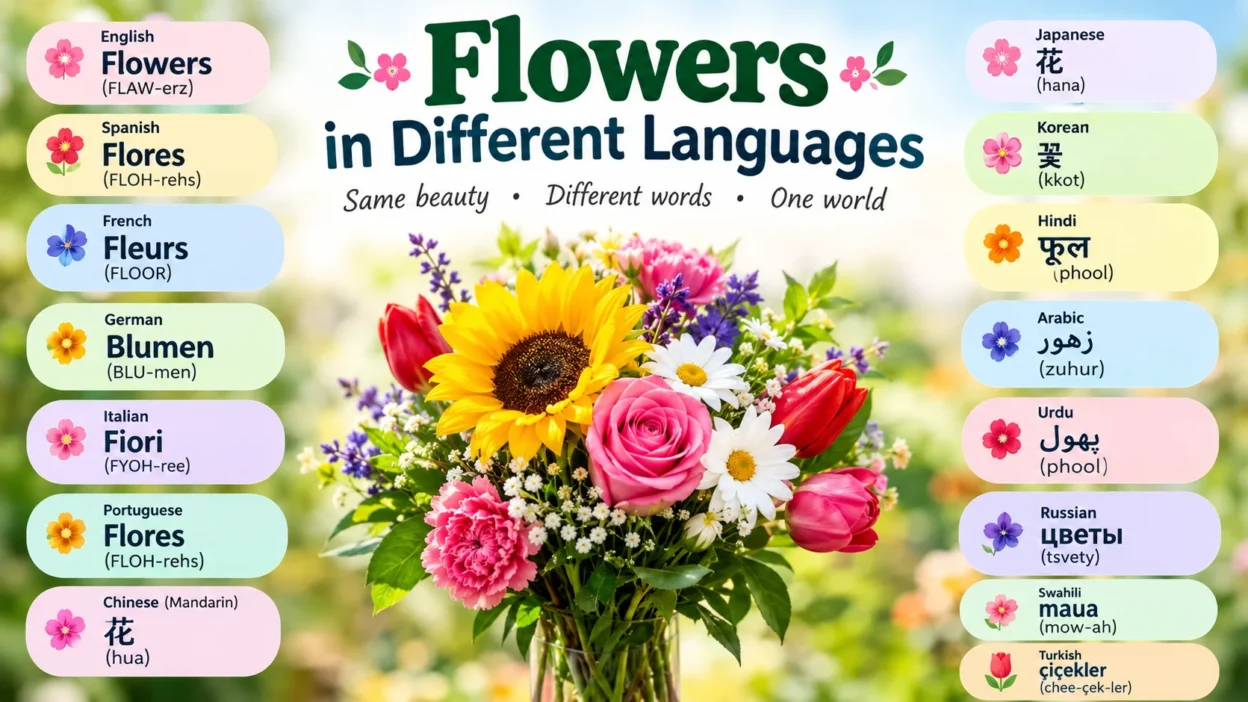
Flowers in Different Languages
| Language | Translation |
| English | Flowers |
| Spanish | Flores |
| French | Fleurs |
| German | Blumen |
| Italian | Fiori |
| Portuguese | Flores |
| Chinese (Mandarin) | 花 (huā) |
| Japanese | 花 (hana) |
| Korean | 꽃 (kkot) |
| Hindi | फूल (phool) |
| Urdu | پھول (phool) |
| Arabic | زهور (zuhūr) |
| Russian | Цветы (tsvety) |
| Turkish | Çiçekler |
| Swahili | Maua |
Flowers in Different Languages
| Language | Native word for flowers | Easy English pronunciation | Example sentence in the language | English meaning |
| English | Flowers | FLOW-erz | These flowers are beautiful. | These flowers are beautiful. |
| Spanish | Flores | FLOH-res | Las flores son bonitas. | The flowers are beautiful. |
| French | Fleurs | FLUR | Les fleurs sont belles. | The flowers are beautiful. |
| German | Blumen | BLOO-men | Die Blumen sind schön. | The flowers are beautiful. |
| Italian | Fiori | FYOH-ree | I fiori sono belli. | The flowers are beautiful. |
| Portuguese | Flores | FLOH-res | As flores são bonitas. | The flowers are beautiful. |
| Dutch | Bloemen | BLOO-men | De bloemen zijn mooi. | The flowers are beautiful. |
| Swedish | Blommor | BLOM-or | Blommorna är vackra. | The flowers are beautiful. |
| Norwegian | Blomster | BLOM-ster | Blomstene er vakre. | The flowers are beautiful. |
| Danish | Blomster | BLOM-ster | Blomsterne er smukke. | The flowers are beautiful. |
| Finnish | Kukat | KOO-kaht | Kukat ovat kauniita. | The flowers are beautiful. |
| Icelandic | Blóm | BLOHM | Blómin eru falleg. | The flowers are beautiful. |
| Irish | Bláthanna | BLAW-huh-nuh | Tá na bláthanna go hálainn. | The flowers are beautiful. |
| Scottish Gaelic | Flùraichean | FLOO-ree-khun | Tha na flùraichean brèagha. | The flowers are beautiful. |
| Welsh | Blodau | BLOH-dye | Mae’r blodau’n brydferth. | The flowers are beautiful. |
| Polish | Kwiaty | KVYA-tih | Te kwiaty są piękne. | These flowers are beautiful. |
| Czech | Květiny | KVYEH-tee-nih | Ty květiny jsou krásné. | These flowers are beautiful. |
| Slovak | Kvety | KVYEH-tih | Tie kvety sú krásne. | Those flowers are beautiful. |
| Ukrainian | Квіти | KVEE-tih | Ці квіти красиві. | These flowers are beautiful. |
| Russian | Цветы | TSVYEH-tih | Эти цветы красивые. | These flowers are beautiful. |
| Bulgarian | Цветя | TSVET-yah | Цветята са красиви. | The flowers are beautiful. |
| Serbian | Цвеће | TSVEH-cheh | Цвеће је лепо. | The flowers are beautiful. |
| Croatian | Cvijeće | TSVYeh-cheh | Cvijeće je lijepo. | The flowers are beautiful. |
| Slovenian | Rože | ROH-zheh | Rože so lepe. | The flowers are beautiful. |
| Macedonian | Цвеќиња | TSVET-kyeen-yah | Цвеќињата се убави. | The flowers are beautiful. |
| Greek | Λουλούδια | loo-LOO-thya | Τα λουλούδια είναι όμορφα. | The flowers are beautiful. |
| Romanian | Flori | FLOR-ee | Florile sunt frumoase. | The flowers are beautiful. |
| Hungarian | Virágok | VEE-rah-gok | A virágok szépek. | The flowers are beautiful. |
| Albanian | Lule | LOO-leh | Lulet janë të bukura. | The flowers are beautiful. |
| Turkish | Çiçekler | chee-CHEK-ler | Çiçekler çok güzel. | The flowers are very beautiful. |
| Arabic | زهور | zu-HOOR | هذه الزهور جميلة. | These flowers are beautiful. |
| Hebrew | פרחים | pra-KHEEM | הפרחים יפים. | The flowers are beautiful. |
| Persian | گلها | gol-HA | این گلها زیبا هستند. | These flowers are beautiful. |
| Urdu | پھول | phool | یہ پھول خوبصورت ہیں۔ | These flowers are beautiful. |
| Hindi | फूल | phool | ये फूल सुंदर हैं। | These flowers are beautiful. |
| Bengali | ফুল | phool | ফুলগুলো সুন্দর। | The flowers are beautiful. |
| Punjabi | ਫੁੱਲ | phull | ਇਹ ਫੁੱਲ ਸੋਹਣੇ ਹਨ। | These flowers are beautiful. |
| Gujarati | ફૂલો | phoo-lo | આ ફૂલો સુંદર છે. | These flowers are beautiful. |
| Marathi | फुले | foo-lay | ही फुले सुंदर आहेत. | These flowers are beautiful. |
| Nepali | फूलहरू | phool-ha-roo | यी फूलहरू सुन्दर छन्। | These flowers are beautiful. |
| Sinhala | මල් | mal | මේ මල් ලස්සනයි. | These flowers are beautiful. |
| Tamil | பூக்கள் | poo-kal | இந்தப் பூக்கள் அழகாக இருக்கின்றன. | These flowers are beautiful. |
| Telugu | పూలు | poo-loo | ఈ పూలు అందంగా ఉన్నాయి. | These flowers are beautiful. |
| Kannada | ಹೂಗಳು | hoo-ga-loo | ಈ ಹೂಗಳು ಸುಂದರವಾಗಿವೆ. | These flowers are beautiful. |
| Malayalam | പൂക്കൾ | poo-kal | ഈ പൂക്കൾ മനോഹരമാണ്. | These flowers are beautiful. |
| Thai | ดอกไม้ | dawk-mai | ดอกไม้สวยมาก | The flowers are very beautiful. |
| Lao | ດອກໄມ້ | dawk-mai | ດອກໄມ້ງາມຫຼາຍ | The flowers are very beautiful. |
| Khmer | ផ្កា | phkaa | ផ្កាស្អាតណាស់។ | The flowers are very beautiful. |
| Vietnamese | Hoa | hwah | Những bông hoa rất đẹp. | The flowers are very beautiful. |
| Chinese (Mandarin) | 花 | hwah (huā) | 这些花很漂亮。 | These flowers are beautiful. |
| Japanese | 花 | hah-nah (hana) | この花はきれいです。 | These flowers are beautiful. |
| Korean | 꽃 | kkot | 이 꽃들은 아름다워요. | These flowers are beautiful. |
| Indonesian | Bunga | BOO-ngah | Bunga-bunga ini indah. | These flowers are beautiful. |
| Malay | Bunga-bunga | BOO-ngah BOO-ngah | Bunga-bunga ini cantik. | These flowers are beautiful. |
| Filipino (Tagalog) | Mga bulaklak | muh-NGAH boo-LAHK-lahk | Magaganda ang mga bulaklak. | The flowers are beautiful. |
| Swahili | Maua | mah-OO-ah | Maua haya ni mazuri. | These flowers are beautiful. |
| Zulu | Izimbali | ee-ZEEM-bah-lee | Izimbali zinhle. | The flowers are beautiful. |
| Xhosa | Iintyatyambo | een-tyah-TYAHM-bo | Iintyatyambo zintle. | The flowers are beautiful. |
| Afrikaans | Blomme | BLOM-uh | Die blomme is mooi. | The flowers are beautiful. |
| Amharic | አበቦች | ah-beh-BOCH | አበቦቹ ቆንጆ ናቸው። | The flowers are beautiful. |
| Somali | Ubaxyo | oo-BAKH-yo | Ubaxyadu waa qurux badan yihiin. | The flowers are beautiful. |
| Yoruba | Àwọn òdòdó | ah-WON aw-daw-DAW | Àwọn òdòdó náà lẹ́wà. | The flowers are beautiful. |
| Igbo | Okooko osisi | oh-KOH-koh oh-SEE-see | Okooko osisi ndị a mara mma. | These flowers are beautiful. |
| Hausa | Furanni | foo-RAN-nee | Furannin suna da kyau. | The flowers are beautiful. |
| Malagasy | Voninkazo | voo-neen-KAH-zoo | Tsara tarehy ny voninkazo. | The flowers are beautiful. |
| Māori | Ngā putiputi | ngah poo-tee-POO-tee | He ātaahua ngā putiputi. | The flowers are beautiful. |
| Hawaiian | Nā pua | nah POO-ah | Nani nā pua. | The flowers are beautiful. |
| Latin | Flores | FLOH-res | Flores pulchrae sunt. | The flowers are beautiful. |
Why Learn the Word Flowers in Different Languages?
Learning flower vocabulary helps you understand how languages describe nature and beauty. It can also make everyday conversations more meaningful when you travel, give gifts, or speak with people from other cultures.
Flowers have different cultural associations. Roses are often connected with love, while lilies may represent remembrance, purity, or renewal. Cherry blossoms are closely associated with spring in Japan, and marigolds have important cultural and ceremonial uses in several countries.
Knowing the local word for flowers can help you shop at flower markets, read signs in gardens, and talk about plants with native speakers.
How to Say Flowers in Different Languages Around the World
The word for flowers varies widely across regions.
- Europe: Languages such as Spanish, French, German, and Italian use flores, fleurs, Blumen, and fiori.
- Asia: Common terms include Hindi phool, Japanese hana, Korean kkot, and Mandarin huā.
- The Middle East: Arabic uses zuhūr, while Persian commonly uses gol-hā.
- Africa: Swahili uses maua, Zulu uses izimbali, and Afrikaans uses blomme.
- The Pacific: Māori uses ngā putiputi, while Hawaiian uses nā pua.
These examples show how the same idea can be expressed through different sounds, writing systems, and grammatical structures.
Common Flower Names in Different Languages
The general word for flowers is useful, but learning the names of individual flowers can make your vocabulary even more practical.
| Flower | Spanish | French | German | Italian |
| Rose | Rosa | Rose | Rose | Rosa |
| Sunflower | Girasol | Tournesol | Sonnenblume | Girasole |
| Tulip | Tulipán | Tulipe | Tulpe | Tulipano |
| Daisy | Margarita | Marguerite | Gänseblümchen | Margherita |
| Lily | Lirio | Lys | Lilie | Giglio |
| Jasmine | Jazmín | Jasmin | Jasmin | Gelsomino |
| Orchid | Orquídea | Orchidée | Orchidee | Orchidea |
| Lavender | Lavanda | Lavande | Lavendel | Lavanda |
Individual flower names may also change according to regional vocabulary and the particular plant species.
Are Flower Translations the Same in Every Language?
No. Translations can differ according to grammar, regional usage, and context.
Some languages use one word for both a flower and flowers, with the surrounding sentence showing whether the meaning is singular or plural. Other languages change the word ending to indicate more than one flower.
For example, Mandarin uses 花 (huā) for flower or flowers, depending on context. Japanese also uses 花 (hana) as a general term, while Spanish typically uses flor for one flower and flores for multiple flowers.
When learning flowers in different languages, it is helpful to learn the word within a sentence rather than memorising a translation alone.
Tips for Remembering Flower Vocabulary
Use these simple methods to remember flower translations more easily.
- Group words by region: Learn European, Asian, African, and Pacific language terms separately.
- Connect words with pictures: Match each word to a photograph of flowers.
- Practise short sentences: Use examples such as “The flowers are beautiful” to remember the word in context.
- Say the words aloud: Pronunciation practice helps you recognise and recall unfamiliar vocabulary.
- Learn individual flower names: Add rose, tulip, sunflower, and lily to your vocabulary after learning the general term.
- Review regularly: Revisit a small group of words each day instead of memorising all 70 at once.
Conclusion
Flowers are a universal part of nature, but every language has its own way of describing them. From flores in Spanish to fleurs in French, phool in Hindi, and maua in Swahili, these translations reveal the variety and richness of languages around the world.
Use this list of flowers in 70 different languages to improve your vocabulary, explore other cultures, and make conversations about nature more interesting. Practising the words in short sentences will help you remember both their meanings and their everyday use.
FAQs
1. How do you say flowers in different languages?
The word varies by language. Examples include flores in Spanish, fleurs in French, Blumen in German, fiori in Italian, phool in Hindi, and maua in Swahili.
2. What is the word for flowers in the most widely spoken languages?
Some common translations are flores in Spanish, fleurs in French, Blumen in German, 花 (huā) in Mandarin, 花 (hana) in Japanese, phool in Hindi, and zuhūr in Arabic.
3. Is the word for flower the same as the word for flowers?
Not always. English changes flower to flowers, and Spanish changes flor to flores. However, some languages use the same word for singular and plural, relying on context to communicate the meaning.
4. Why should I learn flowers in different languages?
Learning flower translations can improve your vocabulary, support travel conversations, help you communicate at flower markets, and introduce you to the cultural importance of plants and flowers.
5. How can I learn flower names in languages easily?
Start with five to ten languages at a time. Use pronunciation guides, pictures, flashcards, and short example sentences. Review the words regularly and practise saying them aloud to improve recall.