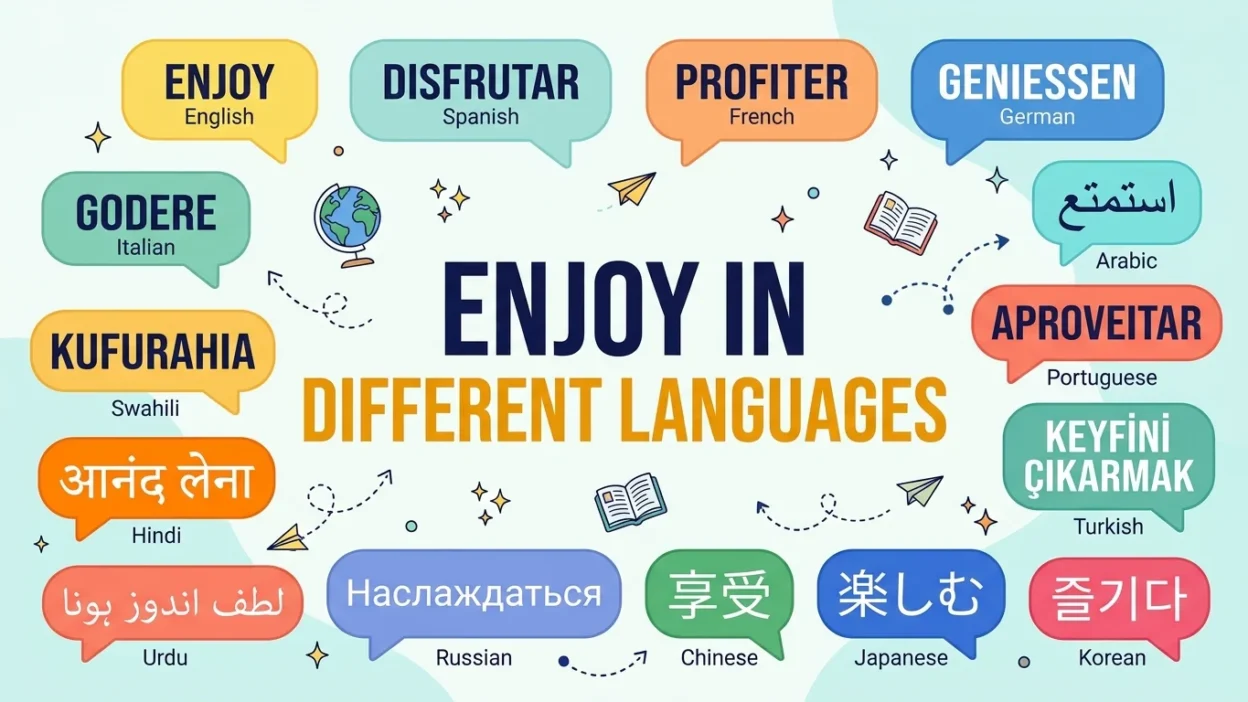
The word “enjoy” is used to express happiness, pleasure, and appreciation for an experience. Whether you are enjoying delicious food, spending time with friends, travelling to a new country, or appreciating a beautiful moment, this simple word helps communicate positive feelings.
Learning how to say enjoy in different languages is a wonderful way to explore cultures, improve your vocabulary, and connect with people around the world. Although many languages have a direct translation of “enjoy”, the most natural expression can change depending on the situation.
In some languages, the word means to take pleasure in something. In others, a different expression is used to wish someone an enjoyable meal, a pleasant trip, or a wonderful experience.
This guide features languages, including their native translations, easy English pronunciations, practical example sentences, and English meanings.
How to Say Enjoy in Different Languages
The translation of “enjoy” depends on the context. For example, “I enjoy music” describes something you like, while “Enjoy your meal” is a friendly expression used before someone eats.
The table below focuses on common translations and natural expressions related to enjoying an activity or experience. Some languages use different grammatical forms depending on the subject and sentence.
Enjoy in Different Languages
| Language | Native Phrase | Easy English Pronunciation | Example Sentence | English Meaning |
| English | Enjoy | en-JOY | I enjoy reading books. | I like reading books. |
| Spanish | Disfrutar | dees-froo-TAR | Me gusta disfrutar de la música. | I like enjoying music. |
| French | Profiter | pro-fee-TAY | Je veux profiter de mes vacances. | I want to enjoy my holiday. |
| German | Genießen | guh-NEE-sen | Ich genieße den Urlaub. | I am enjoying the holiday. |
| Italian | Godere | go-DEH-reh | Voglio godere della vita. | I want to enjoy life. |
| Portuguese | Aproveitar | ah-proh-vay-TAR | Quero aproveitar o dia. | I want to enjoy the day. |
| Dutch | Genieten | khuh-NEE-ten | Ik geniet van de muziek. | I enjoy the music. |
| Swedish | Njuta | NYOO-tah | Jag vill njuta av dagen. | I want to enjoy the day. |
| Norwegian | Nyte | NEE-teh | Jeg vil nyte ferien. | I want to enjoy the holiday. |
| Danish | Nyde | NEW-thuh | Jeg vil nyde maden. | I want to enjoy the food. |
| Finnish | Nauttia | NOWT-tee-ah | Haluan nauttia lomasta. | I want to enjoy the holiday. |
| Icelandic | Njóta | NYOH-tah | Ég vil njóta dagsins. | I want to enjoy the day. |
| Irish | Bain taitneamh as | ban TAHN-yuv uss | Bain taitneamh as an cheol. | Enjoy the music. |
| Welsh | Mwynhau | moo-in-HIGH | Dw i’n mwynhau’r diwrnod. | I am enjoying the day. |
| Polish | Cieszyć się | CHYEH-shich shyeh | Chcę cieszyć się życiem. | I want to enjoy life. |
| Czech | Užívat si | OO-zhee-vaht see | Chci si užívat života. | I want to enjoy life. |
| Slovak | Užívať si | OO-zhee-vaht shee | Chcem si užívať deň. | I want to enjoy the day. |
| Slovenian | Uživati | oo-zhee-VAH-tee | Želim uživati v življenju. | I want to enjoy life. |
| Croatian | Uživati | oo-zhee-VAH-tee | Želim uživati u odmoru. | I want to enjoy the holiday. |
| Serbian | Uživati | oo-zhee-VAH-tee | Želim da uživam u muzici. | I want to enjoy the music. |
| Bosnian | Uživati | oo-zhee-VAH-tee | Želim uživati u životu. | I want to enjoy life. |
| Bulgarian | Наслаждавам се | nas-lazh-DA-vam seh | Искам да се наслаждавам на живота. | I want to enjoy life. |
| Macedonian | Уживам | oo-ZHEE-vam | Уживам во музиката. | I enjoy the music. |
| Russian | Наслаждаться | nas-lazh-DAT-sya | Я хочу наслаждаться жизнью. | I want to enjoy life. |
| Ukrainian | Насолоджуватися | nah-soh-LOH-dzhoo-va-ty-sya | Я хочу насолоджуватися життям. | I want to enjoy life. |
| Belarusian | Атрымліваць асалоду | ah-trim-LEE-vats ah-sah-LOH-doo | Я хачу атрымліваць асалоду ад жыцця. | I want to enjoy life. |
| Greek | Απολαμβάνω | ah-po-lam-VAH-no | Θέλω να απολαμβάνω τη ζωή. | I want to enjoy life. |
| Romanian | A se bucura | ah seh boo-koo-RAH | Vreau să mă bucur de viață. | I want to enjoy life. |
| Hungarian | Élvezni | AYL-vez-nee | Szeretem élvezni az életet. | I like enjoying life. |
| Albanian | Shijoj | shee-YOY | Dua të shijoj jetën. | I want to enjoy life. |
| Turkish | Keyfini çıkarmak | kay-FEE-nee chi-kar-MAK | Hayatın keyfini çıkarmak istiyorum. | I want to enjoy life. |
| Arabic | استمتع | is-tam-TI | أريد أن أستمتع بالحياة. | I want to enjoy life. |
| Hebrew | ליהנות | leh-heh-nawt | אני רוצה ליהנות מהחיים. | I want to enjoy life. |
| Persian | لذت بردن | lazzat bor-DAN | میخواهم از زندگی لذت ببرم. | I want to enjoy life. |
| Urdu | لطف اندوز ہونا | lut-f an-DOZ ho-NA | میں زندگی سے لطف اندوز ہونا چاہتا ہوں۔ | I want to enjoy life. |
| Hindi | आनंद लेना | aa-NAND lay-NA | मैं जीवन का आनंद लेना चाहता हूँ। | I want to enjoy life. |
| Bengali | উপভোগ করা | oo-po-BHOG ko-RA | আমি জীবন উপভোগ করতে চাই। | I want to enjoy life. |
| Punjabi | ਆਨੰਦ ਮਾਣਨਾ | aa-NAND MAAN-na | ਮੈਂ ਜ਼ਿੰਦਗੀ ਦਾ ਆਨੰਦ ਮਾਣਨਾ ਚਾਹੁੰਦਾ ਹਾਂ। | I want to enjoy life. |
| Gujarati | આનંદ માણવો | aa-NAND MAAN-vo | હું જીવનનો આનંદ માણવા માંગુ છું. | I want to enjoy life. |
| Marathi | आनंद घेणे | aa-NAND ghay-NAY | मला जीवनाचा आनंद घ्यायचा आहे. | I want to enjoy life. |
| Nepali | रमाइलो गर्नु | ra-MAI-lo gar-NU | म जीवनको आनन्द लिन चाहन्छु। | I want to enjoy life. |
| Sinhala | විඳිනවා | vee-dee-na-VA | මම ජීවිතය විඳිනවා. | I enjoy life. |
| Tamil | மகிழ்ந்து அனுபவி | ma-kee-rn-dhu a-nu-BHA-vee | நான் வாழ்க்கையை மகிழ்ந்து அனுபவிக்கிறேன். | I enjoy life. |
| Telugu | ఆనందించు | aa-nan-DIN-chu | నేను జీవితాన్ని ఆనందిస్తున్నాను. | I am enjoying life. |
| Kannada | ಆನಂದಿಸು | aa-nan-DEE-su | ನಾನು ಜೀವನವನ್ನು ಆನಂದಿಸುತ್ತೇನೆ. | I enjoy life. |
| Malayalam | ആസ്വദിക്കുക | aas-vaa-DEE-kka | ഞാൻ ജീവിതം ആസ്വദിക്കുന്നു. | I enjoy life. |
| Chinese (Mandarin) | 享受 | shyahng-SHOW | 我很享受生活。 | I really enjoy life. |
| Japanese | 楽しむ | ta-no-SHEE-moo | 人生を楽しみたいです。 | I want to enjoy life. |
| Korean | 즐기다 | jeul-GEE-da | 인생을 즐기고 싶어요. | I want to enjoy life. |
| Vietnamese | Thưởng thức | thuh-UNG thuk | Tôi muốn tận hưởng cuộc sống. | I want to enjoy life. |
| Thai | สนุกกับ | sa-NOOK gap | ฉันสนุกกับชีวิต | I enjoy life. |
| Indonesian | Menikmati | muh-nee-KMAH-tee | Saya ingin menikmati hidup. | I want to enjoy life. |
| Malay | Menikmati | muh-nee-KMAH-tee | Saya mahu menikmati hidup. | I want to enjoy life. |
| Filipino (Tagalog) | Mag-enjoy | mag-en-JOY | Gusto kong mag-enjoy sa buhay. | I want to enjoy life. |
| Burmese | ပျော်ရွှင်ခံစားသည် | pyaw-shwin khan-ZA-thi | ဘဝကို ပျော်ရွှင်စွာ ခံစားချင်တယ်။ | I want to enjoy life. |
| Khmer | រីករាយ | ree-KA-ree | ខ្ញុំចង់រីករាយនឹងជីវិត។ | I want to enjoy life. |
| Lao | ມ່ວນຊື່ນ | muan-SUEN | ຂ້ອຍຢາກມ່ວນຊື່ນກັບຊີວິດ. | I want to enjoy life. |
| Mongolian | Таашаах | taa-SHAKH | Би амьдралаас таашаал авахыг хүсэж байна. | I want to enjoy life. |
| Kazakh | Ләззат алу | laz-ZAT ah-LOO | Мен өмірден ләззат алғым келеді. | I want to enjoy life. |
| Uzbek | Zavqlanmoq | zavq-lan-MOQ | Men hayotdan zavqlanmoqchiman. | I want to enjoy life. |
| Azerbaijani | Zövq almaq | zovq al-MAK | Həyatdan zövq almaq istəyirəm. | I want to enjoy life. |
| Georgian | სიამოვნების მიღება | see-ah-mov-NEH-bis mee-GHEH-ba | მინდა ცხოვრებით სიამოვნება მივიღო. | I want to enjoy life. |
| Armenian | Վայելել | va-ye-LEL | Ես ուզում եմ վայելել կյանքը։ | I want to enjoy life. |
| Swahili | Kufurahia | koo-foo-rah-HEE-ah | Ninataka kufurahia maisha. | I want to enjoy life. |
| Afrikaans | Geniet | khuh-NEET | Ek geniet die lewe. | I enjoy life. |
| Amharic | መደሰት | meh-deh-SET | በሕይወት መደሰት እፈልጋለሁ። | I want to enjoy life. |
| Yoruba | Gbadun | gba-DOON | Mo fẹ́ gbádùn ìgbésí ayé. | I want to enjoy life. |
| Zulu | Ukujabulela | oo-koo-ja-boo-LEH-la | Ngifuna ukujabulela impilo. | I want to enjoy life. |
Note: Pronunciations are approximate guides for English speakers. Some languages change the verb form according to the subject, tense, or context. The examples show common expressions related to enjoyment rather than a single identical grammatical construction in every language.
Why Learn the Word Enjoy in Different Languages?
Learning how to express enjoyment in another language helps you communicate more naturally and understand cultural differences. A simple phrase can make everyday interactions more friendly, whether you are meeting new people, travelling, or learning a language.
Here are a few reasons to learn these translations:
- Travel: Express appreciation for local food, activities, and experiences.
- Communication: Share your interests and feelings with speakers of other languages.
- Language learning: Expand your vocabulary with practical verbs and expressions.
- Cultural understanding: Discover how different languages describe pleasure and happiness.
- Social connections: Use familiar expressions to make conversations warmer and more personal.
Different Ways to Use Enjoy in a Sentence
The English word “enjoy” appears in several everyday situations. Understanding its use makes it easier to choose the right translation in another language.
Enjoy an activity
Use “enjoy” when talking about an activity that brings you pleasure.
Examples:
- I enjoy swimming.
- She enjoys painting.
- We enjoy travelling together.
Enjoy an experience
Use the word when describing something pleasant or memorable.
Examples:
- I enjoyed the concert.
- They enjoyed their holiday.
- He enjoys spending time with his family.
Enjoy your meal
“Enjoy your meal” is a friendly expression commonly used before someone begins eating. Other languages often have established expressions for this situation rather than a literal translation of the verb.
Enjoy yourself
“Enjoy yourself” means to have a good time. It is often used when someone is attending a party, travelling, or taking part in an activity.
For example: “Have a wonderful evening and enjoy yourself!”
How to Say Enjoy in Different Languages Around the World
Translations of “enjoy” reflect differences in grammar, culture, and everyday speech.
In Spanish, disfrutar is widely used for enjoying activities and experiences. French speakers commonly use profiter in expressions about making the most of time or an opportunity. In German, genießen expresses taking pleasure in something, such as food, music, or a holiday.
In Hindi and Urdu, expressions based on आनंद लेना and لطف اندوز ہونا communicate the idea of taking pleasure in an experience. Mandarin Chinese uses 享受 for enjoying something, while Japanese uses 楽しむ to express enjoyment or having fun.
These differences show why understanding context is important when learning enjoy translations. A dictionary equivalent may be correct in one sentence but sound unnatural in another.
Common Phrases Related to Enjoy
Here are some useful English expressions to practise alongside the translations in the table.
| English Phrase | Meaning | Example |
| Enjoy your day | Have a pleasant day | Enjoy your day at the beach. |
| Enjoy your meal | Have a pleasant eating experience | Enjoy your meal with your family. |
| Enjoy yourself | Have a good time | Enjoy yourself at the party. |
| Enjoy the moment | Appreciate the present experience | Enjoy the moment and relax. |
| Enjoy life | Find pleasure in living | She tries to enjoy life every day. |
| Enjoy the journey | Appreciate the experience along the way | Enjoy the journey, not just the destination. |
| Enjoy your holiday | Have a pleasant holiday | I hope you enjoy your holiday. |
| Enjoy the music | Take pleasure in listening to music | We sat outside to enjoy the music. |
Tips for Learning Enjoy Translations
Learning a word is easier when you practise it in realistic situations instead of memorising translations alone.
- Learn complete sentences: Remember how the word is used in a natural phrase.
- Practise pronunciation: Read each translation aloud and listen for unfamiliar sounds.
- Pay attention to grammar: Some languages change verbs depending on who is speaking.
- Use everyday situations: Practise phrases related to food, travel, music, and hobbies.
- Review regularly: Revisit a few languages each day instead of trying to memorise all 70 at once.
Remember that translations are not always interchangeable. When speaking with native speakers, choose the expression that best fits the situation.
Conclusion
Learning how to say enjoy in different languages is a useful way to build vocabulary, communicate positive feelings, and explore cultures around the world. From Spanish disfrutar and French profiter to Hindi आनंद लेना and Japanese 楽しむ, each language offers its own way to express pleasure and appreciation.
Use the 70 translations and example sentences in this guide to practise everyday conversations, improve your language skills, and discover new ways to talk about the things you enjoy.
FAQs
1. How do you say enjoy in different languages?
“Enjoy” can be expressed as disfrutar in Spanish, profiter in French, genießen in German, 享受 in Mandarin Chinese, and 楽しむ in Japanese. The most suitable translation depends on the sentence and context.
2. What is the meaning of enjoy?
Enjoy means to take pleasure or satisfaction in an activity, experience, object, or situation. For example, “I enjoy music” means that listening to music gives me pleasure.
3. How do you say enjoy your meal in different languages?
The expression varies by language. In French, people commonly say Bon appétit. In Spanish, ¡Buen provecho! is widely used, while German speakers often say Guten Appetit! These are natural mealtime expressions rather than literal translations of “enjoy”.
4. Is enjoy translated the same way in every language?
No. Some languages have a direct verb for enjoying something, while others use expressions that mean taking pleasure, having fun, or making the most of an experience. Grammar and context can also change the appropriate form.
5. What is the best way to learn enjoy in all languages?
Start with a few languages, practise the native phrases aloud, and memorise the example sentences. Reviewing translations regularly and using them in real conversations will help you remember their meanings and pronunciation.