The Earth is our home, the planet we live on, and the natural world that supports all life. But how do people around the world say “Earth” in their own languages? From Spanish and French to Arabic, Hindi, Japanese, and Chinese, the word has different forms, pronunciations, and cultural meanings.
Learning earth in different languages is a useful way to explore world languages, improve vocabulary, and understand how people describe our planet. In some languages, the word for Earth also means soil, land, or ground, depending on the context.
In this guide, you will discover translations of Earth, easy English pronunciations, and short example sentences with their English meanings.
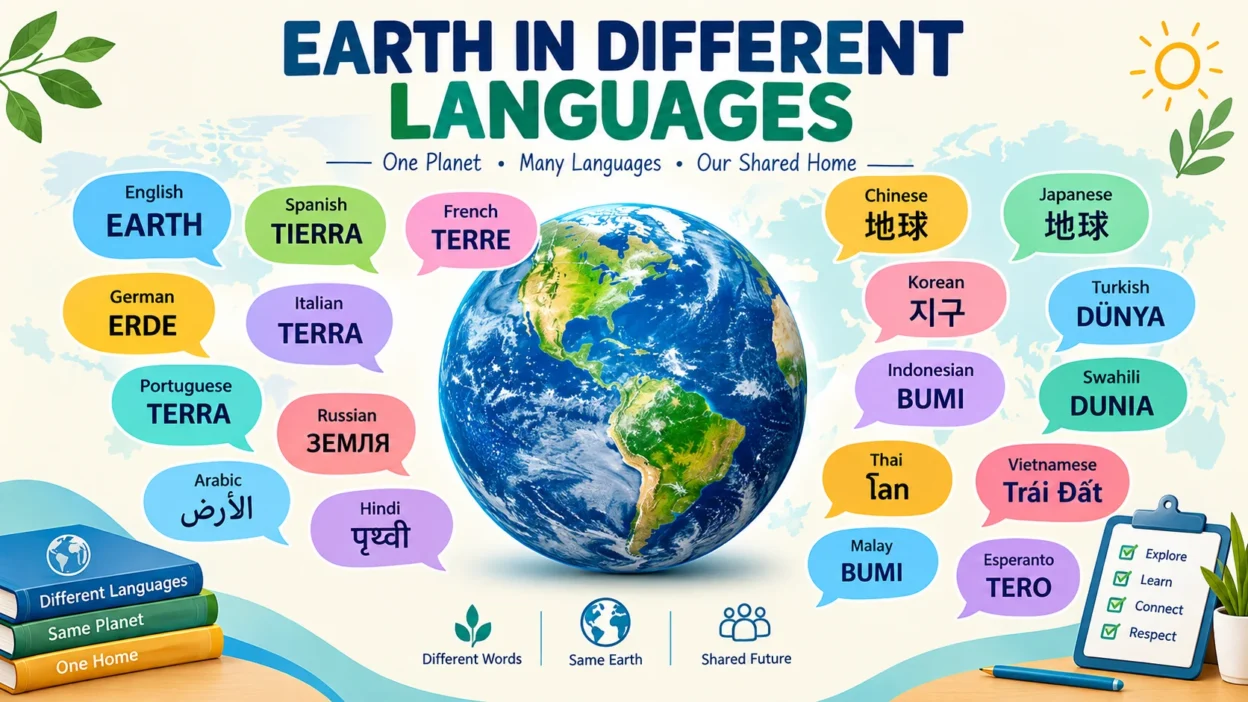
Earth in Different Languages
| Language | Native Word for Earth | Easy English Pronunciation | Example Sentence | English Meaning |
| English | Earth | urth | Earth moves around the Sun. | Earth moves around the Sun. |
| Spanish | Tierra | tee-EH-rrah | La Tierra es nuestro hogar. | Earth is our home. |
| French | Terre | tehr | La Terre est une planète. | Earth is a planet. |
| German | Erde | AIR-duh | Die Erde ist rund. | Earth is round. |
| Italian | Terra | TEHR-rah | La Terra gira um die Sonne. | Earth revolves around the Sun. |
| Portuguese | Terra | TEH-hah | A Terra é o nosso planeta. | Earth is our planet. |
| Dutch | Aarde | AHR-duh | De aarde is prachtig. | Earth is beautiful. |
| Swedish | Jorden | YOR-den | Jorden kretsar kring solen. | Earth revolves around the Sun. |
| Norwegian | Jorden | YOR-den | Jorden er vår planet. | Earth is our planet. |
| Danish | Jorden | YOR-den | Jorden er rund. | Earth is round. |
| Finnish | Maa | mah | Maa kiertää aurinkoa. | Earth revolves around the Sun. |
| Icelandic | Jörðin | YUR-thin | Jörðin er pláneta. | Earth is a planet. |
| Irish | An Domhan | un DOW-un | Is é an Domhan ár mbaile. | Earth is our home. |
| Welsh | Y Ddaear | uh THAI-ar | Is é’r Ddaear ár planed. | Earth is our planet. |
| Polish | Ziemia | ZHEH-myah | Ziemia krąży wokół Słońca. | Earth revolves around the Sun. |
| Czech | Země | ZEH-myeh | Země je naše planeta. | Earth is our planet. |
| Slovak | Zem | zem | Zem obieha okolo Slnka. | Earth revolves around the Sun. |
| Ukrainian | Земля | zem-LYAH | Земля обертається навколо Сонця. | Earth revolves around the Sun. |
| Russian | Земля | zem-LYAH | Земля — наша планета. | Earth is our planet. |
| Bulgarian | Земя | zeh-MYAH | Земята е нашата планета. | Earth is our planet. |
| Serbian | Земља | ZEM-lyah | Земља је наша планета. | Earth is our planet. |
| Croatian | Zemlja | ZEM-lyah | Zemlja je naš planet. | Earth is our planet. |
| Slovenian | Zemlja | ZEM-lyah | Zemlja je naš planet. | Earth is our planet. |
| Greek | Γη | yee | Η Γη είναι ο πλανήτης μας. | Earth is our planet. |
| Romanian | Pământ | puh-MUHNТ | Pământul este planeta noastră. | Earth is our planet. |
| Hungarian | Föld | feuld | A Föld a mi bolygónk. | Earth is our planet. |
| Albanian | Toka | TOH-kah | Toka është planeti ynë. | Earth is our planet. |
| Lithuanian | Žemė | ZHEH-meh | Žemė yra mūsų planeta. | Earth is our planet. |
| Latvian | Zeme | ZEH-meh | Zeme ir mūsu planēta. | Earth is our planet. |
| Estonian | Maa | mah | Maa on meie planeet. | Earth is our planet. |
| Turkish | Dünya | DOON-yah | Dünya bizim gezegenimizdir. | Earth is our planet. |
| Arabic | الأرض | al-ARD | الأرض كوكبنا. | Earth is our planet. |
| Hebrew | כדור הארץ | kah-DUR hah-AH-rets | כדור הארץ הוא הבית שלנו. | Earth is our home. |
| Persian | زمین | za-MEEN | زمین سیاره ماست. | Earth is our planet. |
| Urdu | زمین | za-MEEN | زمین ہمارا گھر ہے۔ | Earth is our home. |
| Hindi | पृथ्वी | PRITH-vee | पृथ्वी हमारा घर है। | Earth is our home. |
| Bengali | পৃথিবী | pṛi-thi-BEE | পৃথিবী আমাদের গ্রহ। | Earth is our planet. |
| Punjabi | ਧਰਤੀ | dhar-TEE | ਧਰਤੀ ਸਾਡਾ ਘਰ ਹੈ। | Earth is our home. |
| Gujarati | પૃથ્વી | PRITH-vee | પૃથ્વી આપણો ગ્રહ છે. | Earth is our planet. |
| Marathi | पृथ्वी | PRITH-vee | पृथ्वी आपला ग्रह आहे. | Earth is our planet. |
| Nepali | पृथ्वी | PRITH-vee | पृथ्वी हाम्रो घर हो। | Earth is our home. |
| Sinhala | පෘථිවිය | pru-thi-VEE-ya | පෘථිවිය අපේ ග්රහලෝකයයි. | Earth is our planet. |
| Tamil | பூமி | BOO-mee | பூமி நமது வீடு. | Earth is our home. |
| Telugu | భూమి | BOO-mee | భూమి మన గ్రహం. | Earth is our planet. |
| Kannada | ಭೂಮಿ | BOO-mee | ಭೂಮಿ ನಮ್ಮ ಗ್ರಹ. | Earth is our planet. |
| Malayalam | ഭൂമി | BOO-mee | ഭൂമി നമ്മുടെ ഗ്രഹമാണ്. | Earth is our planet. |
| Thai | โลก | lohk | โลกเป็นบ้านของเรา | Earth is our home. |
| Vietnamese | Trái Đất | chai dut | Trái Đất là hành tinh của chúng ta. | Earth is our planet. |
| Indonesian | Bumi | BOO-mee | Bumi adalah rumah kita. | Earth is our home. |
| Malay | Bumi | BOO-mee | Bumi ialah planet kita. | Earth is our planet. |
| Filipino | Daigdig | dyeeg-DEEG | Ang daigdig ay tahanan natin. | Earth is our home. |
| Mandarin Chinese | 地球 | dee-CHYOH | 地球是我们的家园。 | Earth is our home. |
| Japanese | 地球 | CHEE-kyoo | 地球は私たちの惑星です。 | Earth is our planet. |
| Korean | 지구 | JEE-goo | 지구는 우리의 행성입니다. | Earth is our planet. |
| Mongolian | Дэлхий | del-KHEE | Дэлхий бол бидний гэр юм. | Earth is our home. |
| Kazakh | Жер | zher | Жер — біздің планетамыз. | Earth is our planet. |
| Uzbek | Yer | yehr | Yer bizning sayyoramiz. | Earth is our planet. |
| Azerbaijani | Yer | yehr | Yer bizim planetimizdir. | Earth is our planet. |
| Armenian | Երկիր | yehr-KEER | Երկիրը մեր մոլորակն է։ | Earth is our planet. |
| Georgian | დედამიწა | deh-dah-MEE-tsah | დედამიწა ჩვენი პლანეტაა. | Earth is our planet. |
| Swahili | Dunia | doo-NEE-ah | Dunia ni nyumba yetu. | Earth is our home. |
| Zulu | Umhlaba | oom-KHLAH-bah | Umhlaba yikhaya lethu. | Earth is our home. |
| Xhosa | Umhlaba | oom-KHLAH-bah | Umhlaba likhaya lethu. | Earth is our home. |
| Afrikaans | Aarde | AHR-duh | Die aarde is ons planeet. | Earth is our planet. |
| Amharic | ምድር | mih-DIR | ምድር ቤታችን ናት። | Earth is our home. |
| Yoruba | Ayé | ah-YEH | Ayé ni ilé wa. | Earth is our home. |
| Hausa | Duniya | doo-NEE-yah | Duniya ita ce gidanmu. | Earth is our home. |
| Igbo | Ụwa | OO-wah | Ụwa bụ ụlọ anyị. | Earth is our home. |
| Malagasy | Tany | TAHN-ee | Ny tany no fonenantsika. | Earth is our home. |
| Haitian Creole | Latè | lah-TEH | Latè se lakay nou. | Earth is our home. |
| Esperanto | Tero | TEH-roh | Tero estas nia planedo. | Earth is our planet. |
Pronunciations are approximate guides for English speakers. Natural pronunciation may vary by region and dialect.
What Does the Word “Earth” Mean?
The word Earth commonly refers to the third planet from the Sun and the only planet currently known to support life. It includes the land, oceans, atmosphere, and living environments that make up our world.
The same word can also refer to soil or ground. For example, “The earth is damp after the rain” refers to soil, while “Earth orbits the Sun” refers to the planet.
This distinction matters when learning earth in different languages because many languages use related words for the planet, land, and soil.
How to Say Earth in Different Languages
To learn how to say Earth in different languages, start with the words most commonly used in everyday conversation:
- Spanish: Tierra
- French: Terre
- German: Erde
- Italian: Terra
- Arabic: الأرض
- Hindi: पृथ्वी
- Urdu: زمین
- Mandarin Chinese: 地球
- Japanese: 地球
- Korean: 지구
Practise each word aloud, then use it in a short sentence. Remember that some languages have separate words for the planet and the ground beneath your feet.
Earth Translations Around the World
Earth translations around the world reflect differences in language, culture, and history. Some words are closely associated with the planet as a whole, while others have broader meanings connected to land, soil, or the world people inhabit.
For example, Spanish uses Tierra, French uses Terre, and Italian uses Terra. These words can refer to both Earth and land, depending on the sentence.
In Mandarin Chinese, 地球 refers to the planet Earth. Japanese also uses 地球, while Korean uses 지구. These terms specifically identify Earth as a planet in common modern usage.
In Urdu and Persian, زمین can mean Earth, land, or ground. The surrounding words help clarify the intended meaning.
Why Is Earth Called by Different Names?
Languages develop through different histories, environments, and cultural traditions. As a result, words for Earth have different origins and associations.
Some names focus on the planet as a celestial body. Others are linked to soil, land, or the place where people live. Even languages that share related words may use them in different ways.
These variations show why translation is more than replacing one word with another. Context is important for choosing the most accurate meaning.
Earth, Soil, Land, and World: What Is the Difference?
Although these words are sometimes interchangeable, they do not always mean the same thing.
- Earth: Usually the planet we live on; it can also mean soil.
- Soil: The upper layer of ground in which plants grow.
- Land: The solid surface of the planet, particularly when contrasted with water or property.
- World: The Earth and its people, societies, and experiences, or a particular area of activity.
When translating Earth into another language, consider whether the sentence refers to the planet, the ground, or the world of human life.
How to Use Earth in Everyday Sentences
Using Earth in simple sentences can help you remember its translations and understand their context.
- Science: Earth is the third planet from the Sun.
- Environment: We should protect Earth’s natural resources.
- Daily life: The earth feels soft after the rain.
- Education: Children learn about Earth in science class.
- Nature: Many different species live on Earth.
When practising another language, choose a sentence that clearly refers to the planet. This makes it easier to remember the correct translation.
Earth in Different Languages in All Languages: Learning Tips
If you want to learn Earth in different languages in all languages, use these simple techniques:
- Learn a few words at a time. Begin with five languages and add more as you remember them.
- Practise native scripts. Learn to recognise words such as 地球, Земля, and पृथ्वी.
- Say each word aloud. Pronunciation guides can help, but listening to native speakers is useful for improving accuracy.
- Use example sentences. Sentences help you distinguish the planet from soil or land.
- Review regularly. Revisit the words after a day, a week, and a month.
These steps can make a list of 70 translations easier to learn and remember.
Conclusion
Earth is known by many different names around the world, from Tierra in Spanish and Terre in French to पृथ्वी in Hindi, 地球 in Chinese and Japanese, and زمین in Urdu. Although the words differ, they all help people describe the planet we share.
Learning earth in different languages expands your vocabulary, improves cultural understanding, and shows how languages express the same important idea in different ways.
FAQs
1. How do you say Earth in different languages?
Earth is Tierra in Spanish, Terre in French, Erde in German, 地球 in Mandarin Chinese, पृथ्वी in Hindi, and زمین in Urdu. The exact word depends on the language and context.
2. What is the most common word for Earth around the world?
There is no single word used worldwide. Each language has its own term, such as Earth, Tierra, Terre, Terra, Dunia, and Bumi.
3. What is Earth called in Hindi and Urdu?
In Hindi, Earth is commonly called पृथ्वी (Prithvi). In Urdu, it is زمین (zameen). Depending on the context, both languages may also use other words associated with the planet or the ground.
4. What is the difference between Earth and earth?
Capitalised Earth generally refers to the planet. Lowercase earth can refer to soil or ground. Capitalisation varies by style guide, but this distinction is useful in many English sentences.
5. Why do Earth translations differ between languages?
Earth translations differ because languages have distinct histories, vocabulary, and cultural influences. Some words refer specifically to the planet, while others can also mean land, soil, or the world.