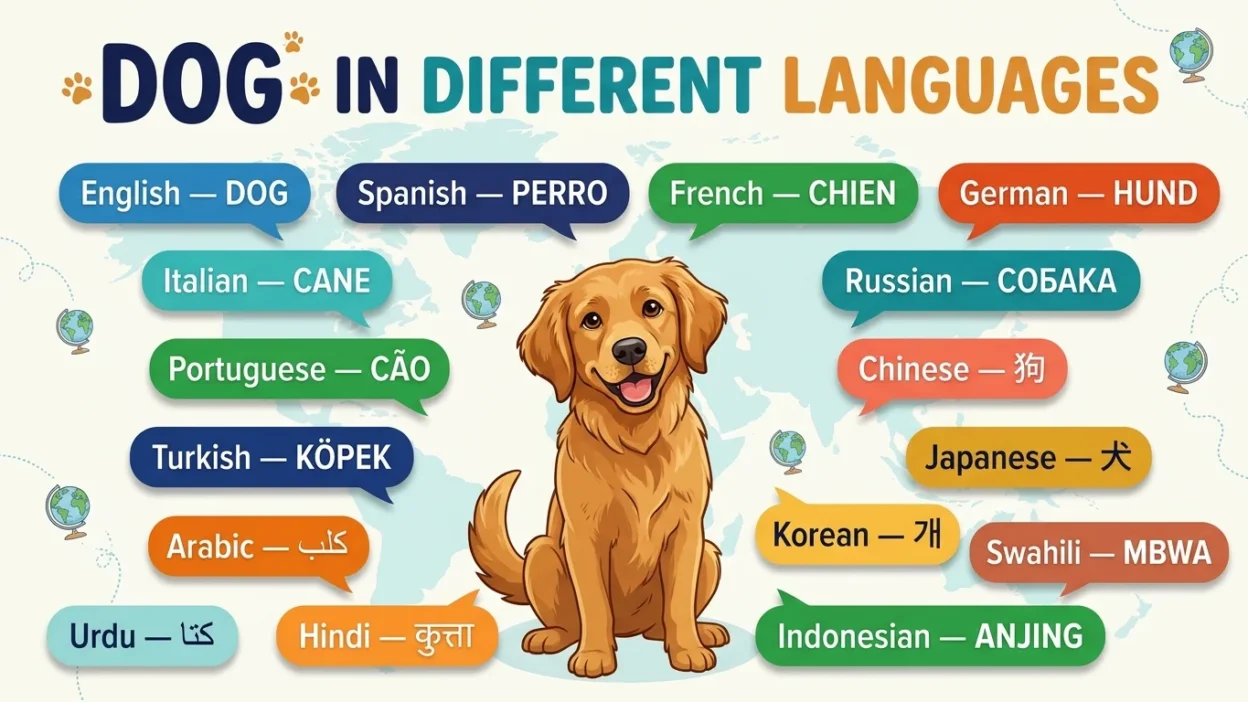
Dogs are beloved companions around the world, known for their loyalty, intelligence, and playful nature. But have you ever wondered what people in different countries call a dog? From perro in Spanish to chien in French and inu in Japanese, the word for this popular animal changes from one language to another.
Learning dog in different languages is a fun way to build vocabulary, explore cultures, and understand how people communicate about animals. Whether you are a language learner, a dog lover, a traveller, or simply curious about world languages, these translations will help you discover how to say “dog” around the world.
In this guide, you will find languages, native words for dog, easy English pronunciation guides, short example sentences, and their English meanings in one convenient table.
Dog in Different Languages
| Language | Native Word for Dog | Easy English Pronunciation | Example Sentence | English Meaning |
| English | Dog | daw g | The dog is friendly. | The dog is friendly. |
| Spanish | Perro | PEH-rroh | El perro es amable. | The dog is friendly. |
| French | Chien | shee-AN | Le chien est gentil. | The dog is friendly. |
| German | Hund | hoont | Der Hund ist freundlich. | The dog is friendly. |
| Italian | Cane | KAH-neh | Il cane è amichevole. | The dog is friendly. |
| Portuguese | Cão | kowng | O cão é amigável. | The dog is friendly. |
| Dutch | Hond | hawnt | De hond is vriendelijk. | The dog is friendly. |
| Swedish | Hund | hoond | Hunden är vänlig. | The dog is friendly. |
| Norwegian | Hund | hoon | Hunden er vennlig. | The dog is friendly. |
| Danish | Hund | hoon | Hunden er venlig. | The dog is friendly. |
| Finnish | Koira | KOY-rah | Koira on ystävällinen. | The dog is friendly. |
| Icelandic | Hundur | HOON-dur | Hundurinn er vingjarnlegur. | The dog is friendly. |
| Irish | Madra | MAH-drah | Tá an madra cairdiúil. | The dog is friendly. |
| Welsh | Ci | kee | Mae’r ci yn gyfeillgar. | The dog is friendly. |
| Polish | Pies | pyess | Pies jest przyjazny. | The dog is friendly. |
| Czech | Pes | pess | Pes je přátelský. | The dog is friendly. |
| Slovak | Pes | pess | Pes je priateľský. | The dog is friendly. |
| Ukrainian | Собака | soh-BAH-kah | Собака дружня. | The dog is friendly. |
| Russian | Собака | suh-BAH-kah | Собака дружелюбная. | The dog is friendly. |
| Bulgarian | Куче | KOO-cheh | Кучето е дружелюбно. | The dog is friendly. |
| Serbian | Пас | pahs | Пас је пријатељски настројен. | The dog is friendly. |
| Croatian | Pas | pahs | Pas je prijateljski nastrojen. | The dog is friendly. |
| Slovenian | Pes | pess | Pes je prijazen. | The dog is friendly. |
| Greek | Σκύλος | SKEE-los | Ο σκύλος είναι φιλικός. | The dog is friendly. |
| Romanian | Câine | KUH-ee-neh | Câinele este prietenos. | The dog is friendly. |
| Hungarian | Kutya | KOO-tyah | A kutya barátságos. | The dog is friendly. |
| Albanian | Qen | chen | Qeni është miqësor. | The dog is friendly. |
| Lithuanian | Šuo | shwoh | Šuo yra draugiškas. | The dog is friendly. |
| Latvian | Suns | soons | Suns ir draudzīgs. | The dog is friendly. |
| Estonian | Koer | KOH-ehr | Koer on sõbralik. | The dog is friendly. |
| Turkish | Köpek | KUR-pek | Köpek dost canlısıdır. | The dog is friendly. |
| Arabic | كلب | kalb | الكلب ودود. | The dog is friendly. |
| Hebrew | כלב | KEH-lev | הכלב ידידותי. | The dog is friendly. |
| Persian | سگ | sag | سگ مهربان است. | The dog is friendly. |
| Urdu | کتا | KUT-tah | کتا دوستانہ ہے۔ | The dog is friendly. |
| Hindi | कुत्ता | KOOT-tah | कुत्ता मिलनसार है। | The dog is friendly. |
| Bengali | কুকুর | KOO-koor | কুকুরটি বন্ধুসুলভ। | The dog is friendly. |
| Punjabi | ਕੁੱਤਾ | KUT-tah | ਕੁੱਤਾ ਦੋਸਤਾਨਾ ਹੈ। | The dog is friendly. |
| Gujarati | કૂતરો | KOO-tah-roh | કૂતરો મૈત્રીપૂર્ણ છે. | The dog is friendly. |
| Marathi | कुत्रा | KOO-trah | कुत्रा मैत्रीपूर्ण आहे. | The dog is friendly. |
| Nepali | कुकुर | KOO-koor | कुकुर मिलनसार छ। | The dog is friendly. |
| Sinhala | බල්ලා | BAL-lah | බල්ලා මිත්රශීලීයි. | The dog is friendly. |
| Tamil | நாய் | naay | நாய் நட்பாக இருக்கிறது. | The dog is friendly. |
| Telugu | కుక్క | KOOK-kah | కుక్క స్నేహపూర్వకంగా ఉంది. | The dog is friendly. |
| Kannada | ನಾಯಿ | NAA-yee | ನಾಯಿ ಸ್ನೇಹಪರವಾಗಿದೆ. | The dog is friendly. |
| Malayalam | നായ | naaya | നായ സൗഹൃദപരമാണ്. | The dog is friendly. |
| Thai | สุนัข | soo-nak | สุนัขเป็นมิตร | The dog is friendly. |
| Vietnamese | Chó | chaw | Con chó rất thân thiện. | The dog is very friendly. |
| Indonesian | Anjing | AHN-jing | Anjing itu ramah. | The dog is friendly. |
| Malay | Anjing | AHN-jing | Anjing itu mesra. | The dog is friendly. |
| Filipino | Aso | AH-soh | Mabait ang aso. | The dog is friendly. |
| Mandarin Chinese | 狗 | gǒu (goʊ) | 这只狗很友好。 | This dog is very friendly. |
| Japanese | 犬 | inu | その犬は人懐っこいです。 | That dog is friendly. |
| Korean | 개 | gae | 그 개는 친근합니다. | That dog is friendly. |
| Mongolian | Нохой | noh-KHOY | Нохой нөхөрсөг. | The dog is friendly. |
| Kazakh | Ит | eet | Ит мейірімді. | The dog is friendly. |
| Uzbek | It | eet | It do’stona. | The dog is friendly. |
| Azerbaijani | İt | eet | İt mehribandır. | The dog is friendly. |
| Armenian | Շուն | shoon | Շունը ընկերասեր է։ | The dog is friendly. |
| Georgian | ძაღლი | dzagh-lee | ძაღლი მეგობრულია. | The dog is friendly. |
| Swahili | Mbwa | mm-bwah | Mbwa ni rafiki. | The dog is a friend. |
| Zulu | Inja | een-jah | Inja inobungane. | The dog is friendly. |
| Xhosa | Inja | een-jah | Inja inobuhlobo. | The dog is friendly. |
| Afrikaans | Hond | hawnt | Die hond is vriendelik. | The dog is friendly. |
| Amharic | ውሻ | woo-shah | ውሻው ወዳጃዊ ነው። | The dog is friendly. |
| Yoruba | Ajá | ah-JAH | Ajá náà nífẹ̀ẹ́ àwọn ènìyàn. | The dog likes people. |
| Hausa | Kare | KAH-reh | Karen yana da kirki. | The dog is kind. |
| Igbo | Nkịta | n-KHEE-tah | Nkịta ahụ nwere omume enyi. | That dog is friendly. |
| Haitian Creole | Chen | shen | Chen an amikal. | The dog is friendly. |
| Esperanto | Hundo | HOON-doh | La hundo estas amika. | The dog is friendly. |
Note: Pronunciation is approximate and may vary by accent or region. Some languages use different forms depending on grammatical gender, sentence structure, or context.
What Is the Word for Dog in Different Languages?
The word “dog” has different forms across languages, but the animal remains familiar to people worldwide.
Here are some popular translations to remember:
- Spanish: Perro
- French: Chien
- German: Hund
- Italian: Cane
- Portuguese: Cão
- Arabic: كلب
- Hindi: कुत्ता
- Urdu: کتا
- Mandarin Chinese: 狗
- Japanese: 犬
- Korean: 개
- Swahili: Mbwa
These words are useful when travelling, learning a new language, reading stories, or talking to people about pets.
How to Say Dog in Different Languages
If you want to learn how to say dog in different languages, start by practising a few common words every day. Read the native spelling, say the word aloud, and use it in a simple sentence.
For example:
- Perro: “El perro corre.” — The dog runs.
- Chien: “Le chien joue.” — The dog plays.
- Hund: “Der Hund schläft.” — The dog sleeps.
- Cane: “Il cane corre.” — The dog runs.
- 犬: “犬が走ります。” — The dog runs.
- کتا: “کتا بھاگتا ہے۔” — The dog runs.
Using words in sentences helps you remember them more easily than memorising translations alone.
Dog Translations Around the World
Dog translations around the world reflect the diversity of human languages and cultures.
In many European languages, similar-looking words appear across neighbouring language groups. German uses Hund, Dutch uses hond, and the Scandinavian languages also use hund. Spanish uses perro, while Italian and Portuguese use cane and cão, respectively.
Across Asia, the words can look and sound very different. Hindi uses kutta, Mandarin Chinese uses gǒu, Japanese uses inu, and Korean uses gae. These differences make learning animal vocabulary an interesting way to explore languages.
In African languages, examples include mbwa in Swahili and inja in Zulu and Xhosa. Each word belongs to its own language system, even when two languages share a similar term.
Why Do Different Languages Have Different Words for Dogs?
Languages develop through centuries of history, migration, cultural exchange, and everyday communication. As communities develop their own vocabulary, familiar animals can acquire entirely different names.
Some words are related because the languages share historical roots. Others developed independently or were influenced by contact with neighbouring communities.
The word for dog may also change according to grammar. Some languages distinguish between male and female dogs, while others use different words for puppies or specific breeds.
Understanding these differences helps explain why translation is not always a simple one-word substitution.
Dog, Puppy, and Pet: What Is the Difference?
These words are related, but each has a different meaning.
- Dog: A domesticated canine, usually referring to the animal at any age.
- Puppy: A young dog.
- Pet: An animal kept for companionship, which may be a dog, cat, bird, or another animal.
When learning dog in different languages, it is important not to confuse the general word for a dog with a word specifically meaning puppy or pet.
For example, Spanish uses perro for dog and cachorro for a puppy. French uses chien for dog and chiot for puppy.
How to Learn Dog in Different Languages Faster
Learning 70 translations may seem challenging, but a few simple habits can make the process easier.
1. Learn Five Words at a Time
Choose five languages and practise their words for dog until you can recall them without looking. Then move on to another group.
2. Practise Native Scripts
Learn to recognise the written forms, such as 狗, 犬, 개, and कुत्ता. This will help you connect each word with its language.
3. Use Short Sentences
Create simple sentences about a dog’s actions, such as running, eating, sleeping, or playing. Context helps you remember the word.
4. Listen to Native Speakers
English pronunciation guides are useful starting points, but they cannot capture every sound perfectly. Listening to native speakers can help you improve accuracy.
5. Review Regularly
Return to the words you have learned after a day, a week, and a month. Regular review helps move vocabulary into long-term memory.
Conclusion
The word “dog” is expressed in many different ways around the world, including perro in Spanish, chien in French, Hund in German, کتا in Urdu, 狗 in Chinese, and 犬 in Japanese. Although the words differ, they all help people talk about one of the world’s most familiar companion animals.
Exploring dog in different languages is a simple and enjoyable way to expand your vocabulary, discover new writing systems, and appreciate the diversity of languages around the world.
FAQs
1. How do you say dog in different languages?
Dog is perro in Spanish, chien in French, Hund in German, cane in Italian, kutta in Hindi, inu in Japanese, and mbwa in Swahili. The exact translation depends on the language.
2. What is the word for dog in the most widely spoken languages?
Some common examples are perro in Spanish, chien in French, Hund in German, 狗 in Mandarin Chinese, कुत्ता in Hindi, and کتا in Urdu.
3. How do you say dog in Japanese and Chinese?
In Japanese, dog is 犬, pronounced inu. In Mandarin Chinese, dog is 狗, pronounced gǒu, with a third tone.
4. What is the difference between dog and puppy in different languages?
A dog is the general term for the animal, while a puppy is a young dog. For example, Spanish uses perro for dog and cachorro for puppy. French uses chien and chiot.
5. Why should I learn dog translations in different languages?
Learning dog translations can help you build vocabulary, communicate while travelling, understand foreign-language content, and explore how different cultures describe familiar animals.