The word “done” is used every day to show that a task is complete, work has finished, or someone is ready to move on. Whether you are finishing homework, completing a project, preparing a meal, or telling a friend that you have finished something, knowing how to say “done” in different languages can make communication easier and more interesting.
The translation of “done” depends on the context. It can mean “finished,” “completed,” or “ready,” and some languages use different expressions depending on the situation. Learning these phrases helps you communicate naturally with people from different cultures.
In this guide, you will discover done in different languages in all languages, including native translations, easy English pronunciations, and simple real-life example sentences.
How to Say Done in Different Languages
“Done” usually describes something that has been completed. In English, you might say “I am done,” “The work is done,” or simply “Done!” In other languages, the best translation may change depending on whether you are talking about a person, a task, or an object.
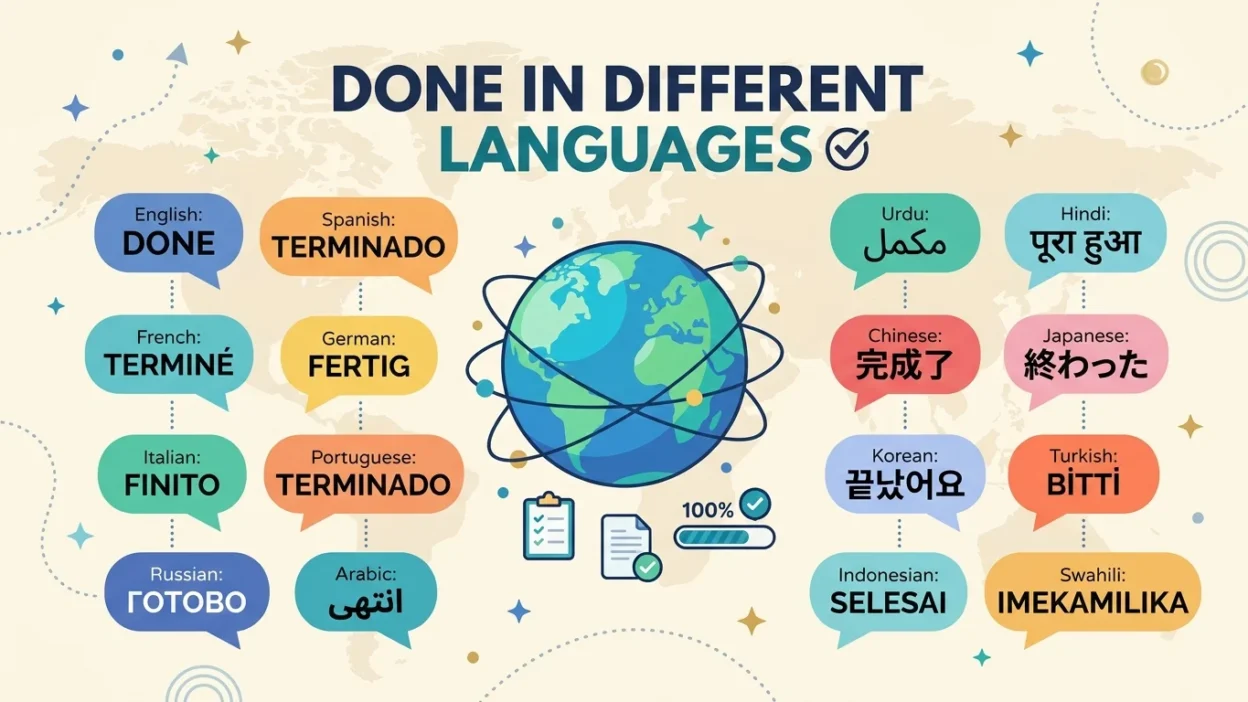
The table below provides translations of “done,” using common equivalents for “finished” or “completed.” Pronunciations are approximate and intended to help English speakers.
Done in Different Languages
| Language | Native Phrase | Easy English Pronunciation | Example Sentence | English Meaning |
| English | Done | duhn | I am done with my homework. | I have finished my homework. |
| Spanish | Terminado | tehr-mee-NAH-doh | El trabajo está terminado. | The work is finished. |
| French | Terminé | tehr-mee-NAY | Le travail est terminé. | The work is finished. |
| German | Fertig | FEHR-tikh | Ich bin mit der Arbeit fertig. | I am done with the work. |
| Italian | Finito | fee-NEE-toh | Il lavoro è finito. | The work is finished. |
| Portuguese | Terminado | tehr-mee-NAH-doo | O trabalho está terminado. | The work is finished. |
| Dutch | Klaar | klaar | Ik ben klaar met mijn werk. | I am done with my work. |
| Russian | Готово | gah-TOH-vah | Всё готово. | Everything is done. |
| Ukrainian | Готово | hoh-TOH-voh | Усе готово. | Everything is done. |
| Polish | Gotowe | goh-TOH-veh | Zadanie jest gotowe. | The task is done. |
| Czech | Hotovo | HOH-toh-voh | Všechno je hotovo. | Everything is done. |
| Slovak | Hotovo | HOH-toh-voh | Všetko je hotovo. | Everything is done. |
| Slovenian | Končano | kohn-CHAH-noh | Delo je končano. | The work is finished. |
| Croatian | Gotovo | GOH-toh-voh | Sve je gotovo. | Everything is done. |
| Serbian | Готово | GOH-toh-voh | Све је готово. | Everything is done. |
| Bosnian | Gotovo | GOH-toh-voh | Sve je gotovo. | Everything is done. |
| Bulgarian | Готово | goh-TOH-voh | Всичко е готово. | Everything is done. |
| Macedonian | Готово | goh-TOH-voh | Сè е готово. | Everything is done. |
| Romanian | Gata | GAH-tah | Am terminat treaba. | I have finished the work. |
| Greek | Έτοιμο | EH-tee-moh | Όλα είναι έτοιμα. | Everything is ready. |
| Albanian | Përfunduar | puhr-foon-DOO-ar | Puna ka përfunduar. | The work has been completed. |
| Hungarian | Kész | kayse | Kész vagyok a munkával. | I am done with the work. |
| Finnish | Valmis | VAHL-mees | Olen valmis työn kanssa. | I am done with the work. |
| Swedish | Klar | klaar | Jag är klar med arbetet. | I am done with the work. |
| Norwegian | Ferdig | FEHR-dee | Jeg er ferdig med arbeidet. | I am done with the work. |
| Danish | Færdig | FEHR-thee | Jeg er færdig med arbejdet. | I am done with the work. |
| Icelandic | Búið | BOO-ith | Verkinu er lokið. | The work is finished. |
| Estonian | Valmis | VAHL-mees | Töö on valmis. | The work is done. |
| Latvian | Pabeigts | pah-BAYGTS | Darbs ir pabeigts. | The work is completed. |
| Lithuanian | Baigta | BYG-tah | Darbas baigtas. | The work is finished. |
| Irish | Críochnaithe | KREE-ukh-nih-huh | Tá an obair críochnaithe. | The work is finished. |
| Welsh | Wedi gorffen | WEH-dee GOR-ven | Dw i wedi gorffen. | I have finished. |
| Scottish Gaelic | Crìochnaichte | KREE-ukh-nee-khuh | Tha an obair crìochnaichte. | The work is finished. |
| Basque | Amaituta | ah-my-TOO-tah | Lana amaituta dago. | The work is finished. |
| Catalan | Acabat | ah-kah-BAHT | La feina està acabada. | The work is finished. |
| Galician | Rematado | reh-mah-TAH-doh | O traballo está rematado. | The work is finished. |
| Turkish | Bitti | beet-TEE | İş bitti. | The work is done. |
| Arabic | انتهى | in-ta-HAH | انتهى العمل. | The work is finished. |
| Hebrew | הסתיים | his-tah-YEM | העבודה הסתיימה. | The work is finished. |
| Persian | تمام شد | ta-MOOM shod | کار تمام شد. | The work is finished. |
| Urdu | مکمل | muk-KAM-mal | میرا کام مکمل ہو گیا۔ | My work is complete. |
| Hindi | पूरा हुआ | POO-rah HOO-ah | मेरा काम पूरा हुआ। | My work is finished. |
| Bengali | শেষ | shesh | আমার কাজ শেষ। | My work is done. |
| Punjabi | ਮੁੱਕ ਗਿਆ | mukk gi-aa | ਮੇਰਾ ਕੰਮ ਮੁੱਕ ਗਿਆ। | My work is finished. |
| Gujarati | પૂરું થયું | POO-roo tha-yoo | મારું કામ પૂરું થયું. | My work is finished. |
| Marathi | पूर्ण झाले | poorn zhaa-lay | माझे काम पूर्ण झाले. | My work is complete. |
| Nepali | सकियो | sah-kee-yo | मेरो काम सकियो। | My work is finished. |
| Sinhala | අවසන් | ah-vah-SAHN | වැඩ අවසන්. | The work is finished. |
| Tamil | முடிந்தது | moo-din-tha-thu | வேலை முடிந்தது. | The work is finished. |
| Telugu | పూర్తయింది | poor-tha-YIN-dee | పని పూర్తయింది. | The work is completed. |
| Kannada | ಮುಗಿದಿದೆ | moo-gee-dee-day | ಕೆಲಸ ಮುಗಿದಿದೆ. | The work is finished. |
| Malayalam | കഴിഞ്ഞു | ka-zhin-yoo | ജോലി കഴിഞ്ഞു. | The work is finished. |
| Odia | ସରିଗଲା | sah-ree-gah-la | କାମ ସରିଗଲା। | The work is finished. |
| Assamese | শেষ | khesh | মোৰ কাম শেষ। | My work is done. |
| Chinese (Mandarin) | 完成了 | wán chéng le | 工作完成了。 | The work is finished. |
| Japanese | 終わった | oh-WAHT-tah | 仕事が終わった。 | The work is finished. |
| Korean | 끝났어요 | kkeun-NAHS-suh-yo | 일이 끝났어요. | The work is finished. |
| Vietnamese | Xong | sawng | Công việc xong rồi. | The work is done. |
| Thai | เสร็จแล้ว | set laew | งานเสร็จแล้ว | The work is finished. |
| Indonesian | Selesai | suh-luh-SAI | Pekerjaan sudah selesai. | The work is finished. |
| Malay | Selesai | suh-luh-SAI | Kerja sudah selesai. | The work is finished. |
| Filipino (Tagalog) | Tapos na | TAH-pos nah | Tapos na ang trabaho. | The work is finished. |
| Burmese | ပြီးပြီ | pee-BEE | အလုပ်ပြီးပြီ။ | The work is finished. |
| Khmer | រួចហើយ | ruoch haey | ការងាររួចហើយ។ | The work is finished. |
| Lao | ແລ້ວ | laew | ວຽກແລ້ວ. | The work is done. |
| Swahili | Imekamilika | ee-meh-kah-mee-LEE-kah | Kazi imekamilika. | The work is complete. |
| Afrikaans | Klaar | klaar | Die werk is klaar. | The work is finished. |
| Amharic | ተጠናቋል | teh-teh-nah-KWAL | ሥራው ተጠናቋል። | The work is finished. |
| Yoruba | Ti parí | tee pah-REE | Iṣẹ́ náà ti parí. | The work is finished. |
Note: Some languages use different forms depending on grammatical gender, number, formality, or the situation. The examples above focus mainly on the sense of a task or piece of work being finished.
What Does “Done” Mean?
“Done” is an English word that commonly means something has been completed, finished, or brought to an end. It can also describe food that has been cooked sufficiently or a person who has finished a particular activity.
For example:
- Task completion: “I am done with my assignment.”
- Finished work: “The report is done.”
- Food preparation: “The chicken is done.”
- Readiness: “Everything is done and ready.”
The right translation depends on how the word is used. A phrase meaning “finished” may work for a task, while another expression may be more natural when talking about food or readiness.
Common Ways to Use “Done” in Everyday Conversation
Learning the different meanings of “done” helps you choose the right translation in another language.
1. Saying You Have Finished Something
Use “done” when you have completed an activity or task.
Example: “I am done with my homework.”
This is useful in school, at work, and in everyday conversations.
2. Confirming That a Task Is Complete
You can use “done” to tell someone that a job or responsibility has been completed.
Example: “The project is done.”
In many languages, this idea is expressed using a word equivalent to “completed” or “finished.”
3. Saying That Food Is Ready
“Done” can describe food that has finished cooking.
Example: “The rice is done.”
Some languages use a different expression for food being cooked than they use for work being completed, so context matters.
4. Using “Done!” as a Short Reply
In casual English, a person may simply say “Done!” to confirm that a request has been completed.
Example:
“Can you send me the file?”
“Done!”
Other languages may use a short expression meaning “finished,” “all set,” or “it is ready.”
Why Learn Done Translations Around the World?
Learning how to say “done” in different languages can help travellers, students, language learners, and people communicating with international colleagues.
- Improve communication: Understand when someone says a task is finished.
- Learn vocabulary: Discover common words used in everyday conversations.
- Support language learning: Compare how different languages express completion.
- Communicate at work: Use familiar expressions when discussing projects and responsibilities.
- Understand cultural differences: Learn that the most natural translation can change according to context.
Even a simple word can reveal important differences in grammar and everyday speech.
Tips for Using “Done” Translations Correctly
When learning done translations, keep these practical tips in mind.
- Consider the context. Decide whether “done” means finished, completed, cooked, or ready.
- Learn complete phrases. Memorising “The work is finished” can be more useful than learning one word alone.
- Pay attention to grammar. Some languages change the word according to gender, number, or sentence structure.
- Practise pronunciation. Read the phrase aloud and listen to fluent speakers when possible.
- Use natural expressions. A direct word-for-word translation may not always sound natural to a native speaker.
The examples in this guide are useful starting points, but complete sentences may vary between regions and everyday situations.
Conclusion
Knowing how to say “done” in different languages helps you communicate the idea of finishing a task, completing work, or being ready. From Spanish terminado and French terminé to Japanese 終わった and Swahili imekamilika, each language has its own way of expressing completion.
Use this list of languages to build your vocabulary, practise everyday expressions, and discover how people around the world communicate that something is done.
FAQs
1. How do you say “done” in different languages?
The translation depends on the language and context. Examples include terminado in Spanish, fini or terminé in French depending on usage, fertig in German, kész in Hungarian, and selesai in Indonesian and Malay.
2. What is the most common meaning of “done”?
“Done” most commonly means finished or completed. It can describe a task, activity, project, or process that has reached its end.
3. How do you say “I am done” in other languages?
The phrase changes by language. For example, Spanish speakers may say “He terminado,” French speakers may say “J’ai fini,” and German speakers may say “Ich bin fertig.” The most natural form depends on the situation.
4. Is “done” the same as “finished” in every language?
No. Although the words often have similar meanings, some languages use different expressions for completed tasks, cooked food, and readiness. The context determines the most suitable translation.
5. Why can “done” have different translations in the same language?
The English word “done” has several meanings. It may describe a completed task, finished food, or readiness to leave. Other languages often use different words or grammatical forms for these situations.