Friendship is one of the most meaningful parts of life. A good friend offers support, shares happiness, listens during difficult times, and makes ordinary moments special. Although the word friend sounds different across languages, its meaning connects people all around the world.
Learning how to say friend in different languages is useful for language learners, travellers, students, writers, and anyone who wants to connect with people from other cultures. Whether you want to call someone your friend, write a heartfelt message, or discover new vocabulary, these translations will help you express friendship more naturally.
In English, friend is singular and friends is plural. Other languages may use different words depending on gender, formality, relationship, or context. Some languages also have special words for a close friend, childhood friend, or best friend.
This guide explores friend in languages, including native translations, easy English pronunciations, example sentences, and their English meanings.
Friend in Different Languages: Quick Translation Guide
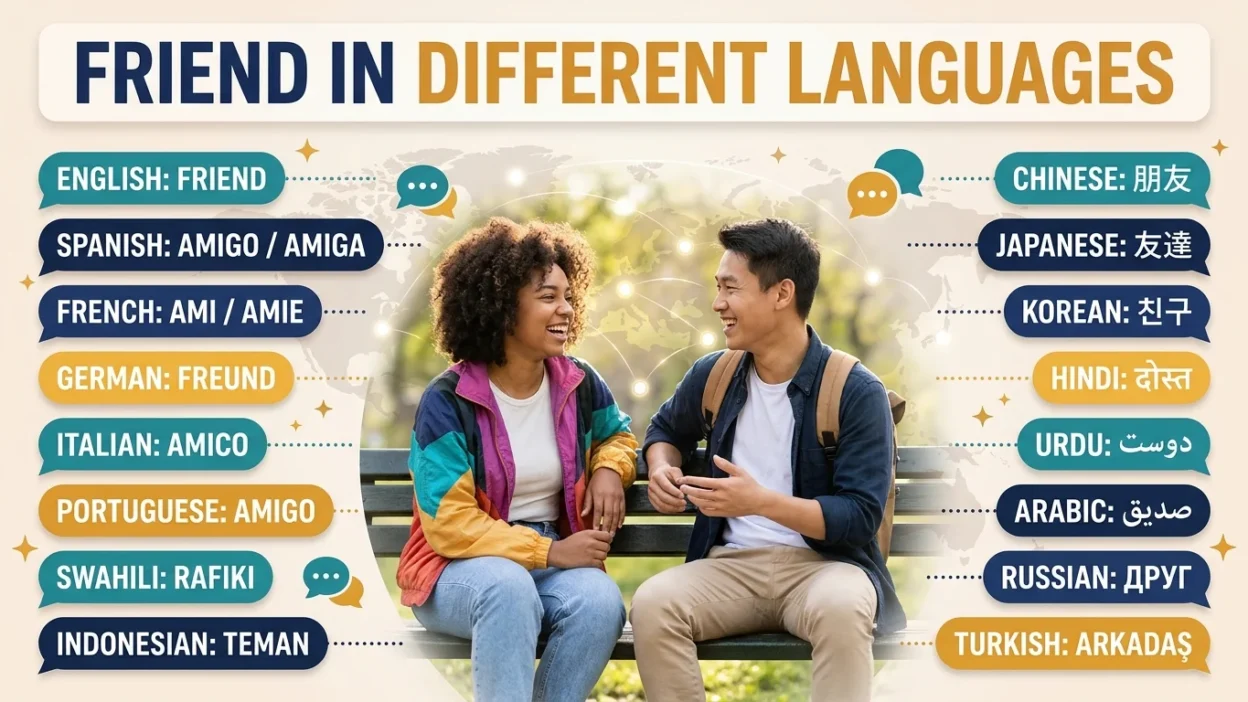
Here are some common ways to say friend in popular languages.
| Language | Word for Friend |
| English | Friend |
| Spanish | Amigo / Amiga |
| French | Ami / Amie |
| German | Freund / Freundin |
| Italian | Amico / Amica |
| Portuguese | Amigo / Amiga |
| Dutch | Vriend |
| Chinese (Mandarin) | 朋友 (péngyou) |
| Japanese | 友達 (tomodachi) |
| Korean | 친구 (chingu) |
| Hindi | दोस्त (dost) |
| Urdu | دوست (dost) |
| Arabic | صديق (ṣadīq) |
| Russian | Друг (drug) |
| Turkish | Arkadaş |
In several languages, the word changes depending on whether the friend is male or female. In others, one common word can refer to a friend of any gender.
Friend in Different Languages
| Language | Native word for friend | Easy English pronunciation | Example sentence in the language | English meaning |
| English | Friend | frend | My friend is very kind. | My friend is very kind. |
| Spanish | Amigo / Amiga | ah-MEE-goh / ah-MEE-gah | Mi amigo es muy amable. | My friend is very kind. |
| French | Ami / Amie | ah-MEE | Mon ami est très gentil. | My friend is very kind. |
| German | Freund / Freundin | froynt / FROYN-din | Mein Freund ist sehr nett. | My friend is very kind. |
| Italian | Amico / Amica | ah-MEE-koh / ah-MEE-kah | Il mio amico è gentile. | My friend is kind. |
| Portuguese | Amigo / Amiga | ah-MEE-goo / ah-MEE-gah | Meu amigo é muito gentil. | My friend is very kind. |
| Dutch | Vriend / Vriendin | vreent / vreen-DIN | Mijn vriend is aardig. | My friend is kind. |
| Swedish | Vän | ven | Min vän är snäll. | My friend is kind. |
| Norwegian | Venn | ven | Vennen min er snill. | My friend is kind. |
| Danish | Ven | ven | Min ven er sød. | My friend is kind. |
| Finnish | Ystävä | OOS-tah-vah | Ystäväni on kiltti. | My friend is kind. |
| Icelandic | Vinur / Vinkona | VEE-noor / VEEN-koh-nah | Vinur minn er góður. | My friend is kind. |
| Irish | Cara | KAH-rah | Is cara maith é. | He is a good friend. |
| Scottish Gaelic | Caraid | KAH-ratch | Tha mo charaid coibhneil. | My friend is kind. |
| Welsh | Ffrind | freend | Mae fy ffrind yn garedig. | My friend is kind. |
| Polish | Przyjaciel / Przyjaciółka | pshih-YAH-chel / pshih-yah-CHOOW-kah | Mój przyjaciel jest miły. | My friend is kind. |
| Czech | Kamarád / Kamarádka | kah-mah-RAHT / kah-mah-RAHT-kah | Můj kamarád je milý. | My friend is kind. |
| Slovak | Kamarát / Kamarátka | KAH-mah-raht / KAH-mah-raht-kah | Môj kamarát je milý. | My friend is kind. |
| Ukrainian | Друг / Подруга | droog / poh-DROO-hah | Мій друг дуже добрий. | My friend is very kind. |
| Russian | Друг / Подруга | droog / pah-DROO-gah | Мой друг очень добрый. | My friend is very kind. |
| Bulgarian | Приятел / Приятелка | pree-YAH-tel / pree-YAH-tel-kah | Моят приятел е мил. | My friend is kind. |
| Serbian | Пријатељ / Пријатељица | pree-YAH-tel / pree-yah-TEL-ee-tsah | Мој пријатељ је добар. | My friend is good. |
| Croatian | Prijatelj / Prijateljica | pree-YAH-tel / pree-yah-TEL-yee-tsah | Moj prijatelj je dobar. | My friend is good. |
| Slovenian | Prijatelj / Prijateljica | pree-yah-TEL / pree-yah-TEL-ee-tsah | Moj prijatelj je prijazen. | My friend is kind. |
| Macedonian | Пријател / Пријателка | pree-YAH-tel / pree-YAH-tel-kah | Мојот пријател е добар. | My friend is good. |
| Greek | Φίλος / Φίλη | FEE-los / FEE-lee | Ο φίλος μου είναι καλός. | My friend is good. |
| Romanian | Prieten / Prietenă | pree-EH-ten / pree-EH-teh-nuh | Prietenul meu este amabil. | My friend is kind. |
| Hungarian | Barát / Barátnő | BAH-raht / BAH-raht-noe | A barátom kedves. | My friend is kind. |
| Albanian | Mik / Mike | meek / MEE-keh | Miku im është i sjellshëm. | My friend is kind. |
| Turkish | Arkadaş | ar-kah-DASH | Arkadaşım çok nazik. | My friend is very kind. |
| Arabic | صديق / صديقة | ṣa-DEEQ / ṣa-DEE-qah | صديقي لطيف جدًا. | My friend is very kind. |
| Hebrew | חבר / חברה | kha-VER / kha-veh-RAH | החבר שלי נחמד. | My friend is kind. |
| Persian | دوست | doost | دوست من مهربان است. | My friend is kind. |
| Urdu | دوست | dost | میرا دوست بہت مہربان ہے۔ | My friend is very kind. |
| Hindi | दोस्त | dost | मेरा दोस्त बहुत अच्छा है। | My friend is very good. |
| Bengali | বন্ধু | BON-dhu | আমার বন্ধু খুব ভালো। | My friend is very good. |
| Punjabi | ਦੋਸਤ | dost | ਮੇਰਾ ਦੋਸਤ ਬਹੁਤ ਚੰਗਾ ਹੈ। | My friend is very good. |
| Gujarati | મિત્ર | MIT-ra | મારો મિત્ર ખૂબ સારો છે. | My friend is very good. |
| Marathi | मित्र / मैत्रीण | mit-ra / mai-treeṇ | माझा मित्र खूप चांगला आहे. | My friend is very good. |
| Nepali | साथी | SAA-thee | मेरो साथी धेरै राम्रो छ। | My friend is very good. |
| Sinhala | මිතුරා / මිතුරිය | mee-too-RAH / mee-too-ree-yah | මගේ මිතුරා හොඳයි. | My friend is good. |
| Tamil | நண்பன் / தோழி | nan-ban / THOH-zhee | என் நண்பன் நல்லவன். | My friend is a good person. |
| Telugu | స్నేహితుడు / స్నేహితురాలు | sne-hi-too-doo / sne-hi-too-RAH-loo | నా స్నేహితుడు మంచివాడు. | My friend is a good person. |
| Kannada | ಸ್ನೇಹಿತ / ಸ್ನೇಹಿತೆ | sne-hi-ta / sne-hi-teh | ನನ್ನ ಸ್ನೇಹಿತ ಒಳ್ಳೆಯವನು. | My friend is a good person. |
| Malayalam | സുഹൃത്ത് | soo-HRUTH | എന്റെ സുഹൃത്ത് നല്ലവനാണ്. | My friend is a good person. |
| Thai | เพื่อน | pheuan | เพื่อนของฉันใจดี | My friend is kind. |
| Lao | ໝູ່ | moo | ໝູ່ຂອງຂ້ອຍໃຈດີ | My friend is kind. |
| Khmer | មិត្តភក្តិ | mit-pak | មិត្តភក្តិរបស់ខ្ញុំចិត្តល្អ។ | My friend is kind. |
| Vietnamese | Bạn | ban | Bạn tôi rất tốt bụng. | My friend is very kind. |
| Chinese (Mandarin) | 朋友 | peng-yoh (péngyou) | 我的朋友很友善。 | My friend is very kind. |
| Japanese | 友達 | toh-moh-dah-chee (tomodachi) | 私の友達はとても親切です。 | My friend is very kind. |
| Korean | 친구 | chin-goo (chingu) | 내 친구는 정말 친절해요. | My friend is really kind. |
| Indonesian | Teman | TEH-man | Teman saya sangat baik. | My friend is very kind. |
| Malay | Kawan | KAH-wan | Kawan saya sangat baik. | My friend is very kind. |
| Filipino (Tagalog) | Kaibigan | kah-ee-BEE-gan | Mabait ang kaibigan ko. | My friend is kind. |
| Swahili | Rafiki | rah-FEE-kee | Rafiki yangu ni mwema. | My friend is kind. |
| Zulu | Umngane | oom-NGAH-neh | Umngane wami unomusa. | My friend is kind. |
| Xhosa | Umhlobo | oom-HLOH-boh | Umhlobo wam unobubele. | My friend is kind. |
| Afrikaans | Vriend / Vriendin | freent / vreen-DIN | My vriend is vriendelik. | My friend is friendly. |
| Amharic | ጓደኛ | gwa-de-NYA | ጓደኛዬ ደግ ነው። | My friend is kind. |
| Somali | Saaxiib | sah-HEEB | Saaxiibkay waa naxariis badan yahay. | My friend is kind. |
| Yoruba | Ọ̀rẹ́ | aw-REH | Ọ̀rẹ́ mi jẹ́ ẹni rere. | My friend is a good person. |
| Igbo | Enyi | EH-nyee | Enyi m dị mma. | My friend is good. |
| Hausa | Aboki / Abokiya | ah-BOH-kee / ah-boh-KEE-yah | Abokina yana da kirki. | My friend is kind. |
| Malagasy | Namana | nah-MAH-nah | Tsara fanahy ny namako. | My friend is kind. |
| Māori | Hoa | HOH-ah | He hoa pai ia nōku. | They are a good friend of mine. |
| Hawaiian | Hoa | HOH-ah | He hoa maikaʻi ʻo ia. | They are a good friend. |
| Latin | Amicus / Amica | ah-MEE-koos / ah-MEE-kah | Amicus meus bonus est. | My friend is good. |
How to Say Friend in Different Languages Around the World
The word friend changes across cultures, and some languages have several expressions for different kinds of friendship.
- Europe: Spanish uses amigo or amiga, French uses ami or amie, and German uses Freund or Freundin.
- South Asia: Hindi and Urdu commonly use dost. Bengali uses bondhu, while Punjabi uses dost.
- East Asia: Mandarin uses péngyou, Japanese uses tomodachi, and Korean uses chingu.
- The Middle East: Arabic uses ṣadīq or ṣadīqah, while Persian uses doost.
- Africa: Swahili uses rafiki, Somali uses saaxiib, and Yoruba uses ọ̀rẹ́.
- Southeast Asia: Indonesian uses teman, Malay uses kawan, and Filipino uses kaibigan.
These examples illustrate the variety of words people use to express companionship and trust.
Different Words for Friend, Close Friend, and Best Friend
Not every friendship is the same. Some languages distinguish between an ordinary friend, a close friend, and a best friend.
| English expression | Spanish | French | German | Italian |
| Friend | Amigo / Amiga | Ami / Amie | Freund / Freundin | Amico / Amica |
| Close friend | Amigo cercano / Amiga cercana | Ami proche / Amie proche | Enger Freund / Enge Freundin | Amico stretto / Amica stretta |
| Best friend | Mejor amigo / Mejor amiga | Meilleur ami / Meilleure amie | Bester Freund / Beste Freundin | Migliore amico / Migliore amica |
| Childhood friend | Amigo de la infancia | Ami d’enfance | Kindheitsfreund | Amico d’infanzia |
The most natural expression depends on the language and situation. In everyday conversation, speakers may use a familiar or informal word rather than a literal translation of “close friend”.
Why Learning Friend Translations Is Useful
Learning friend in different languages can help you build vocabulary and communicate more confidently. It is especially useful when meeting new people, travelling, studying languages, or sending messages to friends who speak another language.
Knowing a local word for friend can also help you understand songs, films, books, and social media posts. It gives you a small but meaningful way to show interest in another culture.
Friendship-related words are also useful for greeting cards, captions, personal letters, and language-learning activities.
Tips for Remembering Friend in Different Languages
Try these practical methods to remember the translations:
- Learn a few words at a time. Start with five languages and gradually add more.
- Practise with sentences. Remembering “My friend is kind” can be easier than memorising a word alone.
- Listen to native speakers. Pay attention to sounds that do not exist in English.
- Learn gender forms where necessary. Spanish, French, German, and several other languages may use different forms for male and female friends.
- Make vocabulary cards. Put the language on one side and the translation and example on the other.
- Use the words in real life. Write a short greeting or message using a word you have recently learnt.
Regular practice will help you remember both the words and how to use them naturally.
Conclusion
Friendship is a universal human connection, but the word friend takes many forms across languages. From amigo in Spanish and ami in French to dost in Hindi and Urdu, péngyou in Mandarin, and rafiki in Swahili, every translation offers a small insight into another language and culture.
Use this guide to explore friend in languages, practise the pronunciations, and learn the example sentences. Even one new word can be a meaningful way to connect with someone from a different part of the world.
FAQs
1. How do you say friend in different languages?
Some common translations are amigo in Spanish, ami in French, Freund in German, dost in Hindi and Urdu, péngyou in Mandarin, tomodachi in Japanese, and rafiki in Swahili.
2. What is the word for friend in the most popular languages?
In Spanish, it is amigo or amiga. In French, it is ami or amie. German uses Freund or Freundin, Italian uses amico or amica, and Mandarin uses péngyou.
3. How do you say best friend in different languages?
Common expressions include mejor amigo or mejor amiga in Spanish, meilleur ami or meilleure amie in French, bester Freund or beste Freundin in German, and migliore amico or migliore amica in Italian.
4. Do all languages have separate words for male and female friends?
No. Some languages distinguish between male and female friends, such as Spanish, French, and German. Other languages, including Mandarin, Japanese, and Korean, commonly use the same general word regardless of gender.
5. What is the easiest way to learn friend in languages?
Start with a few familiar languages, use pronunciation guides, practise short sentences, and review the words regularly. Grouping languages by region and using vocabulary flashcards can also make learning easier.