The word “mom” is one of the most loving and meaningful words in any language. It represents a mother’s love, care, comfort, and support. Although families around the world speak different languages, the special bond between a mother and her child is universal.
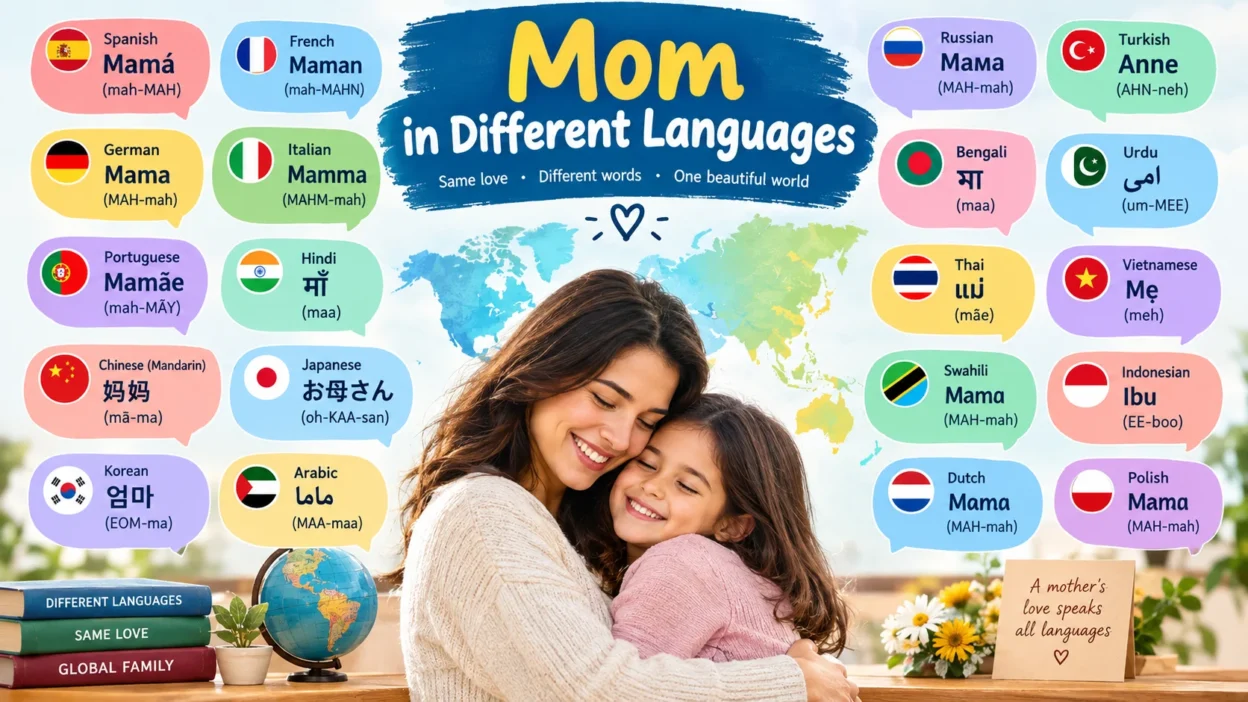
If you want to learn mom in different languages, you will discover that people use words such as mamá in Spanish, maman in French, Mama in German, maa in Hindi, and okaasan in Japanese. Some languages have several affectionate names for mothers, depending on family traditions, regional dialects, and everyday speech.
In this guide, you will find mom in 70 different languages, including native words, easy English pronunciations, real-life example sentences, and their English meanings. Whether you are learning a new language, exploring different cultures, or looking for a special word to express your love for your mother, this list will help you discover how people say “mom” around the world.
Mom in Different Languages: Quick Examples
Here are some popular translations of the word “mom” from different parts of the world.
- Spanish: Mamá
- French: Maman
- German: Mama
- Italian: Mamma
- Portuguese: Mamãe
- Hindi: माँ (Maa)
- Urdu: امی (Ammi)
- Arabic: ماما (Mama)
- Mandarin Chinese: 妈妈 (Māma)
- Japanese: お母さん (Okaasan)
- Korean: 엄마 (Eomma)
- Russian: Мама (Mama)
- Turkish: Anne
- Bengali: মা (Ma)
These words are commonly used to refer to a mother, although some are more affectionate or informal than others.
Mom in Different Languages
| Language | Native Word for Mom | Easy English Pronunciation | Example Sentence | English Meaning |
| English | Mom | mom | Mom is making dinner. | Mom is making dinner. |
| Spanish | Mamá | mah-MAH | Mi mamá está en casa. | My mom is at home. |
| French | Maman | mah-MAHN | Ma maman est gentille. | My mom is kind. |
| German | Mama | MAH-mah | Meine Mama ist zu Hause. | My mom is at home. |
| Italian | Mamma | MAHM-mah | La mia mamma è qui. | My mom is here. |
| Portuguese | Mamãe | mah-MÃY | Minha mamãe está aqui. | My mom is here. |
| Dutch | Mama | MAH-mah | Mijn mama is thuis. | My mom is at home. |
| Swedish | Mamma | MAHM-mah | Min mamma är hemma. | My mom is at home. |
| Norwegian | Mamma | MAHM-mah | Mamma er hjemme. | Mom is at home. |
| Danish | Mor | mohr | Min mor er hjemme. | My mom is at home. |
| Finnish | Äiti | AY-tee | Äiti on kotona. | Mom is at home. |
| Icelandic | Mamma | MAHM-mah | Mamma er heima. | Mom is at home. |
| Irish | Mam | mahm | Tá mo mham sa bhaile. | My mom is at home. |
| Welsh | Mam | mahm | Mae fy mam gartref. | My mom is at home. |
| Polish | Mama | MAH-mah | Moja mama jest w domu. | My mom is at home. |
| Czech | Maminka | mah-MEEN-kah | Moje maminka je doma. | My mom is at home. |
| Slovak | Mama | MAH-mah | Moja mama je doma. | My mom is at home. |
| Ukrainian | Мама | MAH-mah | Моя мама вдома. | My mom is at home. |
| Russian | Мама | MAH-mah | Моя мама дома. | My mom is at home. |
| Belarusian | Мама | MAH-mah | Мая мама дома. | My mom is at home. |
| Bulgarian | Мама | MAH-mah | Мама е вкъщи. | Mom is at home. |
| Serbian | Мама | MAH-mah | Моја мама је код куће. | My mom is at home. |
| Croatian | Mama | MAH-mah | Moja mama je kod kuće. | My mom is at home. |
| Slovenian | Mama | MAH-mah | Moja mama je doma. | My mom is at home. |
| Romanian | Mamă | MAH-muh | Mama mea este acasă. | My mom is at home. |
| Hungarian | Anya | AHN-yah | Anyukám otthon van. | My mom is at home. |
| Greek | Μαμά | mah-MAH | Η μαμά μου είναι στο σπίτι. | My mom is at home. |
| Albanian | Mami | MAH-mee | Mami im është në shtëpi. | My mom is at home. |
| Turkish | Anne | AHN-neh | Annem evde. | My mom is at home. |
| Azerbaijani | Ana | ah-NAH | Anam evdədir. | My mom is at home. |
| Persian | مامان | maa-MAAN | مامانم خانه است. | My mom is at home. |
| Arabic | ماما | MAA-maa | ماما في البيت. | Mom is at home. |
| Hebrew | אמא | EE-mah | אמא שלי בבית. | My mom is at home. |
| Hindi | माँ | maa | मेरी माँ घर पर हैं। | My mom is at home. |
| Urdu | امی | um-MEE | میری امی گھر پر ہیں۔ | My mom is at home. |
| Bengali | মা | maa | আমার মা বাড়িতে আছেন। | My mom is at home. |
| Punjabi | ਮਾਂ | maa | ਮੇਰੀ ਮਾਂ ਘਰ ਵਿੱਚ ਹੈ। | My mom is at home. |
| Gujarati | મમ્મી | MUM-mee | મારી મમ્મી ઘરે છે. | My mom is at home. |
| Marathi | आई | aa-ee | माझी आई घरी आहे. | My mom is at home. |
| Nepali | आमा | AA-maa | मेरी आमा घरमा हुनुहुन्छ। | My mom is at home. |
| Sinhala | අම්මා | UM-maa | අම්මා ගෙදර ඉන්නවා. | Mom is at home. |
| Tamil | அம்மா | UM-maa | என் அம்மா வீட்டில் இருக்கிறார். | My mom is at home. |
| Telugu | అమ్మ | UM-mah | మా అమ్మ ఇంట్లో ఉంది. | My mom is at home. |
| Kannada | ಅಮ್ಮ | UM-mah | ನನ್ನ ಅಮ್ಮ ಮನೆಯಲ್ಲಿದ್ದಾರೆ. | My mom is at home. |
| Malayalam | അമ്മ | UM-mah | എന്റെ അമ്മ വീട്ടിലുണ്ട്. | My mom is at home. |
| Odia | ମାଆ | MAA-aa | ମୋ ମାଆ ଘରେ ଅଛନ୍ତି। | My mom is at home. |
| Assamese | মা | maa | মোৰ মা ঘৰত আছে। | My mom is at home. |
| Mandarin Chinese | 妈妈 | mā-ma | 我妈妈在家。 | My mom is at home. |
| Japanese | お母さん | oh-KAA-san | お母さんは家にいます。 | Mom is at home. |
| Korean | 엄마 | EOM-ma | 엄마는 집에 있어요. | Mom is at home. |
| Vietnamese | Mẹ | meh | Mẹ tôi đang ở nhà. | My mom is at home. |
| Thai | แม่ | mâe | แม่อยู่บ้าน | Mom is at home. |
| Indonesian | Ibu | EE-boo | Ibu saya ada di rumah. | My mom is at home. |
| Malay | Mak | mahk | Mak saya ada di rumah. | My mom is at home. |
| Filipino | Nanay | NAH-nai | Nasa bahay si Nanay. | Mom is at home. |
| Burmese | အမေ | ah-MAY | အမေ အိမ်မှာရှိတယ်။ | Mom is at home. |
| Khmer | ម៉ាក់ | mak | ម៉ាក់នៅផ្ទះ។ | Mom is at home. |
| Lao | ແມ່ | mae | ແມ່ຢູ່ເຮືອນ. | Mom is at home. |
| Mongolian | Ээж | eej | Ээж гэртээ байна. | Mom is at home. |
| Swahili | Mama | MAH-mah | Mama yuko nyumbani. | Mom is at home. |
| Amharic | እናት | eh-NAT | እናቴ ቤት ናት። | My mom is at home. |
| Somali | Hooyo | HOY-yoh | Hooyaday guriga ayay joogtaa. | My mom is at home. |
| Hausa | Mama | MAH-mah | Mamana tana gida. | My mom is at home. |
| Yoruba | Ìyá | ee-YAH | Ìyá mi wà ní ilé. | My mom is at home. |
| Zulu | Umama | oo-MAH-mah | Umama usekhaya. | My mom is at home. |
| Afrikaans | Ma | mah | My ma is by die huis. | My mom is at home. |
| Malagasy | Neny | NEH-nee | Ao an-trano i Neny. | Mom is at home. |
| Haitian Creole | Manman | mahn-MAHN | Manman mwen lakay. | My mom is at home. |
| Esperanto | Panjo | PAHN-yoh | Mia panjo estas hejme. | My mom is at home. |
How to Say Mom in Different Languages
Learning how to say mom in different languages is a wonderful way to understand how families express affection across cultures.
Many languages use words such as mama, mamma, or mamá. These words have similar sounds, making them relatively easy for many learners to recognise. However, not every language follows this pattern.
For example, Finnish uses äiti, Turkish uses anne, and Vietnamese uses mẹ. Japanese commonly uses okaasan when addressing or respectfully referring to one’s mother, while haha is often used when speaking about one’s own mother to someone else.
The right word depends on the language, the relationship between speakers, and the level of formality.
Different Ways to Call Your Mom Around the World
People often use different words for their mothers depending on whether they are speaking formally, casually, or affectionately.
Here are a few examples:
| Language | Everyday or Affectionate Word | More Formal or Alternative Word |
| English | Mom, Mum, Mommy | Mother |
| Spanish | Mamá, Mami | Madre |
| French | Maman | Mère |
| German | Mama, Mutti | Mutter |
| Italian | Mamma | Madre |
| Portuguese | Mamãe, Mamã | Mãe |
| Hindi | माँ (Maa), मम्मी (Mummy) | माता (Mata) |
| Urdu | امی (Ammi) | والدہ (Walida) |
| Arabic | ماما (Mama), أمي (Ummi) | أم (Umm) |
| Mandarin Chinese | 妈妈 (Māma) | 母亲 (Mǔqīn) |
| Japanese | ママ (Mama), お母さん (Okaasan) | 母 (Haha), in appropriate contexts |
| Korean | 엄마 (Eomma) | 어머니 (Eomeoni) |
These alternatives are not always interchangeable. Some are used when directly addressing a mother, while others are more appropriate when talking about her to another person.
Why Is the Word Mom Similar in So Many Languages?
One interesting feature of family vocabulary is that words for mothers often contain sounds such as ma, mama, and amma.
These sounds are relatively easy for many babies to produce during early speech development. As a result, similar-sounding words for mothers appear in many unrelated languages.
However, not every word for mother comes from the same historical source. Languages develop through different cultural and linguistic histories, so similar sounds do not automatically mean that words share an origin.
Words such as mama, mom, maman, and mamma show how certain speech sounds can become familiar ways to express one of the closest family relationships.
Tips for Learning Mom Translations in Different Languages
If you want to remember the translations of mom around the world, use these simple strategies:
- Start with familiar languages: Learn words from languages spoken by your friends, family, or community.
- Practise pronunciation: Pay attention to accents, vowel sounds, and syllable stress.
- Learn words in context: Use short sentences such as “My mom is at home.”
- Compare affectionate and formal words: Understand when to use casual names and when a more respectful term is appropriate.
- Explore regional variations: English speakers may say “Mom,” “Mum,” or “Mummy,” while other languages also have regional alternatives.
- Review regularly: Practise a few words each day rather than trying to memorise every translation at once.
Learning family words can also help you build a foundation for more complex conversations about relatives, relationships, and daily life.
Conclusion
The word “mom” may sound different across the world, but it represents a meaningful family relationship in every culture. From mamá in Spanish and maman in French to maa in Hindi and eomma in Korean, each word reflects the way people communicate affection and familiarity.
This list of mom in 70 different languages gives you a useful introduction to global family vocabulary, with native words, pronunciation guides, and everyday examples. Practise the words that interest you most, and use them to celebrate the many languages spoken around the world.
FAQs
1. How do you say mom in different languages?
Some common translations are mamá in Spanish, maman in French, mamma in Italian, Mama in German, maa in Hindi, Ammi in Urdu, māma in Chinese, and eomma in Korean.
2. What is the most common word for mom around the world?
There is no single word used in every language. However, variations of mama, including mamma, mamá, and maman, are widespread. Other languages use distinct words, such as äiti in Finnish and mẹ in Vietnamese.
3. How do you say mom in Hindi and Urdu?
In Hindi, mom is commonly called माँ (maa) or मम्मी (mummy). In Urdu, common affectionate terms include امی (Ammi) and ماما (Mama). Usage varies between families and regions.
4. What is the difference between mom, mother, and mommy?
“Mom” is a common informal word, especially in American English. “Mother” is more formal, while “Mommy” is often used by young children or as an affectionate family term. British English commonly uses “Mum” and “Mummy.”
5. Why do many languages use words similar to mama?
Sounds such as ma are relatively easy for many babies to produce during early speech development. Similar words for mothers appear in many languages, although their histories and origins are not necessarily the same.