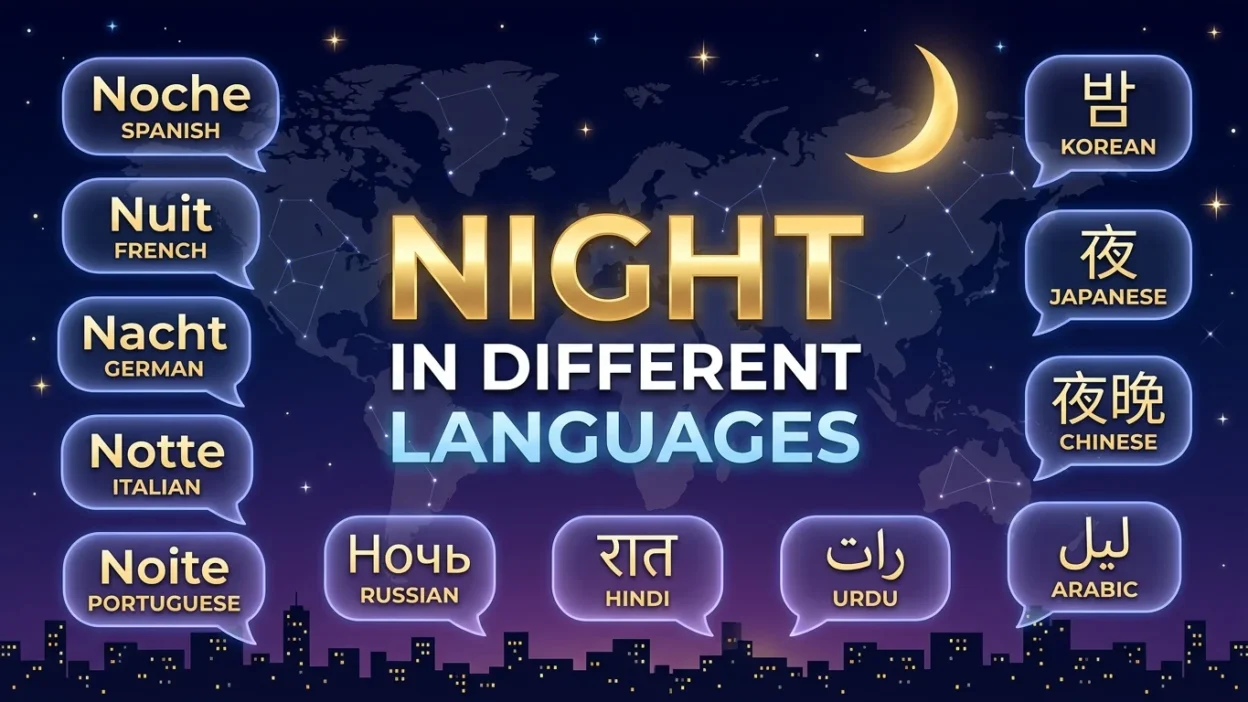
Night is a special part of the day when the sky becomes dark, people rest, and the world grows quieter. Whether you are learning a new language, travelling to another country, or exploring words from different cultures, knowing how to say “night” in other languages is a useful way to build your vocabulary.
In this guide, you will discover night in different languages, including native translations, easy English pronunciations, and simple real-life example sentences. From Spanish and French to Japanese, Arabic, and Hindi, these 70 translations will help you understand how people express the idea of night around the world.
How to Say “Night” in Different Languages
The word “night” generally refers to the dark period between evening and morning. However, each language has its own word, pronunciation, and way of using it in everyday conversation.
For example, “night” is noche in Spanish, nuit in French, Nacht in German, and 夜 (yoru) in Japanese. Some languages also use different expressions depending on whether someone is talking about nighttime or wishing another person a good night.
Night in Different Languages
| Language | Native Translation | Easy English Pronunciation | Example Sentence | English Meaning |
| English | Night | Nайт | The night is quiet. | The nighttime is peaceful. |
| Spanish | Noche | NOH-cheh | La noche es tranquila. | The night is quiet. |
| French | Nuit | Nwee | La nuit est calme. | The night is peaceful. |
| German | Nacht | Nahkht | Die Nacht ist ruhig. | The night is quiet. |
| Italian | Notte | NOT-teh | La notte è tranquilla. | The night is peaceful. |
| Portuguese | Noite | NOY-chee | A noite está calma. | The night is peaceful. |
| Dutch | Nacht | Nahkht | De nacht is stil. | The night is quiet. |
| Swedish | Natt | Naht | Natten är lugn. | The night is peaceful. |
| Norwegian | Natt | Naht | Natten er stille. | The night is quiet. |
| Danish | Nat | Naht | Natten er stille. | The night is quiet. |
| Finnish | Yö | Yuh | Yö on rauhallinen. | The night is peaceful. |
| Icelandic | Nótt | Noht | Nóttin er róleg. | The night is quiet. |
| Irish | Oíche | EE-huh | Tá an oíche ciúin. | The night is quiet. |
| Welsh | Nos | Nohs | Mae’r nos yn dawel. | The night is quiet. |
| Polish | Noc | Nots | Noc jest spokojna. | The night is peaceful. |
| Czech | Noc | Nots | Noc je klidná. | The night is peaceful. |
| Slovak | Noc | Nots | Noc je pokojná. | The night is peaceful. |
| Ukrainian | Ніч | Neech | Ніч тиха. | The night is quiet. |
| Russian | Ночь | Noch | Ночь тихая. | The night is quiet. |
| Bulgarian | Нощ | Nosht | Нощта е тиха. | The night is quiet. |
| Serbian | Ноћ | Noch | Ноћ је мирна. | The night is peaceful. |
| Croatian | Noć | Noch | Noć je mirna. | The night is peaceful. |
| Bosnian | Noć | Noch | Noć je mirna. | The night is peaceful. |
| Slovenian | Noč | Noch | Noč je mirna. | The night is peaceful. |
| Romanian | Noapte | NWAHP-teh | Noaptea este liniștită. | The night is peaceful. |
| Hungarian | Éjszaka | AY-sah-kah | Az éjszaka csendes. | The night is quiet. |
| Greek | Νύχτα | NEEKH-tah | Η νύχτα είναι ήσυχη. | The night is quiet. |
| Albanian | Natë | NAH-tuh | Nata është e qetë. | The night is peaceful. |
| Turkish | Gece | GEH-jeh | Gece sessiz. | The night is quiet. |
| Arabic | ليل | Layl | الليل هادئ. | The night is quiet. |
| Hebrew | לילה | LAY-lah | הלילה שקט. | The night is quiet. |
| Persian | شب | Shab | شب آرام است. | The night is peaceful. |
| Hindi | रात | Raat | रात शांत है। | The night is quiet. |
| Urdu | رات | Raat | رات پُرسکون ہے۔ | The night is peaceful. |
| Bengali | রাত | Raat | রাতটি শান্ত। | The night is peaceful. |
| Punjabi | ਰਾਤ | Raat | ਰਾਤ ਸ਼ਾਂਤ ਹੈ। | The night is quiet. |
| Gujarati | રાત | Raat | રાત શાંત છે. | The night is quiet. |
| Marathi | रात्र | Raatr | रात्र शांत आहे. | The night is peaceful. |
| Nepali | रात | Raat | रात शान्त छ। | The night is peaceful. |
| Sinhala | රාත්රිය | Raat-ree-yah | රාත්රිය නිහඬයි. | The night is quiet. |
| Tamil | இரவு | Ee-ra-vu | இரவு அமைதியாக உள்ளது. | The night is peaceful. |
| Telugu | రాత్రి | Raat-ree | రాత్రి ప్రశాంతంగా ఉంది. | The night is peaceful. |
| Kannada | ರಾತ್ರಿ | Raat-ree | ರಾತ್ರಿ ಶಾಂತವಾಗಿದೆ. | The night is peaceful. |
| Malayalam | രാത്രി | Raat-ree | രാത്രി ശാന്തമാണ്. | The night is peaceful. |
| Thai | กลางคืน | Glang-khuen | กลางคืนเงียบสงบ | The night is peaceful. |
| Vietnamese | Đêm | Dem | Đêm thật yên tĩnh. | The night is very quiet. |
| Indonesian | Malam | MAH-lahm | Malam ini tenang. | Tonight is peaceful. |
| Malay | Malam | MAH-lahm | Malam ini sunyi. | Tonight is quiet. |
| Filipino (Tagalog) | Gabi | GAH-bee | Tahimik ang gabi. | The night is quiet. |
| Mandarin Chinese | 夜晚 | Yèwǎn | 夜晚很安静。 | The night is quiet. |
| Japanese | 夜 | Yoru | 夜は静かです。 | The night is quiet. |
| Korean | 밤 | Bam | 밤이 조용해요. | The night is quiet. |
| Swahili | Usiku | Oo-SEE-koo | Usiku ni tulivu. | The night is peaceful. |
| Afrikaans | Nag | Nahkh | Die nag is stil. | The night is quiet. |
| Amharic | ሌሊት | Leh-leet | ሌሊቱ ጸጥ ያለ ነው። | The night is quiet. |
| Yoruba | Alẹ́ | Ah-leh | Alẹ́ náà dákẹ́ jẹ́ẹ́. | The night is quiet. |
| Hausa | Dare | DAH-reh | Daren yana da shiru. | The night is quiet. |
| Zulu | Ubusuku | Oo-boo-SOO-koo | Ubusuku buthule. | The night is quiet. |
| Xhosa | Ubusuku | Oo-boo-SOO-koo | Ubusuku buthe cwaka. | The night is quiet. |
| Somali | Habeen | HAH-been | Habeenku waa deggan yahay. | The night is peaceful. |
| Malagasy | Alina | Ah-LEE-nah | Milamina ny alina. | The night is peaceful. |
| Māori | Pō | Paw | He marino te pō. | The night is peaceful. |
| Hawaiian | Pō | Poh | He mālie ka pō. | The night is peaceful. |
| Samoan | Po | Poh | E filemu le po. | The night is peaceful. |
| Esperanto | Nokto | NOK-toh | La nokto estas trankvila. | The night is peaceful. |
| Latin | Nox | Noks | Nox tranquilla est. | The night is peaceful. |
| Luxembourgish | Nuecht | Noo-ehkht | D’Nuecht ass roueg. | The night is quiet. |
| Catalan | Nit | Neet | La nit és tranquil·la. | The night is peaceful. |
| Basque | Gaua | GOW-ah | Gaua lasaia da. | The night is peaceful. |
| Estonian | Öö | Uh | Öö on vaikne. | The night is quiet. |
Note: Pronunciations are approximate guides for English speakers. Some words and expressions vary by dialect and context.
Why Learn the Word “Night” in Different Languages?
Learning how to say “night” in other languages can help you communicate during travel, understand conversations, and expand your vocabulary. It is also useful for understanding greetings, bedtime expressions, and cultural traditions.
Here are a few reasons to learn night in different languages:
- Travel: Understand common words used during nighttime activities.
- Language learning: Build vocabulary with a familiar everyday word.
- Communication: Recognise words used in conversations about sleep and evening plans.
- Culture: Discover how different languages describe nighttime.
- Writing: Use appropriate foreign-language words in stories, messages, and creative projects.
How to Say “Good Night” in Different Languages
The word “night” is not always the same as the phrase “good night”. In many languages, people use a special expression to wish someone a peaceful night or say goodbye before sleeping.
| Language | Good Night | Easy Pronunciation |
| Spanish | Buenas noches | BWEH-nas NOH-ches |
| French | Bonne nuit | Bun nwee |
| German | Gute Nacht | GOO-teh nahkht |
| Italian | Buonanotte | Bwoh-nah-NOT-teh |
| Portuguese | Boa noite | BOH-ah NOY-chee |
| Arabic | تصبح على خير | Tus-bih ala khayr |
| Hindi | शुभ रात्रि | Shubh raat-ree |
| Urdu | شب بخیر | Shab ba-khair |
| Mandarin Chinese | 晚安 | Wǎn’ān |
| Japanese | おやすみなさい | O-yasumi-nasai |
These expressions are useful when ending a conversation, sending a bedtime message, or wishing someone a restful sleep.
Common Uses of the Word “Night”
The word “night” appears in many everyday situations. Learning these common uses helps you understand how the word works in sentences.
1. Talking About the Time of Day
Use “night” when describing the period after evening.
- The night is cold.
- We arrived at night.
- The stars shine at night.
2. Talking About Sleep
Night is often connected with resting and bedtime.
- I sleep early at night.
- The baby slept peacefully through the night.
- I read a book before bed at night.
3. Describing Nighttime Activities
People also use the word to discuss events and plans.
- We went for a walk at night.
- The city looks beautiful at night.
- They planned a night trip.
Is “Night” the Same as “Evening” in Every Language?
No. Although night and evening are related, they usually refer to different parts of the day.
Evening generally describes the period between late afternoon and nighttime. Night usually refers to the darker period when people often sleep.
The exact boundaries depend on local customs, daylight, seasons, and context. Some languages also use expressions differently depending on the time or situation.
Tips for Learning Night in Different Languages
You can remember foreign-language vocabulary more easily by connecting each word with a familiar activity.
- Learn three to five translations at a time.
- Read each native word aloud.
- Practise the example sentences in the table.
- Compare words from languages that share similar roots.
- Learn “good night” alongside “night” to understand everyday usage.
- Review previously learned words regularly.
Practising a little each day will help you remember the translations and use them with greater confidence.
Conclusion
The word “night” is used around the world, but every language expresses it in its own way. From noche in Spanish and nuit in French to raat in Hindi and Urdu, and yoru in Japanese, these 70 translations show how different cultures describe the nighttime hours.
Use this guide to learn the native words, practise their pronunciations, and explore common expressions related to night in different languages.
Frequently Asked Questions
1. How do you say “night” in different languages?
“Night” is noche in Spanish, nuit in French, Nacht in German, notte in Italian, raat in Hindi and Urdu, and 夜 (yoru) in Japanese.
2. What is the word for night in Spanish?
The Spanish word for night is noche. For example, La noche es tranquila means “The night is quiet.”
3. What is the difference between “night” and “good night”?
“Night” refers to the dark period between evening and morning. “Good night” is a greeting or farewell commonly used when someone is going to sleep or ending a conversation late in the day.
4. How do you say “good night” in different languages?
Examples include buenas noches in Spanish, bonne nuit in French, Gute Nacht in German, buonanotte in Italian, and おやすみなさい (oyasuminasai) in Japanese.
5. Why do different languages have different words for night?
Each language develops its own vocabulary, pronunciation, and grammar over time. Historical influences and cultural usage help explain why the same concept has different names around the world.