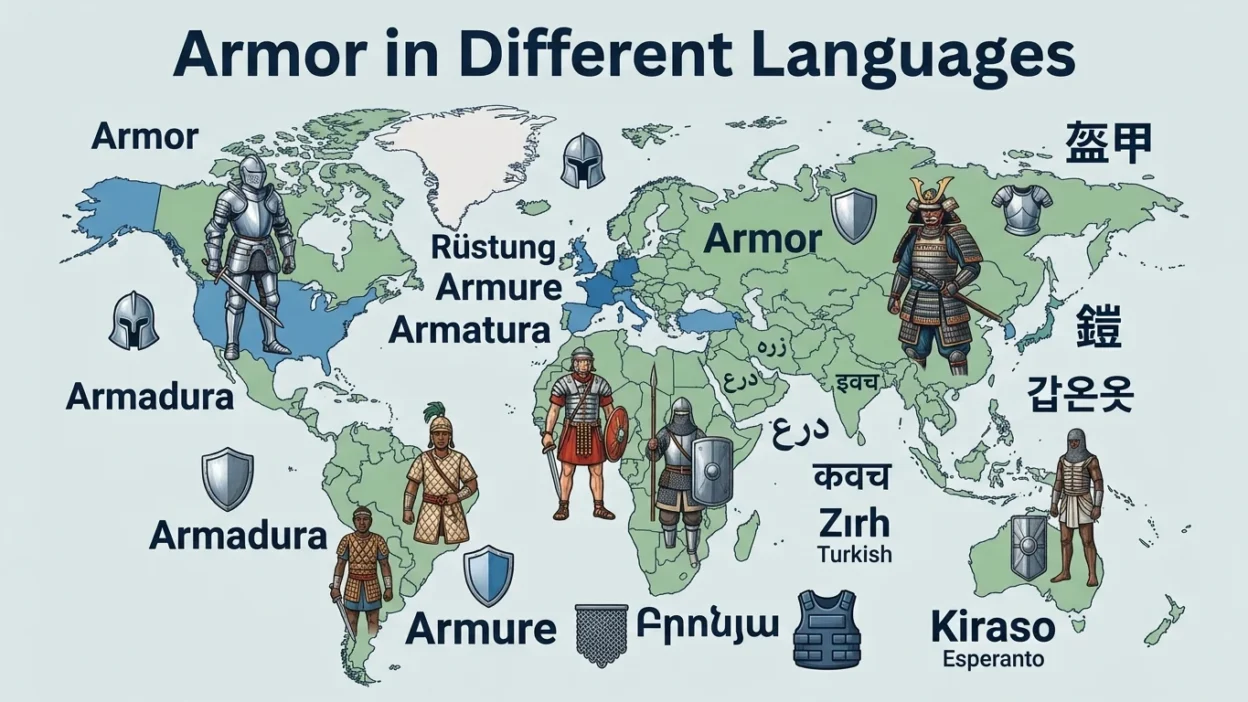
The word armor refers to protective clothing or equipment worn to protect the body from weapons, injury, or attack. It is strongly associated with knights, warriors, soldiers, medieval history, and modern protective equipment.
If you are searching for armor in different languages, this guide gives you translations from around the world. Each entry includes the native word, an easy English pronunciation, a short real-life example sentence, and the English meaning of that sentence.
Whether you are learning vocabulary, researching history, writing a story, studying another language, or simply curious about armor translations, this list makes it easy to compare the word across different languages and cultures.
Armor in All Languages
| Language | Native Phrase | Easy English Pronunciation | Example Sentence | English Meaning |
| English | Armor | AR-mer | The knight wore heavy armor. | The knight wore heavy protective equipment. |
| Spanish | Armadura | ar-mah-DOO-rah | El caballero llevaba una armadura. | The knight wore armor. |
| French | Armure | ar-MUR | Le chevalier portait une armure. | The knight wore armor. |
| German | Rüstung | ROOS-toong | Der Ritter trug eine Rüstung. | The knight wore armor. |
| Italian | Armatura | ar-mah-TOO-rah | Il cavaliere indossava un’armatura. | The knight wore armor. |
| Portuguese | Armadura | ar-mah-DOO-rah | O cavaleiro usava uma armadura. | The knight wore armor. |
| Dutch | Harnas | HAR-nas | De ridder droeg een harnas. | The knight wore armor. |
| Swedish | Rustning | ROOST-ning | Riddaren bar en rustning. | The knight wore armor. |
| Norwegian | Rustning | ROOST-ning | Ridderen bar en rustning. | The knight wore armor. |
| Danish | Rustning | ROOST-ning | Ridderen bar en rustning. | The knight wore armor. |
| Finnish | Haarniska | HAAR-nis-kah | Ritari käytti haarniskaa. | The knight wore armor. |
| Icelandic | Brynja | BRIN-yah | Riddarinn bar brynju. | The knight wore armor. |
| Polish | Zbroja | ZBROY-ah | Rycerz nosił zbroję. | The knight wore armor. |
| Czech | Brnění | BRN-yeh-nee | Rytíř měl brnění. | The knight had armor. |
| Slovak | Brnenie | BRNEH-nyeh | Rytier mal brnenie. | The knight had armor. |
| Slovenian | Oklep | OH-klep | Vitez je nosil oklep. | The knight wore armor. |
| Croatian | Oklop | OH-klop | Vitez je nosio oklop. | The knight wore armor. |
| Serbian | Оклоп | OH-klop | Vitez je nosio oklop. | The knight wore armor. |
| Bosnian | Oklop | OH-klop | Vitez je nosio oklop. | The knight wore armor. |
| Bulgarian | Броня | BRON-yah | Рицарят носеше броня. | The knight wore armor. |
| Macedonian | Оклоп | OH-klop | Витезот носеше оклоп. | The knight wore armor. |
| Russian | Броня | BROHN-yah | Рыцарь носил броню. | The knight wore armor. |
| Ukrainian | Броня | BROHN-yah | Лицар носив броню. | The knight wore armor. |
| Belarusian | Браня | BRAHN-yah | Рыцар насіў браню. | The knight wore armor. |
| Romanian | Armură | ar-MOOR-uh | Cavalerul purta armură. | The knight wore armor. |
| Hungarian | Páncél | PAHN-tsayl | A lovag páncélt viselt. | The knight wore armor. |
| Albanian | Armaturë | ar-mah-TOOR-uh | Kalorësi kishte armaturë. | The knight had armor. |
| Greek | Πανοπλία | pa-nop-LEE-ah | Ο ιππότης φορούσε πανοπλία. | The knight wore armor. |
| Turkish | Zırh | zuhr | Şövalye zırh giydi. | The knight wore armor. |
| Arabic | درع | DIR | ارتدى الفارس درعًا. | The knight wore armor. |
| Hebrew | שריון | shir-YON | האביר לבש שריון. | The knight wore armor. |
| Persian | زره | zeh-REH | شوالیه زره پوشید. | The knight wore armor. |
| Urdu | زرہ | ZIR-rah | سپاہی نے زرہ پہنی۔ | The soldier wore armor. |
| Hindi | कवच | kuh-VACH | योद्धा ने कवच पहना। | The warrior wore armor. |
| Bengali | বর্ম | BORMO | যোদ্ধা বর্ম পরেছিল। | The warrior wore armor. |
| Punjabi | ਕਵਚ | kuh-VACH | ਯੋਧੇ ਨੇ ਕਵਚ ਪਾਇਆ। | The warrior wore armor. |
| Gujarati | બખ્તર | BAKH-tar | સૈનિકે બખ્તર પહેર્યું. | The soldier wore armor. |
| Marathi | चिलखत | chil-KHAT | योद्ध्याने चिलखत घातले. | The warrior wore armor. |
| Nepali | कवच | kuh-VACH | योद्धाले कवच लगायो। | The warrior wore armor. |
| Tamil | கவசம் | ka-va-SAM | வீரன் கவசம் அணிந்தான். | The warrior wore armor. |
| Telugu | కవచం | ka-va-CHAM | యోధుడు కవచం ధరించాడు. | The warrior wore armor. |
| Kannada | ಕವಚ | ka-va-CHA | ಯೋಧನು ಕವಚವನ್ನು ಧರಿಸಿದನು. | The warrior wore armor. |
| Malayalam | കവചം | ka-va-CHAM | യോദ്ധാവ് കവചം ധരിച്ചു. | The warrior wore armor. |
| Sinhala | සන්නාහය | san-naa-HAY-ah | සෙබළා සන්නාහය පැළඳ සිටියේය. | The soldier wore armor. |
| Chinese (Mandarin) | 盔甲 | kuī jiǎ | 骑士穿着盔甲。 | The knight wore armor. |
| Japanese | 鎧 | yoroi | 騎士は鎧を着ていました。 | The knight was wearing armor. |
| Korean | 갑옷 | ga-bot | 기사는 갑옷을 입었습니다. | The knight wore armor. |
| Vietnamese | Áo giáp | ow zap | Hiệp sĩ mặc áo giáp. | The knight wore armor. |
| Thai | เกราะ | graw | อัศวินสวมเกราะ | The knight wore armor. |
| Indonesian | Baju zirah | bah-joo zee-rah | Kesatria memakai baju zirah. | The knight wore armor. |
| Malay | Perisai | puh-ree-SAI | Kesatria memakai perisai. | The knight used a shield. |
| Filipino | Baluti | bah-LOO-tee | Ang mandirigma ay nagsuot ng baluti. | The warrior wore armor. |
| Mongolian | Хуяг | khoo-YAG | Дайчин хуяг өмсөв. | The warrior wore armor. |
| Kazakh | Сауыты | sah-oo-TUH | Жауынгер сауыт киді. | The warrior wore armor. |
| Uzbek | Sovut | soh-VOOT | Jangchi sovut kiydi. | The warrior wore armor. |
| Azerbaijani | Zireh | zee-REH | Cəngavər zireh geyindi. | The knight wore armor. |
| Georgian | ჯავშანი | jan-SHAH-nee | რაინდს ჯავშანი ეცვა. | The knight wore armor. |
| Armenian | Զրահ | zra-H | Ասպետը զրահ էր հագել։ | The knight was wearing armor. |
| Swahili | Silaha ya kujikinga | see-LAH-ha ya koo-jee-KEE-nga | Askari alivaa silaha ya kujikinga. | The soldier wore protective armor. |
| Amharic | ጋሻ | GAH-sha | ወታደሩ ጋሻ ለበሰ። | The soldier wore protective gear. |
| Hausa | Makamai | mah-KAH-my | Jarumin ya sa makamai. | The warrior wore protective equipment. |
| Yoruba | Ihamọra | ee-ha-MOH-rah | Jagunjagun naa wọ ihamọra. | The warrior wore armor. |
| Igbo | Ekike agha | eh-KEE-keh AH-gah | Dike ahụ yi ekike agha. | The warrior wore armor. |
| Zulu | Izikhali | ee-zee-KHAH-lee | Iqhawe lagqoka izikhali. | The warrior wore armor. |
| Xhosa | Isikrweqe | ee-see-KRWEH-keh | Igorha lanxiba isikrweqe. | The warrior wore armor. |
| Afrikaans | Wapenrusting | VAA-pen-roos-ting | Die ridder het wapenrusting gedra. | The knight wore armor. |
| Māori | Kākahu whakamaru | KAA-ka-hoo fa-ka-ma-roo | I mau te toa i te kākahu whakamaru. | The warrior wore protective clothing. |
| Samoan | Ofutau | oh-foo-TAU | Na ofuina e le fitafita le ofutau. | The soldier wore armor. |
| Hawaiian | Kapa kila | KAH-pah KEE-lah | Ua komo ke koa i ka kapa kila. | The warrior wore metal armor. |
| Esperanto | Kiraso | kee-RAH-so | La kavaliro portis kirason. | The knight wore armor. |
| Latin | Lorica | loh-REE-kah | Miles loricam gerebat. | The soldier wore armor. |
What Does Armor Mean?
Armor means protective equipment designed to protect a person or object from physical harm. Historically, armor was commonly made from materials such as leather, metal, or other strong materials.
In historical contexts, armor is often associated with knights, warriors, and soldiers. A suit of armor could protect important parts of the body, including the chest, arms, legs, head, and hands.
Today, the word can also describe modern protective equipment used by military personnel, law enforcement officers, and others who need protection from physical threats.
How to Say Armor in Different Languages
When learning how to say armor in different languages, it is useful to remember that translations can vary depending on the type of protection being discussed.
For example, a historical suit of metal armor may have a different word from a modern protective vest or body armour. Some languages also distinguish between armor, shields, protective clothing, and military equipment.
The translations in this guide focus mainly on the general concept of armor or protective body equipment.
Armor Translations Around the World
The idea of armor has existed across many cultures throughout history. Different civilisations developed their own protective equipment according to their technology, environment, warfare, and available materials.
European languages often have words related to historical suits of armor and knights. Asian languages may use terms connected with protective clothing or traditional warrior equipment. Other languages use broader expressions referring to protective gear.
This makes armor translations around the world an interesting part of vocabulary and cultural history.
Historical Armor and Modern Armor
Historical armor was designed primarily to protect warriors during combat. Medieval European knights, Japanese samurai, and soldiers from many other cultures used different forms of protective equipment.
Modern armor can look very different. Bullet-resistant vests, protective helmets, shields, and specialised military equipment are examples of modern protective technology.
Although the materials and designs have changed considerably, the basic purpose remains similar: protecting the body from harm.
Armor in Different Languages for Language Learners
Learning the word armor in another language can be useful when studying history, fantasy literature, films, games, military vocabulary, or cultural traditions.
For better memorisation, learn the word together with a complete sentence. For example, instead of memorising only the English word “armor”, learn a sentence such as “The knight wore armor.”
This approach helps you understand how the noun works naturally within a sentence.
Related Words for Armor
Several English words are connected with armor and protection. Their meanings are not always identical, so context is important.
Common related words include:
- Armour
- Protection
- Shield
- Helmet
- Breastplate
- Chainmail
- Plate armour
- Body armour
- Protective gear
- Defensive equipment
- Armour plating
- Protective clothing
Armour is the traditional British English spelling, while armor is the standard American English spelling.
Armor in All Languages: Key Vocabulary
The 70 translations above demonstrate how languages around the world express the idea of armor. Some use a single noun, while others use expressions describing protective equipment or clothing.
If you are creating multilingual content, studying vocabulary, or researching historical terminology, it is important to consider the context before selecting a translation.
A word referring to medieval armor may not always be the best choice for modern body armor.
Why Learn Armor in different Languages?
Learning armor in different languages can be useful for several reasons. Students can use the vocabulary when studying world history. Writers can use it when creating multilingual stories or historical fiction. Travellers and language learners can also expand their vocabulary by learning practical nouns connected with culture and history.
It is also an interesting way to discover how different languages describe similar concepts.
Conclusion
Learning armor in different languages reveals how a simple idea can be expressed in many different linguistic forms. From armadura in Spanish and armure in French to 盔甲 in Mandarin, 鎧 in Japanese, 갑옷 in Korean, and कवच in Hindi, the concept of protective equipment appears across cultures and languages.
These armor translations can help language learners, students, writers, history enthusiasts, and anyone interested in vocabulary around the world. Understanding the word in context is the best way to learn how it is naturally used in each language.
FAQs
1. How do you say armor in different languages?
The word “armor” has different translations around the world. Examples include armadura in Spanish, armure in French, Rüstung in German, 盔甲 in Mandarin Chinese, 鎧 in Japanese, 갑옷 in Korean, and कवच in Hindi.
2. What is armor called in British English?
In British English, the word is normally spelled armour rather than armor. The pronunciation and general meaning are essentially the same.
3. What is the difference between armor and a shield?
Armor is protective equipment worn on the body, while a shield is normally a separate defensive object held or carried to protect against attacks.
4. What is armor used for?
Armor is used to protect the body or other objects from physical damage. Historically, it was widely used by warriors and soldiers, while modern forms of armor are used in various protective and military applications.
5. Why are there different words for armor in different languages?
Every language develops its own vocabulary based on its history, culture, grammar, and contact with other languages. As a result, some languages use a direct equivalent of armor, while others describe the concept through words associated with protection, clothing, or military equipment.