Being creative means having the ability to produce new, original, or imaginative ideas. It is a useful word in everyday conversations, education, art, business, design, writing, and many other areas.
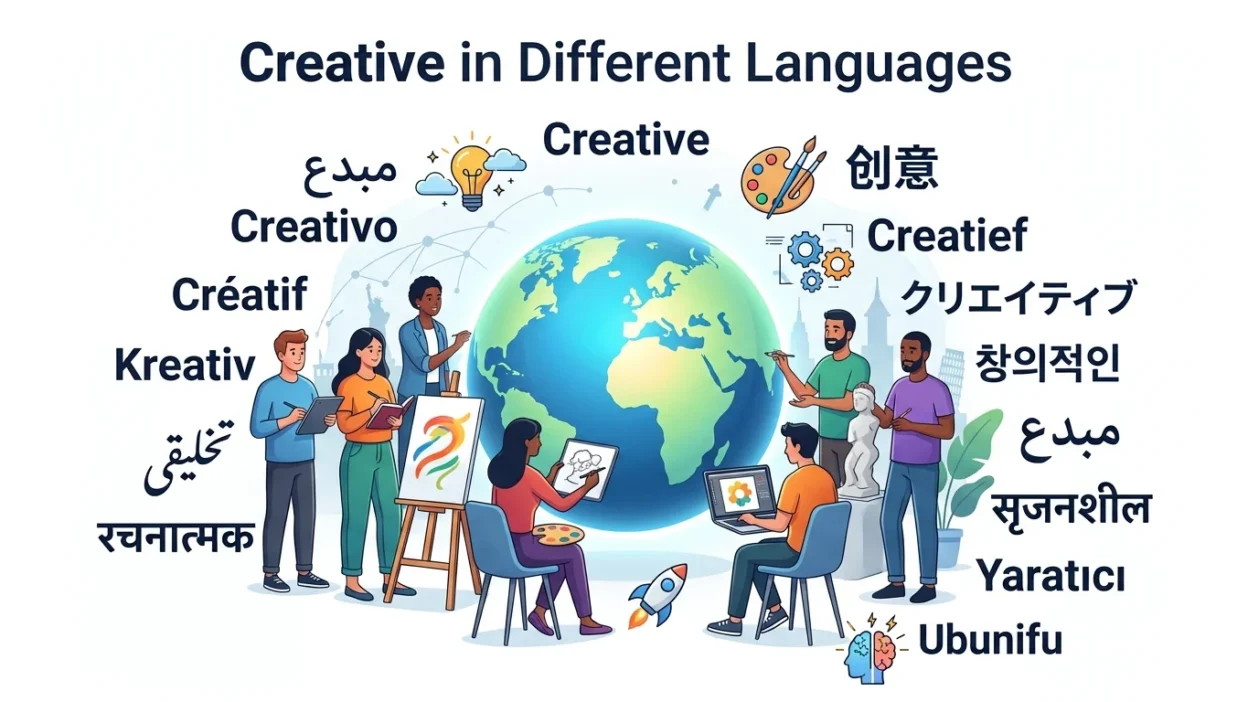
If you want to learn how to say creative in different languages, this guide gives you translations with easy English pronunciations and short real-life examples. The table below makes it simple to compare creative translations around the world and understand how the word is naturally used.
Whether you are learning a new language, travelling, studying, writing, or simply exploring world languages, these translations can help you understand how different cultures express the idea of creativity.
Creative in All Languages
| Language | Native Phrase | Easy English Pronunciation | Example Sentence | English Meaning |
| English | Creative | kree-AY-tiv | She is very creative. | She has many original ideas. |
| Spanish | Creativo | kree-ah-TEE-voh | Él es muy creativo. | He is very creative. |
| French | Créatif | kray-ah-TEEF | Il est très créatif. | He is very creative. |
| German | Kreativ | kray-ah-TEEF | Er ist sehr kreativ. | He is very creative. |
| Italian | Creativo | kray-ah-TEE-voh | Lui è molto creativo. | He is very creative. |
| Portuguese | Criativo | kree-ah-TEE-voh | Ele é muito criativo. | He is very creative. |
| Dutch | Creatief | kray-ah-TEEF | Hij is erg creatief. | He is very creative. |
| Swedish | Kreativ | kray-ah-TEEV | Hon är mycket kreativ. | She is very creative. |
| Norwegian | Kreativ | kray-ah-TEEV | Hun er veldig kreativ. | She is very creative. |
| Danish | Kreativ | kray-ah-TEEV | Hun er meget kreativ. | She is very creative. |
| Finnish | Luova | LOO-oh-vah | Hän on luova. | He/She is creative. |
| Icelandic | Skapandi | SKA-pahn-di | Hún er mjög skapandi. | She is very creative. |
| Polish | Kreatywny | kreh-ah-TEE-vnih | On jest kreatywny. | He is creative. |
| Czech | Kreativní | kreh-ah-teev-NEE | Je velmi kreativní. | He/She is very creative. |
| Slovak | Kreatívny | kreh-ah-TEEV-nee | Je veľmi kreatívny. | He is very creative. |
| Slovenian | Ustvarjalen | oost-var-YAH-len | On je zelo ustvarjalen. | He is very creative. |
| Croatian | Kreativan | kreh-ah-TEE-vahn | On je vrlo kreativan. | He is very creative. |
| Serbian | Kreativan | kreh-ah-TEE-vahn | On je veoma kreativan. | He is very creative. |
| Bosnian | Kreativan | kreh-ah-TEE-vahn | On je veoma kreativan. | He is very creative. |
| Bulgarian | Творчески | TVOR-ches-kee | Той е много творчески. | He is very creative. |
| Macedonian | Креативен | kreh-ah-TEE-ven | Тој е многу креативен. | He is very creative. |
| Russian | Креативный | kree-ah-TEE-vnih | Он очень креативный. | He is very creative. |
| Ukrainian | Креативний | kreh-ah-TEE-vniy | Він дуже креативний. | He is very creative. |
| Belarusian | Крэатыўны | kreh-ah-TYOO-vnih | Ён вельмі крэатыўны. | He is very creative. |
| Romanian | Creativ | kreh-ah-TEEV | El este foarte creativ. | He is very creative. |
| Hungarian | Kreatív | kreh-ah-TEEV | Ő nagyon kreatív. | He/She is very creative. |
| Albanian | Krijues | kree-YOOS | Ai është shumë krijues. | He is very creative. |
| Greek | Δημιουργικός | thee-mee-oor-yee-KOS | Είναι πολύ δημιουργικός. | He is very creative. |
| Turkish | Yaratıcı | yah-rah-tuh-JUH | O çok yaratıcı. | He/She is very creative. |
| Arabic | مبدع | mub-DI | هو مبدع جدًا. | He is very creative. |
| Hebrew | יצירתי | yets-ee-rah-TEE | הוא מאוד יצירתי. | He is very creative. |
| Persian | خلاق | khall-AAGH | او خیلی خلاق است. | He/She is very creative. |
| Urdu | تخلیقی | takh-LEE-kee | وہ بہت تخلیقی ہے۔ | He/She is very creative. |
| Hindi | रचनात्मक | rach-naa-TMAK | वह बहुत रचनात्मक है। | He/She is very creative. |
| Bengali | সৃজনশীল | shri-jon-SHEEL | সে খুব সৃজনশীল। | He/She is very creative. |
| Punjabi | ਰਚਨਾਤਮਕ | rach-naa-Tmak | ਉਹ ਬਹੁਤ ਰਚਨਾਤਮਕ ਹੈ। | He/She is very creative. |
| Gujarati | સર્જનાત્મક | sar-jan-AAT-mak | તે ખૂબ સર્જનાત્મક છે. | He/She is very creative. |
| Marathi | सर्जनशील | sar-jan-SHEEL | तो खूप सर्जनशील आहे. | He is very creative. |
| Nepali | सिर्जनात्मक | sir-ja-naat-MAK | ऊ धेरै सिर्जनात्मक छ। | He/She is very creative. |
| Tamil | படைப்பாற்றல் மிக்க | pa-daip-PAAT-ral mik-ka | அவள் படைப்பாற்றல் மிக்கவர். | She is very creative. |
| Telugu | సృజనాత్మక | sru-ja-naat-MA-ka | ఆమె చాలా సృజనాత్మకంగా ఉంది. | She is very creative. |
| Kannada | ಸೃಜನಶೀಲ | sru-ja-na-SHEE-la | ಅವನು ತುಂಬಾ ಸೃಜನಶೀಲ. | He is very creative. |
| Malayalam | സൃഷ്ടിപരമായ | srishti-pa-ra-MAA-ya | അവൻ വളരെ സൃഷ്ടിപരനാണ്. | He is very creative. |
| Sinhala | නිර්මාණශීලී | neer-maa-na-SHEE-lee | ඔහු ඉතා නිර්මාණශීලීයි. | He is very creative. |
| Chinese (Mandarin) | 有创意的 | yǒu chuàngyì de | 他很有创意。 | He is very creative. |
| Japanese | クリエイティブな | kuri-ei-ti-bu na | 彼はとてもクリエイティブです。 | He is very creative. |
| Korean | 창의적인 | chang-ui-jeok-in | 그는 매우 창의적이에요. | He is very creative. |
| Vietnamese | Sáng tạo | sahng TAOW | Cô ấy rất sáng tạo. | She is very creative. |
| Thai | สร้างสรรค์ | saang-SAN | เขามีความคิดสร้างสรรค์มาก | He is very creative. |
| Indonesian | Kreatif | kreh-ah-TEEF | Dia sangat kreatif. | He/She is very creative. |
| Malay | Kreatif | kreh-ah-TEEF | Dia sangat kreatif. | He/She is very creative. |
| Filipino | Malikhain | mah-lik-HA-in | Siya ay malikhain. | He/She is creative. |
| Mongolian | Бүтээлч | boo-TEELCH | Тэр маш бүтээлч. | He/She is very creative. |
| Kazakh | Шығармашыл | shuh-gar-ma-SHUL | Ол өте шығармашыл. | He/She is very creative. |
| Uzbek | Ijodkor | ee-jod-KOR | U juda ijodkor. | He/She is very creative. |
| Azerbaijani | Yaradıcı | yah-rah-duh-JUH | O çox yaradıcıdır. | He/She is very creative. |
| Georgian | შემოქმედებითი | shem-ok-med-eh-BEE-tee | ის ძალიან შემოქმედებითია. | He/She is very creative. |
| Armenian | Ստեղծագործ | stegh-tsa-gorts | Նա շատ ստեղծագործ է։ | He/She is very creative. |
| Swahili | Ubunifu | oo-boo-NEE-foo | Ana ubunifu mwingi. | He/She is very creative. |
| Amharic | ፈጠራ ያለው | fe-te-RA ya-lew | እሱ በጣም ፈጠራ አለው። | He is very creative. |
| Hausa | Mai kirkira | my keer-KEE-rah | Yana da kirkira sosai. | He is very creative. |
| Yoruba | Ẹlẹ́dàá | eh-leh-DA-ah | Ó jẹ́ ẹlẹ́dàá gan-an. | He is very creative. |
| Igbo | Onye okike | on-yeh oh-KEE-keh | Ọ bụ onye okike. | He/She is creative. |
| Zulu | Okudala | oh-koo-DAH-lah | Unobuciko bokudala. | He/She is creative. |
| Xhosa | Uyilo | oo-YEE-loh | Unobuchule bokuyila. | He/She is creative. |
| Afrikaans | Kreatief | kreh-ah-TEEF | Hy is baie kreatief. | He is very creative. |
| Māori | Auaha | ow-AH-ha | He tino auaha ia. | He/She is very creative. |
| Samoan | Foafoa | fo-ah-FOH-ah | E matuā foafoa o ia. | He/She is very creative. |
| Hawaiian | Hoʻokumu | ho-oh-KOO-moo | He kanaka hoʻokumu ʻo ia. | He/She is a creative person. |
| Esperanto | Kreiva | kreh-EE-vah | Li estas tre kreiva. | He/She is very creative. |
| Latin | Creativus | kreh-ah-TEE-voos | Ille creativus est. | He is creative. |
What Does “Creative” Mean?
The word creative describes someone or something that shows imagination, originality, and the ability to produce new ideas.
For example, a creative person might find an unusual solution to a problem, create an interesting piece of art, write an original story, design something attractive, or think about a familiar situation in a completely new way.
The word can describe people, ideas, work, designs, solutions, writing, projects, and many other things.
How to Say “Creative” in Different Languages
When learning how to say creative in different languages, it is important to remember that a direct translation may change depending on grammar, gender, number, and context.
For example, languages such as Spanish, French, Italian, and German can change adjectives according to the person or noun being described. Other languages may use a phrase that means “having creativity” or “full of creative ideas”.
The translations in the table use natural everyday forms wherever possible so learners can see how the word works in a real sentence.
Creative Translations Around the World
The idea of creativity is found in almost every culture. Artists, writers, teachers, inventors, designers, musicians, business owners, and students all use creativity in different ways.
In some languages, the closest translation focuses directly on being creative. In others, the expression can be connected with imagination, originality, invention, craftsmanship, or the ability to create something new.
This makes creative translations around the world particularly interesting for language learners because the same basic idea can be expressed through different linguistic structures.
Creative in Different Languages for Everyday Conversations
You can use the word creative in many everyday situations.
You might describe a friend as creative because they enjoy painting. You could call a solution creative because it solves a difficult problem in an unusual way. You could also describe a business idea, design, classroom activity, or piece of writing as creative.
Here are a few simple English examples:
- She has a creative mind.
- That is a very creative idea.
- My brother is creative with his designs.
- The teacher planned a creative activity.
- We need a creative solution to this problem.
These simple sentences can help you understand how the translated forms in other languages are used.
Why Learn “Creative” in 70 Languages?
Learning one useful word in many languages can be an enjoyable way to explore vocabulary and culture.
The word creative is especially useful because creativity is relevant to school, work, technology, art, entertainment, advertising, writing, and everyday problem-solving.
Knowing these translations can also help travellers, language students, teachers, content creators, and anyone interested in communicating with people from different countries.
Creative and Related Words
Although creative has a clear meaning, several related words can appear in similar contexts.
Some common English words include:
- Imaginative
- Original
- Inventive
- Innovative
- Artistic
- Inspired
- Resourceful
- Expressive
- Visionary
- Productive
These words are not always exact synonyms. The best choice depends on what you are describing.
For example, artistic often relates to art, while innovative usually focuses on new methods, products, or ideas. Imaginative highlights the ability to form new or unusual ideas.
Creative in All Languages: A Useful Vocabulary Guide
The 70 translations above show that there is no single universal way to express creativity. Some languages use an adjective similar to the English word, while others use expressions connected with creating, inventing, or producing something original.
If you are studying languages, try learning the native phrase together with its example sentence rather than memorising the translation alone. Seeing the word in context makes it easier to remember and use naturally.
Conclusion
Learning how to say creative in different languages is a simple way to expand your vocabulary while discovering how different languages express imagination and originality. From Spanish and French to Mandarin, Japanese, Arabic, Hindi, Swahili, Māori, and many others, the word appears in many interesting forms.
These creative translations can be useful for language learning, travel, education, writing, design, and everyday communication. No matter which language you speak, creativity remains a powerful way to share ideas and see the world differently.
FAQs
1. How do you say “creative” in different languages?
“Creative” has different translations depending on the language. For example, it is creativo in Spanish, créatif in French, kreativ in German, 有创意的 in Mandarin Chinese, クリエイティブな in Japanese, and 창의적인 in Korean.
2. What is the most common translation of “creative”?
There is no single translation that is most common worldwide. Many European languages use forms related to the Latin-rooted word, while other languages use expressions based on ideas such as creating, inventing, or having originality.
3. How do you say “creative person” in other languages?
The exact expression depends on the language. Some languages use an adjective directly with the word for person, while others use a phrase meaning someone who creates or has creative ability.
4. Is “creative” used differently in other languages?
Yes. Grammar and context can affect the translation. Some languages change adjectives according to gender or number, while others use different structures to describe a person’s creative ability.
5. Why should I learn “creative” in different languages?
Learning this word in multiple languages can expand your vocabulary, support language study, improve cross-cultural communication, and help you understand how different languages express imagination and originality.