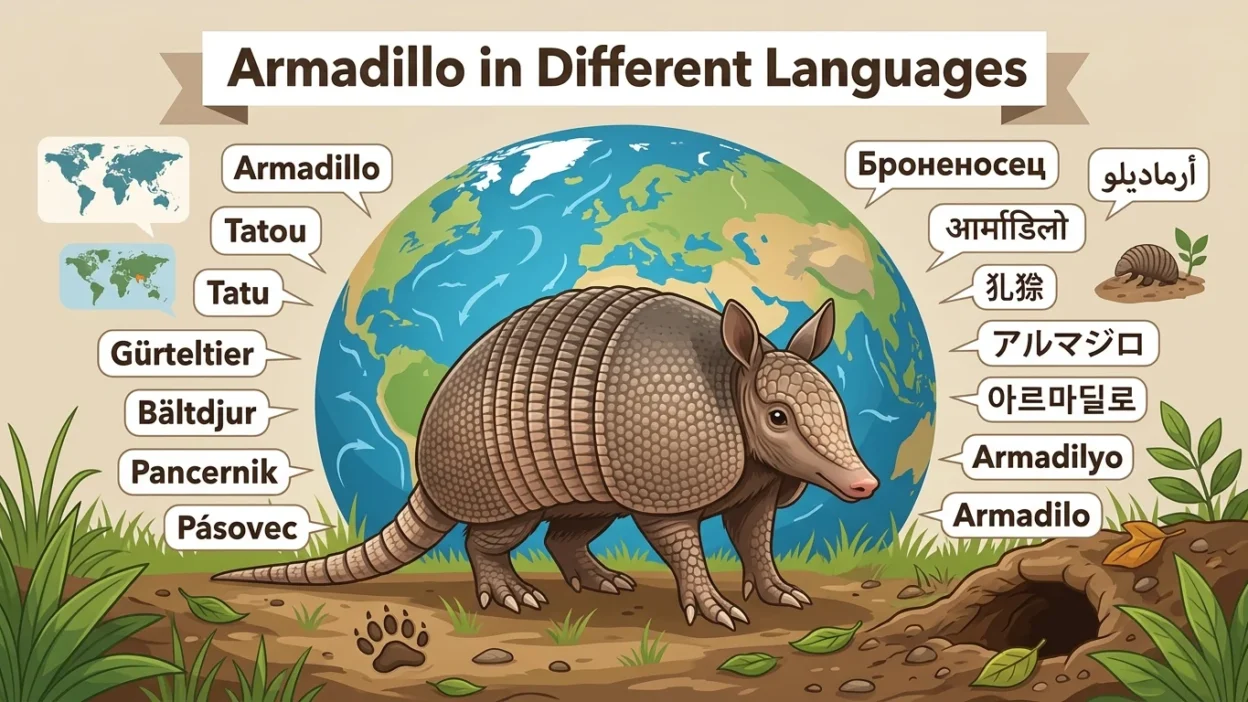
An armadillo is a small to medium-sized mammal recognised for its hard protective shell-like plates, short legs, and burrowing behaviour. Armadillos are native mainly to the Americas and are especially associated with Central and South America.
If you are searching for armadillo in different languages, this guide gives you translations from around the world. Each entry includes the native word, an easy English pronunciation, a short real-life example sentence, and the English meaning of that sentence.
Learning animal names in different languages is useful for students, travellers, wildlife enthusiasts, language learners, writers, and anyone interested in global vocabulary. This guide also makes it easy to discover armadillo translations around the world and see which languages use a native word and which use a form borrowed from another language.
Armadillo in All Languages
| Language | Native Phrase | Easy English Pronunciation | Example Sentence | English Meaning |
| English | Armadillo | ar-ma-DIL-oh | I saw an armadillo. | I saw an armadillo. |
| Spanish | Armadillo | ar-ma-DEE-yoh | Vi un armadillo. | I saw an armadillo. |
| French | Tatou | tah-TOO | J’ai vu un tatou. | I saw an armadillo. |
| German | Gürteltier | GOOR-tel-teer | Ich habe ein Gürteltier gesehen. | I saw an armadillo. |
| Italian | Armadillo | ar-ma-DEEL-loh | Ho visto un armadillo. | I saw an armadillo. |
| Portuguese | Tatu | tah-TOO | Eu vi um tatu. | I saw an armadillo. |
| Dutch | Gordeldier | GOR-del-deer | Ik zag een gordeldier. | I saw an armadillo. |
| Swedish | Bältdjur | BELT-dyoor | Jag såg ett bältdjur. | I saw an armadillo. |
| Norwegian | Beltedyr | BEL-teh-deer | Jeg så et beltedyr. | I saw an armadillo. |
| Danish | Bæltedyr | BEL-teh-deer | Jeg så et bæltedyr. | I saw an armadillo. |
| Finnish | Vyötiäinen | VUH-tee-eye-nen | Näin vyötiäisen. | I saw an armadillo. |
| Icelandic | Beltisdýr | BEL-tis-deer | Ég sá beltisdýr. | I saw an armadillo. |
| Polish | Pancernik | pan-TSER-neek | Widziałem pancernika. | I saw an armadillo. |
| Czech | Pásovec | PAA-so-vets | Viděl jsem pásovce. | I saw an armadillo. |
| Slovak | Pásavec | PAA-sa-vets | Videl som pásavca. | I saw an armadillo. |
| Slovenian | Pasavec | PA-sa-vets | Videl sem pasavca. | I saw an armadillo. |
| Croatian | Oklopnik | OH-klop-neek | Vidio sam oklopnika. | I saw an armadillo. |
| Serbian | Armadilo | ar-ma-DEE-loh | Video sam armadila. | I saw an armadillo. |
| Bosnian | Armadilo | ar-ma-DEE-loh | Vidio sam armadila. | I saw an armadillo. |
| Bulgarian | Броненосец | broh-neh-NOH-sets | Видях броненосец. | I saw an armadillo. |
| Macedonian | Броненосец | broh-neh-NOH-sets | Видов броненосец. | I saw an armadillo. |
| Russian | Броненосец | broh-neh-NOH-syets | Я увидел броненосца. | I saw an armadillo. |
| Ukrainian | Броненосець | broh-neh-NOH-sets | Я побачив броненосця. | I saw an armadillo. |
| Belarusian | Браняносец | brah-nya-NOH-syets | Я ўбачыў браняносца. | I saw an armadillo. |
| Romanian | Tatu | tah-TOO | Am văzut un tatu. | I saw an armadillo. |
| Hungarian | Armadilló | ar-ma-DEEL-loh | Láttam egy armadillót. | I saw an armadillo. |
| Albanian | Armadillo | ar-ma-DEE-loh | Pashë një armadillo. | I saw an armadillo. |
| Greek | Αρμαντίλο | ar-man-TEE-loh | Είδα ένα αρμαντίλο. | I saw an armadillo. |
| Turkish | Armadillo | ar-ma-DEEL-loh | Bir armadillo gördüm. | I saw an armadillo. |
| Arabic | أرماديلو | ar-ma-DEE-loh | رأيت أرماديلو. | I saw an armadillo. |
| Hebrew | ארמדילו | ar-ma-DEE-loh | ראיתי ארמדילו. | I saw an armadillo. |
| Persian | آرمادیلو | ar-ma-DEE-loh | من یک آرمادیلو دیدم. | I saw an armadillo. |
| Urdu | آرمڈیلو | ar-ma-DEE-loh | میں نے ایک آرمڈیلو دیکھا۔ | I saw an armadillo. |
| Hindi | आर्माडिलो | ar-ma-DI-lo | मैंने एक आर्माडिलो देखा। | I saw an armadillo. |
| Bengali | আর্মাডিলো | ar-ma-DEE-loh | আমি একটি আর্মাডিলো দেখেছি। | I saw an armadillo. |
| Punjabi | ਆਰਮਾਡਿਲੋ | ar-ma-DEE-loh | ਮੈਂ ਇੱਕ ਆਰਮਾਡਿਲੋ ਦੇਖਿਆ। | I saw an armadillo. |
| Gujarati | આર્માડિલો | ar-ma-DEE-loh | મેં એક આર્માડિલો જોયું. | I saw an armadillo. |
| Marathi | आर्माडिलो | ar-ma-DEE-loh | मी एक आर्माडिलो पाहिला. | I saw an armadillo. |
| Nepali | आर्माडिलो | ar-ma-DEE-lo | मैले एउटा आर्माडिलो देखें। | I saw an armadillo. |
| Tamil | அர்மாடில்லோ | ar-ma-DEE-loh | நான் ஒரு அர்மாடில்லோவை பார்த்தேன். | I saw an armadillo. |
| Telugu | ఆర్మడిల్లో | ar-ma-DIL-lo | నేను ఒక ఆర్మడిల్లోను చూశాను. | I saw an armadillo. |
| Kannada | ಆರ್ಮಡಿಲ್ಲೊ | ar-ma-DIL-lo | ನಾನು ಆರ್ಮಡಿಲ್ಲೊವನ್ನು ನೋಡಿದೆ. | I saw an armadillo. |
| Malayalam | ആർമഡില്ലോ | ar-ma-DIL-loh | ഞാൻ ഒരു ആർമഡില്ലോയെ കണ്ടു. | I saw an armadillo. |
| Sinhala | ආමඩිලෝ | aa-ma-di-LOH | මම ආමඩිලෝවෙක් දැක්කා. | I saw an armadillo. |
| Chinese (Mandarin) | 犰狳 | qiú yú | 我看到了一只犰狳。 | I saw an armadillo. |
| Japanese | アルマジロ | a-ru-ma-ji-ro | アルマジロを見ました。 | I saw an armadillo. |
| Korean | 아르마딜로 | a-reu-ma-dil-lo | 아르마딜로를 봤어요. | I saw an armadillo. |
| Vietnamese | Armadillo | ar-ma-DEE-loh | Tôi nhìn thấy một con armadillo. | I saw an armadillo. |
| Thai | อาร์มาดิลโล | aa-maa-di-loh | ฉันเห็นอาร์มาดิลโล | I saw an armadillo. |
| Indonesian | Armadillo | ar-ma-DEE-loh | Saya melihat armadillo. | I saw an armadillo. |
| Malay | Armadillo | ar-ma-DEE-loh | Saya melihat armadillo. | I saw an armadillo. |
| Filipino | Armadilyo | ar-ma-DIL-yoh | Nakakita ako ng armadilyo. | I saw an armadillo. |
| Mongolian | Армадилло | ar-ma-DEEL-loh | Би армадилло харсан. | I saw an armadillo. |
| Kazakh | Броненосец | broh-neh-NOH-sets | Мен броненосец көрдім. | I saw an armadillo. |
| Uzbek | Bronenosets | broh-neh-NOH-sets | Men bronenosetsni ko’rdim. | I saw an armadillo. |
| Azerbaijani | Armadillo | ar-ma-DEEL-loh | Mən armadillo gördüm. | I saw an armadillo. |
| Georgian | არმადილო | ar-ma-DEE-loh | მე არმადილო ვნახე. | I saw an armadillo. |
| Armenian | Արմադիլո | ar-ma-DEE-loh | Ես արմադիլո տեսա։ | I saw an armadillo. |
| Swahili | Armadilo | ar-ma-DEE-loh | Niliona armadilo. | I saw an armadillo. |
| Amharic | አርማዲሎ | ar-ma-DEE-lo | አርማዲሎ አየሁ። | I saw an armadillo. |
| Hausa | Armadillo | ar-ma-DEE-loh | Na ga armadillo. | I saw an armadillo. |
| Yoruba | Armadillo | ar-ma-DEE-loh | Mo rí armadillo. | I saw an armadillo. |
| Igbo | Armadillo | ar-ma-DEE-loh | Ahụrụ m armadillo. | I saw an armadillo. |
| Zulu | I-armadillo | ee-ar-ma-DEE-loh | Ngabona i-armadillo. | I saw an armadillo. |
| Xhosa | Iarmadillo | ee-ar-ma-DEE-loh | Ndabona iarmadillo. | I saw an armadillo. |
| Afrikaans | Gordeldier | GOR-del-deer | Ek het ‘n gordeldier gesien. | I saw an armadillo. |
| Māori | Armadillo | ar-ma-DEE-loh | I kite au i te armadillo. | I saw an armadillo. |
| Samoan | Armadillo | ar-ma-DEE-loh | Na ou vaai i le armadillo. | I saw an armadillo. |
| Esperanto | Armadilo | ar-ma-DEE-loh | Mi vidis armadilon. | I saw an armadillo. |
| Latin | Armadillo | ar-ma-DIL-loh | Armadillum vidi. | I saw an armadillo. |
What Does “Armadillo” Mean?
An armadillo is a mammal belonging to the group of animals known for their protective bony plates. These plates form a natural covering over parts of the animal’s body.
Armadillos are generally recognised by their unusual appearance, strong claws, and ability to dig. Many species spend considerable time searching for food in the soil or moving through underground burrows.
The word armadillo comes from Spanish and is associated with the idea of something being armoured or protected. This is a fitting name because the animal’s body is covered by a distinctive protective shell of bony plates.
How to Say Armadillo in Different Languages
When learning how to say armadillo in different languages, you will notice two main patterns.
Some languages have their own traditional word for the animal. For example, German uses Gürteltier, while French uses tatou and Portuguese uses tatu.
Other languages use a form of the international word armadillo, sometimes adapting its spelling or pronunciation to fit the local writing system.
Mandarin Chinese is another interesting example. The word 犰狳 is a traditional Chinese name for the animal and is pronounced qiú yú.
Armadillo Translations Around the World
The armadillo is native to the Americas, so the animal’s name has travelled between languages through exploration, science, zoology, and international communication.
In Spanish and Portuguese, which are especially important languages in parts of the animal’s native range, words such as armadillo and tatu are widely associated with these mammals.
European languages often have their own terms. German Gürteltier, for example, literally relates to the idea of a “belted animal”. Several Slavic languages use words connected with the animal’s armour-like body.
This makes armadillo translations around the world particularly interesting because the names can describe the animal’s appearance rather than simply copying the English word.
Armadillo in Different Languages for Animal Lovers
Animal names are useful vocabulary for anyone learning another language. The word armadillo is especially interesting because it describes an unusual animal that may not be familiar to people in every part of the world.
You can practise the vocabulary with simple sentences such as:
- I saw an armadillo.
- The armadillo is digging.
- The armadillo has a hard shell.
- An armadillo lives in a burrow.
- We learned about armadillos at school.
Learning the word in a sentence is often easier than memorising a translation on its own.
What Does an Armadillo Look Like?
Armadillos have a distinctive body shape. Their backs are covered with protective plates, while their underside is softer.
They usually have short legs and strong claws that help them dig. Depending on the species, an armadillo can vary considerably in size, colour, and body shape.
The protective covering is one of the most recognisable characteristics of the animal and is also the reason why many languages use words associated with armour, protection, or a shield-like body.
Where Do Armadillos Live?
Armadillos are native to the Americas. Different species can be found in different habitats, including grasslands, forests, savannas, and areas with suitable soil for digging.
Their distribution varies by species, and some armadillos have expanded into areas where environmental conditions allow them to survive.
Because of their burrowing lifestyle, soil conditions are especially important for many armadillo species.
Armadillo and Its Unique Protection
One of the most fascinating features of an armadillo is its protective body covering.
The animal’s bony plates are covered by a layer of skin and form a natural defence against predators. The exact structure and flexibility of this protection vary between species.
This unusual characteristic has also influenced the way people describe armadillos in different languages. Several names around the world refer directly or indirectly to the animal’s armour-like appearance.
Armadillo vs Similar Animals
An armadillo may sometimes be confused with other animals because of its protective body covering. However, it is a distinct type of mammal.
The animal is not a reptile, despite its armour-like appearance. It is also different from pangolins, which have overlapping scales rather than the bony plates characteristic of armadillos.
Learning the correct vocabulary can therefore help avoid confusion when discussing wildlife in another language.
Why Learn Armadillo in 70 Languages?
Learning armadillo in all languages can be useful for language students, teachers, wildlife enthusiasts, researchers, travellers, writers, and people interested in animal vocabulary.
It also provides an interesting example of how languages borrow words from one another. Some languages have distinctive native names, while others use adaptations of the international word.
Studying these differences can make multilingual vocabulary more memorable and enjoyable.
Armadillo in All Languages: A Quick Vocabulary Guide
The 70 translations in this guide cover languages from Europe, Asia, Africa, the Middle East, and the Pacific.
Not every language uses the same type of word. Some have a unique traditional term, some use a loanword, and others use a word that describes the animal’s armour-like appearance.
For learners, the most useful approach is to remember the native term together with a simple sentence. This gives you both the vocabulary and an example of how it can be used naturally.
Interesting Facts About the Word Armadillo
The English word armadillo comes from Spanish. Its connection with the idea of armour reflects the animal’s protective body plates.
The word has also been adopted into many languages with only minor changes in spelling or pronunciation.
Other languages have developed descriptive names based on the animal’s appearance. These differences make animal vocabulary an interesting way to explore the relationship between language, culture, and nature.
Conclusion
Learning armadillo in different languages is a fascinating way to expand your animal vocabulary while discovering how different cultures name unusual wildlife. From armadillo in English and Spanish to tatu in Portuguese, Gürteltier in German, 犰狳 in Mandarin, and pancernik in Polish, the animal has many interesting names around the world.
These armadillo translations can be useful for language learners, students, wildlife enthusiasts, teachers, writers, and anyone curious about multilingual vocabulary. Learning each translation alongside a simple example sentence makes the word easier to understand and remember.
FAQs
1. How do you say armadillo in different languages?
The word varies considerably between languages. Examples include armadillo in English and Spanish, tatou in French, tatu in Portuguese, Gürteltier in German, 犰狳 in Mandarin Chinese, and アルマジロ in Japanese.
2. What is armadillo called in Spanish?
In Spanish, an armadillo is called armadillo. Regional Spanish can also have additional names for particular species or local varieties.
3. What is armadillo called in German?
In German, armadillo is called Gürteltier. The word is associated with the idea of a “belted animal” and refers to the animal’s distinctive body covering.
4. What is armadillo called in Portuguese?
In Portuguese, armadillo is commonly called tatu. The word is widely associated with armadillos in Portuguese-speaking regions.
5. Why do some languages use the word armadillo while others have different names?
Languages develop animal names through different historical and cultural processes. Some languages borrow international or scientific terms, while others develop native names based on an animal’s appearance, behaviour, habitat, or traditional use.