The word army refers to an organised military force, especially one that is primarily responsible for operations on land. It is an important word in history, geography, politics, current affairs, literature, and everyday language learning.
If you are searching for army in different languages, this guide provides translations from languages around the world. Each entry includes the native word, an easy English pronunciation, a short example sentence, and the English meaning of that sentence.
Whether you are learning a new language, studying world history, researching military vocabulary, or simply interested in how common words change across cultures, this list makes it easy to explore army translations around the world.
Army in All Languages
| Language | Native Phrase | Easy English Pronunciation | Example Sentence | English Meaning |
| English | Army | AR-mee | The army arrived in the city. | The military land force arrived in the city. |
| Spanish | Ejército | eh-HER-see-toh | El ejército llegó a la ciudad. | The army arrived in the city. |
| French | Armée | ar-MAY | L’armée est arrivée dans la ville. | The army arrived in the city. |
| German | Armee | ar-MAY | Die Armee kam in die Stadt. | The army came to the city. |
| Italian | Esercito | eh-ZAIR-chee-toh | L’esercito è arrivato in città. | The army arrived in the city. |
| Portuguese | Exército | eh-ZAIR-see-too | O exército chegou à cidade. | The army arrived in the city. |
| Dutch | Leger | LAY-gher | Het leger kwam naar de stad. | The army came to the city. |
| Swedish | Armé | ar-MAY | Armén kom till staden. | The army came to the city. |
| Norwegian | Hær | hair | Hæren kom til byen. | The army came to the city. |
| Danish | Hær | hair | Hæren kom til byen. | The army came to the city. |
| Finnish | Armeija | AR-may-yah | Armeija saapui kaupunkiin. | The army arrived in the city. |
| Icelandic | Her | hair | Herinn kom til borgarinnar. | The army came to the city. |
| Polish | Armia | AR-mya | Armia przybyła do miasta. | The army arrived in the city. |
| Czech | Armáda | ar-MAA-dah | Armáda dorazila do města. | The army arrived in the city. |
| Slovak | Armáda | ar-MAA-dah | Armáda prišla do mesta. | The army came to the city. |
| Slovenian | Vojska | VOY-skah | Vojska je prišla v mesto. | The army came to the city. |
| Croatian | Vojska | VOY-skah | Vojska je stigla u grad. | The army arrived in the city. |
| Serbian | Војска | VOY-skah | Војска је стигла у град. | The army arrived in the city. |
| Bosnian | Vojska | VOY-skah | Vojska je stigla u grad. | The army arrived in the city. |
| Bulgarian | Армия | ar-MEE-yah | Армията пристигна в града. | The army arrived in the city. |
| Macedonian | Армија | ar-MEE-yah | Армијата пристигна во градот. | The army arrived in the city. |
| Russian | Армия | ar-MEE-yah | Армия прибыла в город. | The army arrived in the city. |
| Ukrainian | Армія | ar-MEE-yah | Армія прибула до міста. | The army arrived in the city. |
| Belarusian | Армія | ar-MEE-yah | Армія прыбыла ў горад. | The army arrived in the city. |
| Romanian | Armată | ar-MAH-tuh | Armata a ajuns în oraș. | The army arrived in the city. |
| Hungarian | Hadsereg | HOD-sheh-reg | A hadsereg megérkezett a városba. | The army arrived in the city. |
| Albanian | Ushtri | OOSH-tree | Ushtria mbërriti në qytet. | The army arrived in the city. |
| Greek | Στρατός | strah-TOS | Ο στρατός έφτασε στην πόλη. | The army arrived in the city. |
| Turkish | Ordu | OR-doo | Ordu şehre geldi. | The army came to the city. |
| Arabic | جيش | JAYSH | وصل الجيش إلى المدينة. | The army arrived in the city. |
| Hebrew | צבא | tsa-VA | הצבא הגיע לעיר. | The army arrived in the city. |
| Persian | ارتش | ARTESH | ارتش به شهر رسید. | The army arrived in the city. |
| Urdu | فوج | FOJ | فوج شہر میں پہنچ گئی۔ | The army arrived in the city. |
| Hindi | सेना | SAY-na | सेना शहर में पहुँची। | The army arrived in the city. |
| Bengali | সেনাবাহিনী | shay-na-ba-hee-nee | সেনাবাহিনী শহরে পৌঁছেছে। | The army has arrived in the city. |
| Punjabi | ਫੌਜ | FOJ | ਫੌਜ ਸ਼ਹਿਰ ਵਿੱਚ ਪਹੁੰਚ ਗਈ। | The army arrived in the city. |
| Gujarati | લશ્કર | LASH-kar | લશ્કર શહેરમાં પહોંચ્યું. | The army arrived in the city. |
| Marathi | सैन्य | SAI-nya | सैन्य शहरात पोहोचले. | The army arrived in the city. |
| Nepali | सेना | SAY-na | सेना शहरमा पुग्यो। | The army arrived in the city. |
| Tamil | இராணுவம் | ee-RAA-noo-vam | இராணுவம் நகரத்திற்கு வந்தது. | The army came to the city. |
| Telugu | సైన్యం | SAI-nyam | సైన్యం నగరానికి వచ్చింది. | The army came to the city. |
| Kannada | ಸೈನ್ಯ | SAI-nya | ಸೈನ್ಯ ನಗರಕ್ಕೆ ಬಂದಿತು. | The army came to the city. |
| Malayalam | സൈന്യം | SAI-nyam | സൈന്യം നഗരത്തിലെത്തി. | The army arrived in the city. |
| Sinhala | හමුදාව | ha-moo-DAA-wa | හමුදාව නගරයට පැමිණියා. | The army came to the city. |
| Chinese (Mandarin) | 军队 | jūn duì | 军队到达了城市。 | The army arrived in the city. |
| Japanese | 軍隊 | gun-tai | 軍隊が町に到着しました。 | The army arrived in the town. |
| Korean | 군대 | goon-dae | 군대가 도시에 도착했습니다. | The army arrived in the city. |
| Vietnamese | Quân đội | kwahn doy | Quân đội đã đến thành phố. | The army arrived in the city. |
| Thai | กองทัพ | gong-thap | กองทัพมาถึงเมืองแล้ว | The army has arrived in the city. |
| Indonesian | Tentara | ten-TAH-rah | Tentara tiba di kota. | The army arrived in the city. |
| Malay | Tentera | ten-TEH-rah | Tentera tiba di bandar. | The army arrived in the city. |
| Filipino | Hukbo | HOOK-boh | Dumating ang hukbo sa lungsod. | The army arrived in the city. |
| Mongolian | Арми | AR-mee | Арми хотод ирлээ. | The army arrived in the city. |
| Kazakh | Әскер | aes-KAIR | Әскер қалаға келді. | The army came to the city. |
| Uzbek | Armiya | ar-MEE-yah | Armiya shaharga yetib keldi. | The army arrived in the city. |
| Azerbaijani | Ordu | OR-doo | Ordu şəhərə gəldi. | The army came to the city. |
| Georgian | არმია | ar-MEE-ah | არმია ქალაქში ჩავიდა. | The army arrived in the city. |
| Armenian | Բանակ | ba-NAK | Բանակը հասավ քաղաք։ | The army reached the city. |
| Swahili | Jeshi | JEH-shee | Jeshi lilifika mjini. | The army arrived in the city. |
| Amharic | ሠራዊት | seh-rah-WEET | ሠራዊቱ ወደ ከተማው ደረሰ። | The army arrived in the city. |
| Hausa | Soja | SOH-jah | Sojoji sun isa birnin. | The soldiers reached the city. |
| Yoruba | Ẹgbẹ́ ọmọ ogun | ehg-BEH OH-moh oh-GOON | Ẹgbẹ́ ọmọ ogun dé ìlú náà. | The army arrived in the city. |
| Igbo | Ndị agha | n-dee AH-gah | Ndị agha rutere n’obodo. | The army arrived in the town. |
| Zulu | Ibutho | ee-BOO-toh | Ibutho lafika edolobheni. | The army arrived in the city. |
| Xhosa | Umkhosi | oom-KHO-see | Umkhosi ufike esixekweni. | The army arrived in the city. |
| Afrikaans | Weermag | VEER-maKH | Die weermag het in die stad aangekom. | The army arrived in the city. |
| Māori | Ope taua | OH-peh TAU-ah | I tae te ope taua ki te tāone. | The army arrived in the town. |
| Samoan | ʻAu tau | ow TAU | Na taunuu le ʻau tau i le aai. | The army arrived in the city. |
| Hawaiian | Pūʻali koa | poo-AH-lee KOH-ah | Ua hōʻea ka pūʻali koa i ke kūlanakauhale. | The army arrived in the city. |
| Esperanto | Armeo | ar-MEH-oh | La armeo alvenis en la urbon. | The army arrived in the city. |
| Latin | Exercitus | ek-ser-KEE-toos | Exercitus ad urbem venit. | The army came to the city. |
What Does “Army” Mean?
An army is a large organised military force, generally associated with fighting and operating on land. An army is made up of personnel who are organised into different units, ranks, and specialised roles.
The word can also have a broader historical meaning. Many ancient and medieval societies had armies that were organised differently from modern military forces.
In everyday English, army can refer to a country’s land-based military force or, depending on context, to a large organised group of people.
How to Say Army in Different Languages
If you are learning how to say army in different languages, it is useful to understand that the exact translation can depend on the country’s military terminology.
For example, some languages use a word that directly corresponds to “army”, while others use terms that can mean military force, armed forces, troops, or soldiers depending on context.
The table above focuses on the commonly used word or expression for an army as an organised military force.
Army Translations Around the World
The concept of an army has existed in societies across the world for thousands of years. Ancient kingdoms, empires, city-states, and modern nations have developed organised forces for defence, warfare, and national security.
Different languages naturally developed their own terminology for these forces. Some words have ancient roots, while others entered languages through historical contact with neighbouring cultures.
This makes army translations around the world particularly interesting for anyone studying history, languages, or culture.
Army, Military, Troops and Soldiers: What Is the Difference?
These words are related but do not always mean exactly the same thing.
Army usually refers to an organised land-based military force.
Military is a broader term that can include land, naval, and air forces.
Troops generally refers to groups of soldiers or military personnel.
Soldiers are individual members of an army or other military force.
Understanding these differences can help language learners choose the correct word when translating military vocabulary.
Army in Different Languages for Language Learners
The word army can be useful vocabulary for students interested in history, geography, international affairs, books, films, documentaries, and cultural studies.
A good way to remember a new translation is to learn it within a sentence rather than memorising the word by itself.
For example, learning “The army arrived in the city” alongside the native translation gives you useful information about both vocabulary and sentence structure.
Historical Use of the Word Army
Armies have played an important role throughout human history. Ancient civilisations created organised forces for defence, expansion, and protection of territory.
Over time, armies developed new structures, technologies, uniforms, transportation methods, and communication systems. The meaning of the word remained broadly connected with organised military forces, even as military institutions changed.
This historical development is one reason why words for army appear in many different forms across the world’s languages.
Army Vocabulary in Different Languages
Learning the word army can also introduce learners to other useful vocabulary.
Related terms may include:
- Soldier
- Military
- Troops
- Officer
- Commander
- Defence
- Battlefield
- Regiment
- Battalion
- Uniform
- Military base
- Armed forces
The exact translations of these words vary by language and context.
Why Learn Army in all Languages?
Learning army in different languages can be valuable for language students, historians, writers, translators, researchers, and people interested in global cultures.
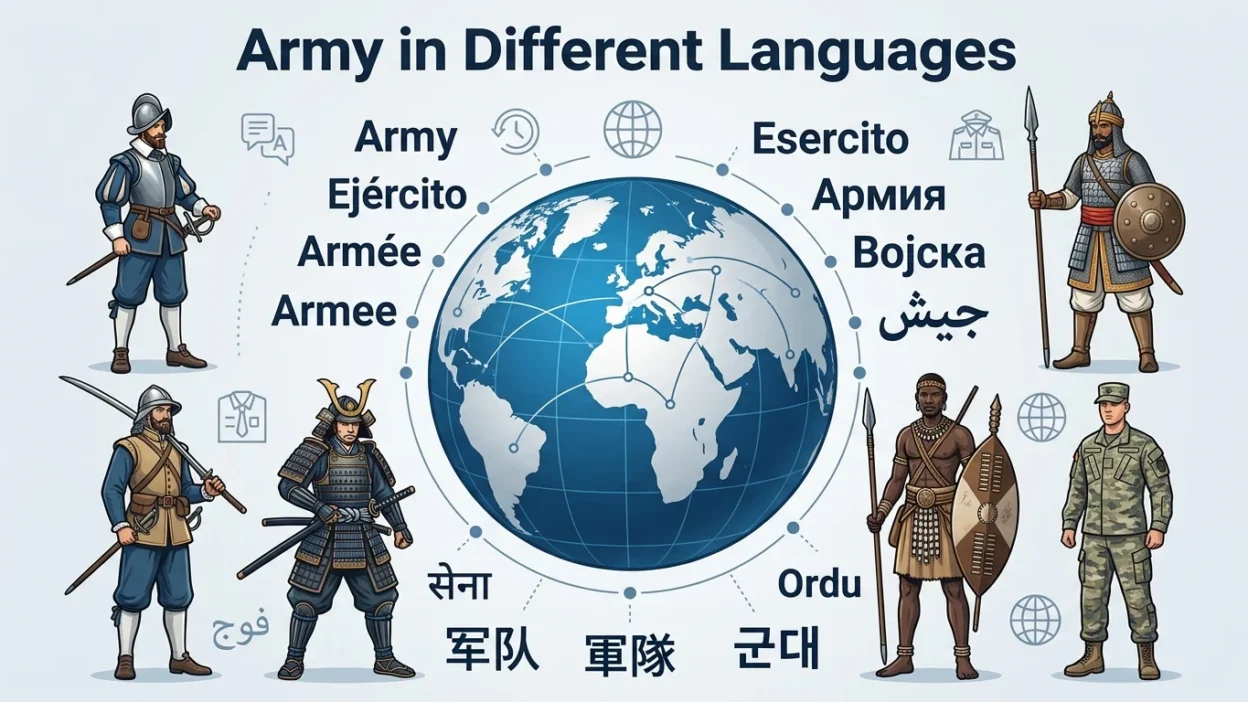
It also demonstrates how languages can use completely different words for the same basic concept. For example, Spanish uses ejército, Arabic uses جيش, Mandarin uses 军队, Japanese uses 軍隊, and Swahili uses jeshi.
Comparing these forms can make vocabulary learning more interesting and memorable.
Army in All Languages: Quick Vocabulary Guide
The 70 translations in this guide provide a broad overview of how languages express the concept of an army.
When using these words in professional, historical, or technical writing, context should always be considered. Some languages distinguish more clearly between an army, military, armed forces, troops, and soldiers than English does.
For everyday vocabulary learning, however, the terms in the table provide useful starting points for understanding the word army in each language.
Conclusion
Learning army in different languages is a useful way to explore vocabulary, history, and cultural differences. From ejército in Spanish and armée in French to 军队 in Mandarin, 軍隊 in Japanese, 군대 in Korean, and jeshi in Swahili, the concept of an organised military force is expressed in many fascinating ways.
These army translations can help language learners expand their vocabulary while discovering how different languages describe an important historical and modern concept.
FAQs
1. How do you say “army” in different languages?
“Army” has different translations across the world. For example, it is ejército in Spanish, armée in French, Armee in German, армия in Russian, جيش in Arabic, सेना in Hindi, 军队 in Mandarin, and 軍隊 in Japanese.
2. What is the word for army in British English?
The word is army in both British and American English. The spelling does not change between the two varieties.
3. Is “army” the same as “military”?
Not always. Army generally refers to the land-based military force, while military is a broader term that can include the army, navy, air force, and other branches.
4. What is the difference between an army and soldiers?
An army is an organised military force, while soldiers are individual members of that force. In other words, an army consists of soldiers and other military personnel.
5. Why does “army” have different translations in different languages?
Languages develop independently and are influenced by their own history, culture, grammar, and neighbouring languages. As a result, different languages use different words to describe the same general concept of an organised military force.