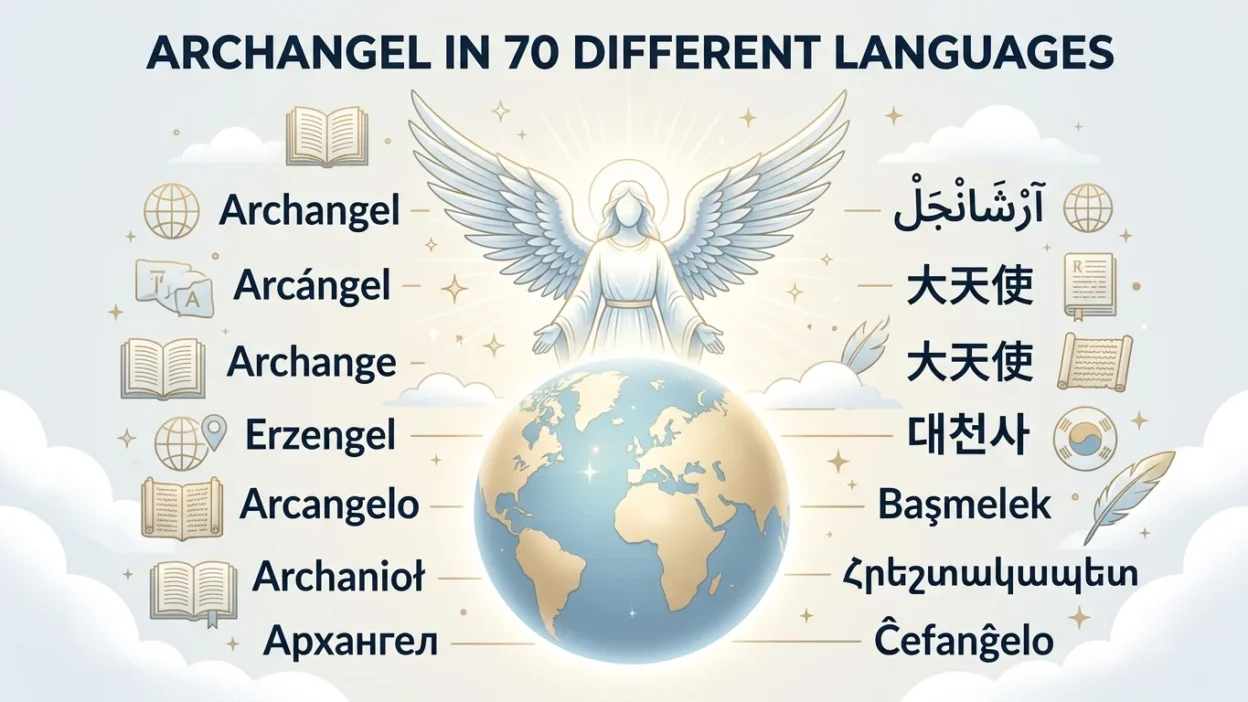
The word archangel refers to an angel of high rank or special importance in certain religious traditions. The concept appears in Christianity, Judaism, Islam, and other religious and cultural traditions, although beliefs about archangels can differ between faiths.
If you are searching for archangel in different languages, this guide provides translations from around the world. Each entry includes the native term, an easy English pronunciation, a short example sentence, and the English meaning of that sentence.
Whether you are studying languages, exploring religious vocabulary, researching mythology, writing, or simply curious about how the word is expressed across cultures, this list makes archangel translations around the world easy to compare.
Archangel in All Languages
| Language | Native Phrase | Easy English Pronunciation | Example Sentence | English Meaning |
| English | Archangel | ARK-ayn-jel | The archangel is mentioned in the text. | The archangel is mentioned in the text. |
| Spanish | Arcángel | ar-KAN-hel | El arcángel aparece en el texto. | The archangel appears in the text. |
| French | Archange | ar-KAHNZH | L’archange apparaît dans le texte. | The archangel appears in the text. |
| German | Erzengel | ERTS-eng-el | Der Erzengel wird im Text erwähnt. | The archangel is mentioned in the text. |
| Italian | Arcangelo | ar-KAN-jeh-loh | L’arcangelo appare nel testo. | The archangel appears in the text. |
| Portuguese | Arcanjo | ar-KAHN-zhoo | O arcanjo aparece no texto. | The archangel appears in the text. |
| Dutch | Aartsengel | AARTS-eng-el | De aartsengel wordt in de tekst genoemd. | The archangel is mentioned in the text. |
| Swedish | Ärkeängel | AIR-keh-eng-el | Ärkeängeln nämns i texten. | The archangel is mentioned in the text. |
| Norwegian | Erkeengel | AIR-keh-eng-el | Erkeengelen nevnes i teksten. | The archangel is mentioned in the text. |
| Danish | Ærkeengel | AIR-keh-eng-el | Ærkeenglen nævnes i teksten. | The archangel is mentioned in the text. |
| Finnish | Arkkienkeli | ARK-kee-en-keh-lee | Arkkienkeli mainitaan tekstissä. | The archangel is mentioned in the text. |
| Icelandic | Erkiengill | ER-kih-en-gitl | Erkiengillinn er nefndur í textanum. | The archangel is mentioned in the text. |
| Polish | Archanioł | ar-KHA-nyow | Archanioł jest wspomniany w tekście. | The archangel is mentioned in the text. |
| Czech | Archanděl | ar-KHAN-dyel | Archanděl je zmíněn v textu. | The archangel is mentioned in the text. |
| Slovak | Archanjel | ar-KHAN-yel | Archanjel je spomenutý v texte. | The archangel is mentioned in the text. |
| Slovenian | Nadangel | nah-DAHN-gel | Nadangel je omenjen v besedilu. | The archangel is mentioned in the text. |
| Croatian | Arkanđeo | ar-KAN-djeh-oh | Arkanđeo se spominje u tekstu. | The archangel is mentioned in the text. |
| Serbian | Арханђео | ar-KHAN-djeh-oh | Арханђео се помиње у тексту. | The archangel is mentioned in the text. |
| Bosnian | Arkanđeo | ar-KAN-djeh-oh | Arkanđeo se spominje u tekstu. | The archangel is mentioned in the text. |
| Bulgarian | Архангел | ar-KHAN-gel | Архангелът е споменат в текста. | The archangel is mentioned in the text. |
| Macedonian | Архангел | ar-KHAN-gel | Архангелот е споменат во текстот. | The archangel is mentioned in the text. |
| Russian | Архангел | ar-KHAN-gel | Архангел упоминается в тексте. | The archangel is mentioned in the text. |
| Ukrainian | Архангел | ar-KHAN-hel | Архангел згадується в тексті. | The archangel is mentioned in the text. |
| Belarusian | Архангел | ar-KHAN-gel | Архангел згадваецца ў тэксце. | The archangel is mentioned in the text. |
| Romanian | Arhanghel | ar-HAN-ghel | Arhanghelul este menționat în text. | The archangel is mentioned in the text. |
| Hungarian | Arkangyal | AR-kan-yal | Az arkangyal szerepel a szövegben. | The archangel appears in the text. |
| Albanian | Kryeengjëll | kree-ehn-JELL | Kryeengjëlli përmendet në tekst. | The archangel is mentioned in the text. |
| Greek | Αρχάγγελος | ar-KHAN-ge-los | Ο αρχάγγελος αναφέρεται στο κείμενο. | The archangel is mentioned in the text. |
| Turkish | Başmelek | bash-meh-LEK | Başmelek metinde geçiyor. | The archangel appears in the text. |
| Arabic | رئيس الملائكة | ra-EES al-ma-LA-i-kah | ذُكر رئيس الملائكة في النص. | The archangel is mentioned in the text. |
| Hebrew | מלאך | ma-LAKH | המלאך מוזכר בטקסט. | The angel is mentioned in the text. |
| Persian | فرشته مقرب | feh-resh-TEH mo-KAR-rab | فرشته مقرب در متن ذکر شده است. | The archangel is mentioned in the text. |
| Urdu | مقرب فرشتہ | mu-KAR-rab far-ISH-tah | مقرب فرشتہ متن میں مذکور ہے۔ | The archangel is mentioned in the text. |
| Hindi | प्रधान देवदूत | pra-DHAAN de-va-DOOT | प्रधान देवदूत का पाठ में उल्लेख है। | The archangel is mentioned in the text. |
| Bengali | প্রধান দেবদূত | pro-dhaan de-bo-DOOT | প্রধান দেবদূতের কথা পাঠ্যে আছে। | The archangel is mentioned in the text. |
| Punjabi | ਮਹਾਂ ਦੂਤ | ma-HAN DOOT | ਮਹਾਂ ਦੂਤ ਦਾ ਪਾਠ ਵਿੱਚ ਜ਼ਿਕਰ ਹੈ। | The archangel is mentioned in the text. |
| Gujarati | મુખ્ય દેવદૂત | MUKH-ya de-va-DOOT | મુખ્ય દેવદૂતનો ઉલ્લેખ લખાણમાં છે. | The archangel is mentioned in the text. |
| Marathi | प्रधान देवदूत | pra-DHAAN de-va-DOOT | प्रधान देवदूताचा उल्लेख मजकुरात आहे. | The archangel is mentioned in the text. |
| Nepali | प्रधान स्वर्गदूत | pra-DHAAN swar-ga-DOOT | प्रधान स्वर्गदूतको उल्लेख पाठमा छ। | The archangel is mentioned in the text. |
| Tamil | தலைமைக் தூதர் | tha-LAI-maik THOO-thar | தலைமைக் தூதர் உரையில் குறிப்பிடப்பட்டுள்ளார். | The archangel is mentioned in the text. |
| Telugu | ప్రధాన దేవదూత | pra-DHA-na de-va-DOO-ta | ప్రధాన దేవదూత ప్రస్తావించబడ్డాడు. | The archangel is mentioned in the text. |
| Kannada | ಪ್ರಧಾನ ದೇವದೂತ | pra-DHA-na de-va-DOO-ta | ಪ್ರಧಾನ ದೇವದೂತನನ್ನು ಪಠ್ಯದಲ್ಲಿ ಉಲ್ಲೇಖಿಸಲಾಗಿದೆ. | The archangel is mentioned in the text. |
| Malayalam | പ്രധാന ദൂതൻ | pra-DHAA-na DOO-than | പ്രധാന ദൂതനെ പാഠത്തിൽ പരാമർശിക്കുന്നു. | The archangel is mentioned in the text. |
| Sinhala | අග්ර දේවදූතයා | ag-ra day-va-DOO-ta-ya | අග්ර දේවදූතයා පාඨයේ සඳහන් වේ. | The archangel is mentioned in the text. |
| Chinese (Mandarin) | 大天使 | dà tiān shǐ | 大天使出现在文本中。 | The archangel appears in the text. |
| Japanese | 大天使 | dai-tenshi | 大天使が本文に登場します。 | The archangel appears in the text. |
| Korean | 대천사 | dae-cheon-sa | 대천사가 본문에 나옵니다. | The archangel appears in the text. |
| Vietnamese | Tổng lãnh thiên thần | tong lanh tyen thun | Tổng lãnh thiên thần xuất hiện trong văn bản. | The archangel appears in the text. |
| Thai | อัครเทวดา | ak-kra thay-wa-daa | อัครเทวดาปรากฏในข้อความ | The archangel appears in the text. |
| Indonesian | Malaikat agung | ma-la-ee-kat AH-goong | Malaikat agung disebut dalam teks. | The archangel is mentioned in the text. |
| Malay | Malaikat agung | ma-la-ee-kat AH-goong | Malaikat agung disebut dalam teks. | The archangel is mentioned in the text. |
| Filipino | Arkanghel | ar-KANG-hel | Binanggit ang arkanghel sa teksto. | The archangel is mentioned in the text. |
| Mongolian | Тэргүүн тэнгэр | ter-GOON teng-ger | Тэргүүн тэнгэрийг бичвэрт дурдсан. | The archangel is mentioned in the text. |
| Kazakh | Бас періште | bas peh-RISH-teh | Бас періште мәтінде аталады. | The archangel is mentioned in the text. |
| Uzbek | Bosh farishta | bosh fa-RISH-ta | Bosh farishta matnda tilga olingan. | The archangel is mentioned in the text. |
| Azerbaijani | Baş mələk | bash meh-LEK | Baş mələk mətndə qeyd olunur. | The archangel is mentioned in the text. |
| Georgian | მთავარანგელოზი | mtav-ar-an-GEH-lo-zee | მთავარანგელოზი ტექსტშია მოხსენიებული. | The archangel is mentioned in the text. |
| Armenian | Հրեշտակապետ | hresh-ta-ka-PET | Հրեշտակապետը հիշատակվում է տեքստում։ | The archangel is mentioned in the text. |
| Swahili | Malaika mkuu | ma-LAI-ka M-koo | Malaika mkuu ametajwa katika maandishi. | The archangel is mentioned in the text. |
| Amharic | ሊቀ መላእክት | lee-keh meh-la-ekt | ሊቀ መላእክት በጽሑፉ ተጠቅሷል። | The archangel is mentioned in the text. |
| Hausa | Babban mala’ika | BAH-bahn ma-LAI-ka | An ambaci babban mala’ika a cikin rubutu. | The archangel is mentioned in the text. |
| Yoruba | Angẹli agba | an-GEH-lee AHG-bah | A mẹnuba angẹli agba ninu ọrọ naa. | The archangel is mentioned in the text. |
| Igbo | Mmụọ ozi ukwu | MMOH oh-zee OO-koo | A kpọrọ mmụọ ozi ukwu aha n’akwụkwọ. | The archangel is mentioned in the text. |
| Zulu | Ingelosi enkulu | in-geh-LOH-see en-KOO-loo | Ingelosi enkulu iyashiwo embhalweni. | The archangel is mentioned in the text. |
| Xhosa | Ingelosi enkulu | in-geh-LOH-see en-KOO-loo | Ingelosi enkulu ikhankanywe embhalweni. | The archangel is mentioned in the text. |
| Afrikaans | Aartsengel | AARTS-eng-el | Die aartsengel word in die teks genoem. | The archangel is mentioned in the text. |
| Māori | Anahera nui | a-na-HEH-ra NOO-ee | Ka whakahuatia te anahera nui i te tuhinga. | The archangel is mentioned in the text. |
| Samoan | Agelu sili | ah-GEH-loo SEE-lee | Ua taʻua le agelu sili i le tusitusiga. | The archangel is mentioned in the text. |
| Hawaiian | ʻAnela nui | ah-NEH-la NOO-ee | Ua ʻōlelo ʻia ka ʻanela nui ma ka palapala. | The archangel is mentioned in the text. |
| Esperanto | Ĉefanĝelo | cheh-FAN-jeh-loh | La ĉefanĝelo estas menciita en la teksto. | The archangel is mentioned in the text. |
| Latin | Archangelus | ar-khan-GEH-loos | Archangelus in textu memoratur. | The archangel is mentioned in the text. |
What Does “Archangel” Mean?
An archangel is generally understood as an angel of especially high rank or importance. The term is associated with religious traditions and sacred texts, although different faiths and denominations may understand the role of archangels differently.
The English word comes from a Greek-rooted term meaning an angel of high or chief rank. The concept is particularly familiar through names such as Michael and other figures associated with different religious traditions.
Because beliefs vary, the meaning and role of an archangel should be understood according to the specific religious or cultural context.
How to Say Archangel in Different Languages
If you want to learn how to say archangel in different languages, you will notice that many European languages have forms closely related to the ancient Greek and Latin tradition.
For example, Spanish uses arcángel, Italian uses arcangelo, French uses archange, and German uses Erzengel. Other languages have developed their own traditional expressions.
In several Asian and African languages, the concept can be expressed through a phrase meaning something similar to a chief, great, or principal angel.
Archangel Translations Around the World
The concept of an archangel appears in different religious and cultural contexts around the world. However, the exact beliefs, names, ranks, and roles associated with these figures are not identical across traditions.
This is important when exploring archangel translations around the world. A translation may describe the general concept while the religious meaning behind the term depends on the culture and tradition in which it is used.
Archangel in Different Religious Traditions
Archangels are discussed in several religious traditions, but the details differ considerably.
In Christianity, archangels are associated with important heavenly roles, and Michael is one of the best-known figures described with this title in Christian traditions.
In Judaism, angels appear in various religious texts and traditions, with different interpretations concerning their roles and ranks.
In Islam, angels are an important part of Islamic belief, and figures such as Jibril are particularly significant. The terminology and classification of angels can differ from Christian usage.
Because these traditions have their own teachings, it is best to avoid assuming that the word archangel carries exactly the same meaning everywhere.
Archangel Names in Different Languages
Some well-known names associated with archangels have also developed different forms in different languages.
For example, Michael may appear as Miguel in Spanish contexts, Michel in French, Michele in Italian, and Михаил in Russian. Gabriel also has forms such as Gabriel, Gabriël, Gabriele, and Gavriil depending on the language.
These changes show how religious vocabulary can adapt to the pronunciation, spelling, and writing systems of different cultures.
Archangel Vocabulary for Language Learners
Learning archangel in all languages can be useful for people studying religious vocabulary, mythology, history, literature, or translation.
The best way to remember a new word is to learn it in context. That is why the table includes short example sentences rather than presenting isolated translations alone.
When studying a particular language, also pay attention to grammatical forms. A noun may change according to case, number, or sentence structure.
Why Learn Archangel in all Languages?
Learning a religious or cultural word in multiple languages can provide an interesting look at linguistic history.
Many European terms are recognisably related to one another, while other languages use completely different expressions. Comparing these forms can help language learners understand how vocabulary develops through history and cultural contact.
It can also be useful for writers, students, translators, researchers, and anyone interested in global religious vocabulary.
Related Words to Archangel
Several words are closely associated with the concept of an archangel. Their exact meanings can vary by religious tradition.
Common related terms include:
- Angel
- Heavenly messenger
- Celestial being
- Guardian angel
- Seraph
- Cherub
- Messenger
- Spirit
- Heavenly host
- Archangel
These words should not automatically be treated as exact synonyms because different traditions use them in different ways.
Archangel in All Languages: A Quick Guide
The 70 translations above show that the word archangel can be expressed through direct loanwords, traditional religious terms, and descriptive phrases.
If you are using one of these translations in a religious, academic, or historical context, it is important to consider the terminology preferred by the relevant tradition.
For general language learning, however, these translations provide a useful introduction to how the concept is represented across different languages.
Conclusion
Learning archangel in different languages is an interesting way to explore international vocabulary, religious terminology, and linguistic history. From arcángel in Spanish and archange in French to 大天使 in Chinese, 대천사 in Korean, Հրեշտակապետ in Armenian, and malaika mkuu in Swahili, the concept appears in many different linguistic forms.
These archangel translations also demonstrate that words connected with religion can develop differently across cultures. Understanding both the translation and its cultural context can make language learning more meaningful and accurate.
FAQs
1. How do you say “archangel” in different languages?
“Archangel” has many different translations. Examples include arcángel in Spanish, archange in French, Erzengel in German, arcangelo in Italian, 大天使 in Mandarin Chinese, 大天使 in Japanese, and 대천사 in Korean.
2. What is the meaning of archangel?
An archangel is generally understood as an angel of high rank or special importance. The precise meaning and role can differ between religious traditions.
3. What is archangel in Spanish?
The Spanish word for archangel is arcángel. It is commonly used in religious and literary contexts.
4. What is archangel in Arabic?
A common Arabic expression for archangel is رئيس الملائكة, which can be understood as “chief of the angels” or “leader of the angels”.
5. Are archangels understood the same way in every religion?
No. Different religious traditions have different beliefs about angels, archangels, their names, their ranks, and their roles. The meaning should therefore be understood within the relevant religious context.