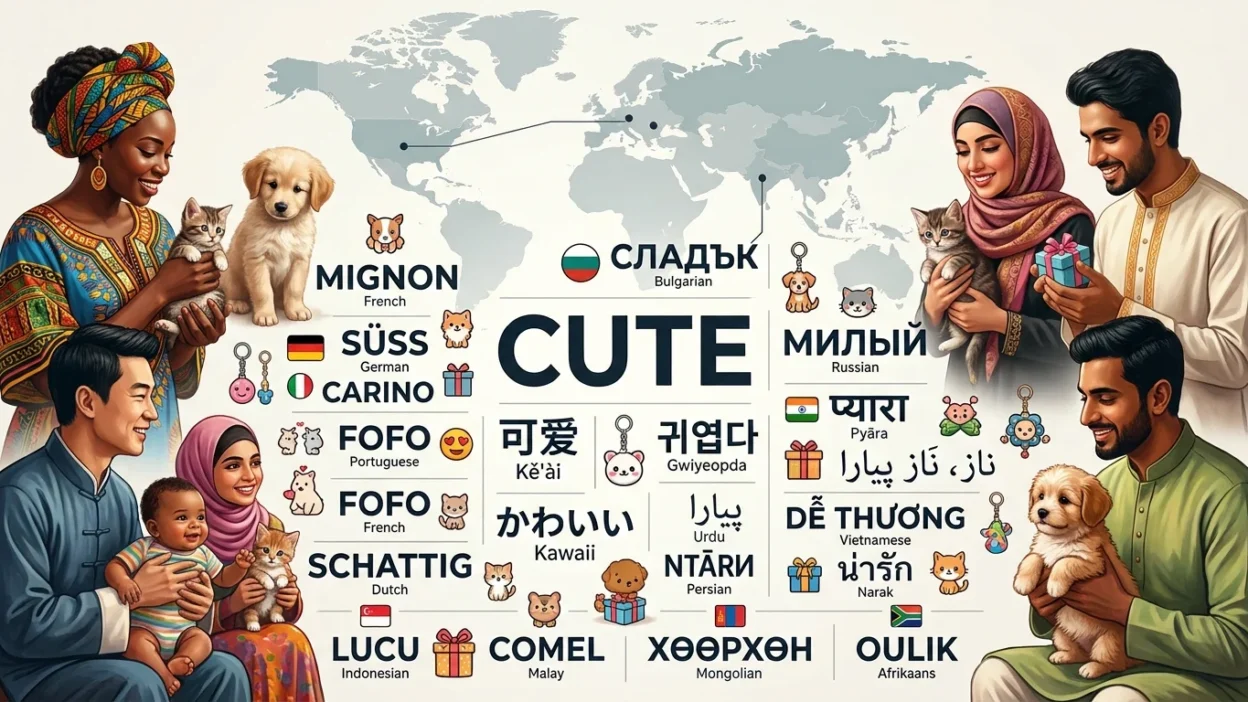
The word “cute” is a simple way to describe something adorable, charming, attractive, or endearing. We use it for people, babies, animals, clothes, objects, places, and even small gestures. But how does this popular word change when you move from one language to another?
If you are searching for cute in different languages, this guide provides useful translations with easy English pronunciations, real-life example sentences, and English meanings. It is helpful for language learners, travellers, writers, students, and anyone interested in international vocabulary.
Cute in Different Languages
| Language | Correct Native Phrase | Easy English Pronunciation | Real-Life Example Sentence | English Meaning |
| English | Cute | KYOOT | That puppy is cute. | That puppy is adorable. |
| Spanish | Lindo / Linda | LEEN-doh / LEEN-dah | ¡Qué lindo cachorro! | What a cute puppy! |
| French | Mignon / Mignonne | meen-YOHN / meen-YON | Ce petit chat est mignon. | This little cat is cute. |
| German | Süß | ZOOSS | Das Baby ist süß. | The baby is cute. |
| Italian | Carino / Carina | kah-REE-noh / kah-REE-nah | Che gattino carino! | What a cute kitten! |
| Portuguese | Fofo / Fofa | FOH-foh / FOH-fah | Que cachorro fofo! | What a cute puppy! |
| Dutch | Schattig | SKHAH-tikh | Die puppy is schattig. | That puppy is cute. |
| Swedish | Söt | SOOT | Vilken söt katt! | What a cute cat! |
| Norwegian | Søt | SOOT | For en søt katt! | What a cute cat! |
| Danish | Sød | SOETH | Sikke en sød hund! | What a cute dog! |
| Finnish | Söpö | SOO-poh | Tuo kissa on söpö. | That cat is cute. |
| Icelandic | Sætur / Sæt | SAI-tur / SAI-t | Þessi kettlingur er sætur. | This kitten is cute. |
| Irish | Gleoite | GLYOH-chuh | Tá an madra gleoite. | The dog is cute. |
| Scottish Gaelic | Grinn | GRIN | Tha an cù grinn. | The dog is cute. |
| Welsh | Ciwt | KYOOT | Mae’r ci’n ciwt. | The dog is cute. |
| Polish | Słodki / Słodka | SWOHT-kee / SWOHT-kah | Jaki słodki pies! | What a cute dog! |
| Czech | Roztomilý / Roztomilá | ROH-stoh-mee-lee | To kotě je roztomilé. | This kitten is cute. |
| Slovak | Roztomilý / Roztomilá | ROH-stoh-mee-lee | To mačiatko je roztomilé. | This kitten is cute. |
| Slovenian | Srčkan / Srčkana | SURCH-kahn / SURCH-kah-nah | Ta mucek je srčkan. | This kitten is cute. |
| Croatian | Simpatičan / Simpatična | seem-pah-TEE-chahn | Ovaj pas je simpatičan. | This dog is cute. |
| Serbian | Сладак / Слатка | SLAH-dahk / SLAHT-kah | Како је сладак пас! | What a cute dog! |
| Bosnian | Simpatičan / Simpatična | seem-pah-TEE-chahn | Ovaj pas je simpatičan. | This dog is cute. |
| Macedonian | Сладок / Слатка | SLAH-dok / SLAHT-kah | Како е слатко маче! | What a cute kitten! |
| Bulgarian | Сладък / Сладка | SLAH-duhk / SLAHT-kah | Какво сладко коте! | What a cute kitten! |
| Romanian | Drăguț / Drăguță | druh-GOOT / druh-GOOT-suh | Ce cățeluș drăguț! | What a cute puppy! |
| Hungarian | Aranyos | AH-rah-nyosh | Milyen aranyos kutya! | What a cute dog! |
| Greek | Χαριτωμένος / Χαριτωμένη | kha-ree-toh-MEH-nos / kha-ree-toh-MEH-nee | Τι χαριτωμένο γατάκι! | What a cute kitten! |
| Albanian | I lezetshëm / E lezetshme | ee leh-ZET-shum / eh leh-ZET-shmeh | Sa qen i lezetshëm! | What a cute dog! |
| Russian | Милый / Милая | MEE-lee / MEE-lah-yah | Какая милая кошка! | What a cute cat! |
| Ukrainian | Милий / Мила | MY-lee / MY-lah | Яка мила кішка! | What a cute cat! |
| Belarusian | Мілы / Мілая | MEE-lee / MEE-lah-yah | Якая мілая кошка! | What a cute cat! |
| Lithuanian | Mielas / Miela | MYEH-las / MYEH-lah | Koks mielas šuniukas! | What a cute puppy! |
| Latvian | Mīļš / Mīļa | MEELSH / MEE-lya | Cik mīļš kaķēns! | What a cute kitten! |
| Estonian | Armas | AHR-mas | Kui armas kutsikas! | What a cute puppy! |
| Maltese | Ħelu / Ħelwa | HEH-loo / HEHL-wah | Kemm hu ħelu dan il-ġriewi! | How cute this puppy is! |
| Turkish | Sevimli | seh-VEEM-lee | Ne sevimli bir kedi! | What a cute cat! |
| Azerbaijani | Şirin | shee-REEN | Nə şirin pişikdir! | What a cute cat! |
| Georgian | საყვარელი | sah-KVAH-reh-lee | რა საყვარელი ლეკვია! | What a cute puppy! |
| Armenian | Սիրուն | see-ROON | Ինչ սիրուն շնիկ է։ | What a cute puppy! |
| Persian | ناز | NAHZ | چه بچه نازی! | What a cute baby! |
| Arabic | لطيف / لطيفة | lah-TEEF / lah-TEE-fah | هذا الطفل لطيف. | This child is cute. |
| Hebrew | חמוד / חמודה | kha-MOOD / kha-moo-DAH | איזה חתול חמוד! | What a cute cat! |
| Hindi | प्यारा / प्यारी | PYAAR-ah / PYAAR-ee | कितना प्यारा बच्चा है! | What a cute baby! |
| Urdu | پیارا / پیاری | PYAAR-ah / PYAAR-ee | کتنا پیارا بچہ ہے! | What a cute baby! |
| Bengali | মিষ্টি | MISH-tee | কী মিষ্টি বিড়াল! | What a cute cat! |
| Punjabi | ਪਿਆਰਾ / ਪਿਆਰੀ | PYAAR-ah / PYAAR-ee | ਕਿੰਨਾ ਪਿਆਰਾ ਕੁੱਤਾ ਹੈ! | What a cute dog! |
| Gujarati | ક્યૂટ | KYOOT | આ બિલાડી કેટલી ક્યૂટ છે! | This cat is so cute! |
| Marathi | गोंडस | GON-das | किती गोंडस मांजर आहे! | What a cute cat! |
| Nepali | प्यारो / प्यारी | PYAAR-oh / PYAAR-ee | कति प्यारो कुकुर! | What a cute dog! |
| Sinhala | හුරුබුහුටි | hoo-roo-boo-HOO-tee | මේ පූසා හුරුබුහුටියි. | This cat is cute. |
| Tamil | அழகான | a-la-GAA-na | இந்த பூனை அழகாக இருக்கிறது. | This cat is cute. |
| Telugu | ముద్దుగా | mood-doo-GAA | ఈ పిల్లి ముద్దుగా ఉంది. | This cat is cute. |
| Kannada | ಮುದ್ದಾದ | mood-DAH-da | ಈ ಬೆಕ್ಕು ಮುದ್ದಾಗಿದೆ. | This cat is cute. |
| Malayalam | ക്യൂട്ട് | KYOOT | ഈ പൂച്ച വളരെ ക്യൂട്ടാണ്. | This cat is very cute. |
| Odia | ସୁନ୍ଦର | SOON-dor | ଏହି ବିଲେଇଟି ସୁନ୍ଦର। | This cat is cute. |
| Assamese | মৰমলগা | moh-rom-loh-GAH | এই মেকুৰীটো মৰমলগা। | This cat is cute. |
| Chinese (Mandarin) | 可爱 | kuh-EYE | 这只猫很可爱。 | This cat is very cute. |
| Japanese | かわいい | kah-wah-EE | この猫はかわいいです。 | This cat is cute. |
| Korean | 귀엽다 | kwee-yup-DAH | 이 강아지는 귀여워요. | This puppy is cute. |
| Vietnamese | Dễ thương | zay THUONG | Con mèo này dễ thương. | This cat is cute. |
| Thai | น่ารัก | nah-RAHK | แมวตัวนี้น่ารัก | This cat is cute. |
| Indonesian | Lucu | LOO-choo | Kucing ini lucu. | This cat is cute. |
| Malay | Comel | CHOH-mel | Kucing ini comel. | This cat is cute. |
| Filipino | Cute / Kaibig-ibig | KYOOT / ka-ee-BIG ee-BIG | Ang cute ng kuting! | The kitten is cute! |
| Mongolian | Хөөрхөн | KHOOR-khon | Энэ муур хөөрхөн. | This cat is cute. |
| Swahili | Mzuri | m-ZOO-ree | Mtoto huyu ni mzuri. | This child is cute. |
| Zulu | Muhle | MOO-hleh | Le ngane imnandi. | This child is cute. |
| Afrikaans | Oulik | OH-lək | Hierdie hondjie is oulik. | This puppy is cute. |
| Amharic | ቆንጆ | KOHN-joh | ይህ ውሻ ቆንጆ ነው። | This dog is cute. |
| Haitian Creole | Bèl | BEL | Ti chat sa a bèl. | This little cat is cute. |
| Esperanto | Ĉarma | CHAR-mah | Ĉi tiu katido estas ĉarma. | This kitten is cute. |
How to Say Cute in Different Languages
If you want to know how to say cute in different languages, the most important thing to remember is that there is not always a perfect one-word equivalent.
For example, Spanish commonly uses lindo or linda, while German uses süß. French uses mignon or mignonne, and Italian uses carino or carina.
In several languages, the translation changes according to the gender or grammatical form of the person or thing being described. This is why some entries in the table contain two forms.
Cute in Different Languages Around the World
The idea of describing something as cute exists across cultures, but languages express it in their own distinctive ways.
In Japanese, かわいい (kawaii) is particularly well known and can describe adorable people, animals, clothing, characters, and objects.
Korean uses 귀엽다, while Mandarin Chinese uses 可爱. In Indonesian, lucu is commonly used for something cute or funny in an endearing way.
These examples show how a simple adjective can have different cultural and linguistic associations.
Cute in European Languages
European languages offer many fascinating translations for “cute”.
French uses mignon, German uses süß, Italian uses carino, Spanish uses lindo, and Portuguese uses fofo.
Slavic languages also have several distinctive forms. Polish uses słodki, Russian uses милый, Croatian can use simpatičan, and Bulgarian uses сладък.
Although some words are historically related or influenced by similar concepts, their everyday usage can differ from language to language.
Cute in Asian Languages
Asian languages provide some of the most recognisable expressions for “cute”.
Japanese かわいい is widely associated with adorable things and is also familiar internationally through the concept of “kawaii” culture.
Mandarin Chinese uses 可爱, Korean uses 귀엽다, Vietnamese uses dễ thương, and Thai uses น่ารัก.
South Asian languages also have several natural ways to describe something as cute. Hindi and Urdu commonly use forms of प्यारा / پیارا, while Marathi uses गोंडस.
Cute in Different Languages Translations
When looking at cute in different languages translations, context matters.
In English, “cute” can describe physical appearance, personality, behaviour, design, or even a clever idea. Another language may use different words for these meanings.
For example, a word used for a cute baby may not be the most natural choice for a cute dress or a charming person. Understanding the situation helps you choose a more natural translation.
Cute, Pretty, Adorable and Lovely
The words “cute”, “pretty”, “adorable”, and “lovely” overlap, but they are not identical.
Cute often suggests something charming or endearing. Pretty usually focuses more on attractive appearance. Adorable expresses a stronger feeling of affection, while lovely can describe something beautiful, pleasant, or delightful.
The best translation therefore depends on what you are describing.
Why Learn Cute in Different Languages?
“Cute” is a useful everyday adjective because it appears in casual conversations, social media posts, messages, travel situations, and descriptions of people and animals.
Learning this word in another language can also help you communicate naturally when talking about pets, children, gifts, clothing, photographs, and memorable experiences.
It is a simple vocabulary word that can make conversations feel more expressive.
Tips for Using Cute in Another Language
Before using a translation, check whether the word changes according to gender, number, or grammatical context.
It is also useful to learn the word inside a complete sentence rather than memorising it by itself. This makes it easier to understand natural word order and pronunciation.
For languages using a different writing system, practise both the native spelling and the pronunciation. This can help you recognise the word in messages, menus, signs, and online content.
Conclusion
Learning cute in different languages is a fun way to expand your everyday vocabulary and discover how different cultures express affection, charm, and admiration.
From lindo in Spanish and mignon in French to süß in German, かわいい in Japanese, 可爱 in Mandarin, and 귀엽다 in Korean, the word “cute” takes many interesting forms around the world.
Whether you are learning a new language, travelling, writing a message, or simply exploring international vocabulary, these translations offer a practical starting point.
FAQs
1. What is cute in different languages?
“Cute” has many translations depending on the language and context. Examples include lindo in Spanish, mignon in French, süß in German, かわいい in Japanese, 可爱 in Chinese, and 귀엽다 in Korean.
2. How do you say cute in Spanish?
“Cute” in Spanish can commonly be translated as lindo or linda. The form can change depending on the gender of the noun being described.
3. How do you say cute in Japanese?
“Cute” in Japanese is commonly かわいい (kawaii). It is widely used for adorable people, animals, objects, clothes, characters, and other things.
4. What is cute in Korean?
The Korean adjective 귀엽다 (gwiyeopda) means “cute” or “adorable”. In everyday speech, forms such as 귀여워요 are commonly used.
5. What is the difference between cute and adorable?
Both words describe something endearing or charming, but “adorable” usually expresses a stronger sense of affection. “Cute” is broader and is commonly used for people, animals, objects, styles, and behaviour.