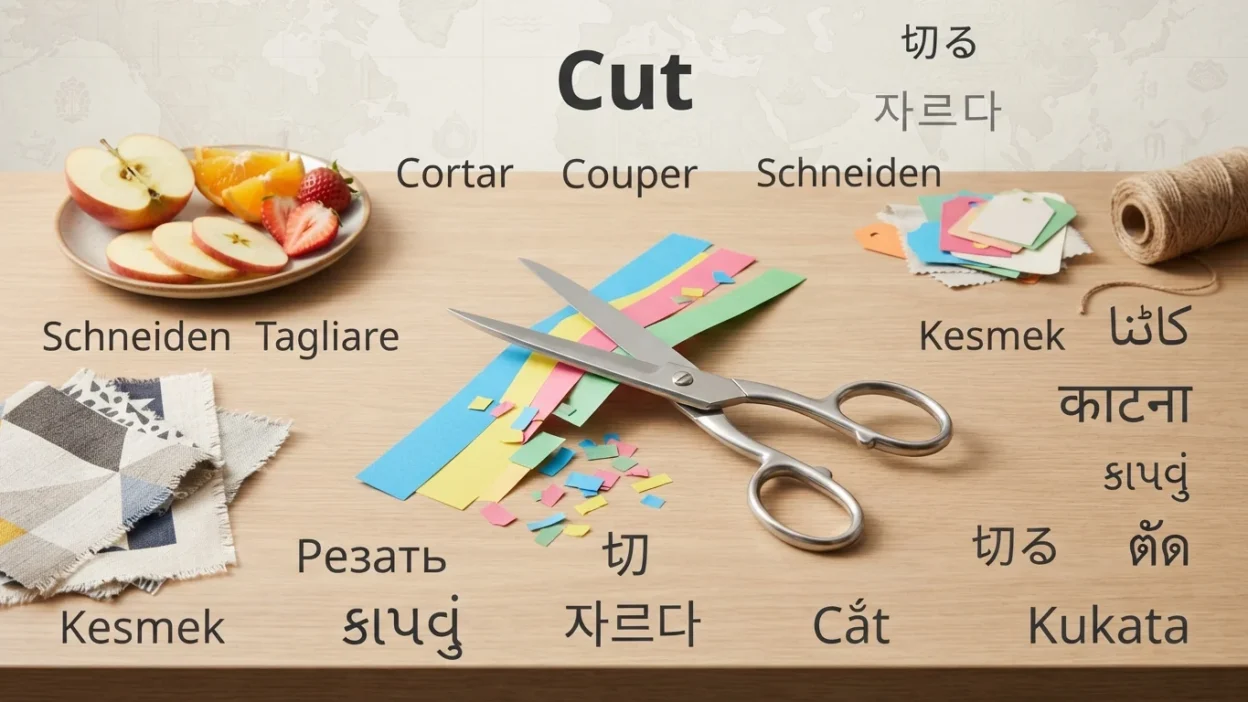
Have you ever wondered how to say “cut in different languages”? The word “cut” is one of the most useful everyday verbs in English. It can describe using a knife or scissors, shortening something, cutting hair, or dividing an object.
Because languages use different grammatical forms and expressions, the translation of “cut” can vary depending on context. This guide focuses mainly on “cut” as a verb, such as cutting paper, food, hair, or another object.
Below, you will find ways to say cut in different languages, including the native phrase, easy English pronunciation, a natural example sentence, and its English meaning.
Cut in Different Languages
| Language | Native Phrase | Easy English Pronunciation | Example Sentence | English Meaning |
| English | Cut | KUT | Please cut the paper. | Please cut the paper. |
| Spanish | Cortar | kor-TAR | Corta el papel, por favor. | Please cut the paper. |
| French | Couper | koo-PAY | Coupe le papier, s’il te plaît. | Please cut the paper. |
| German | Schneiden | SHNY-dən | Schneide das Papier. | Cut the paper. |
| Italian | Tagliare | tal-YAH-reh | Taglia la carta, per favore. | Please cut the paper. |
| Portuguese | Cortar | kor-TAR | Corte o papel, por favor. | Please cut the paper. |
| Dutch | Snijden | SNY-dən | Snijd het papier. | Cut the paper. |
| Swedish | Skära | SHAY-rah | Skär papperet. | Cut the paper. |
| Danish | Skære | SKAIR-eh | Skær papiret. | Cut the paper. |
| Norwegian | Skjære | SHYEH-reh | Skjær papiret. | Cut the paper. |
| Finnish | Leikata | LAY-kah-tah | Leikkaa paperi. | Cut the paper. |
| Icelandic | Skera | SKEH-ra | Skerðu pappírinn. | Cut the paper. |
| Irish | Gearr | GYAR | Gearr an páipéar. | Cut the paper. |
| Welsh | Torri | TOR-ree | Torrwch y papur. | Cut the paper. |
| Scottish Gaelic | Gearradh | GYAR-uh | Gearr am pàipear. | Cut the paper. |
| Latin | Secare | seh-KAH-reh | Seca chartam. | Cut the paper. |
| Romanian | Tăia | tuh-YA | Taie hârtia. | Cut the paper. |
| Greek | Κόβω | KOH-voh | Κόψε το χαρτί. | Cut the paper. |
| Albanian | Pres | PRES | Preje letrën. | Cut the paper. |
| Basque | Moztu | MOZ-too | Moztu papera. | Cut the paper. |
| Catalan | Tallar | tah-YAR | Talla el paper. | Cut the paper. |
| Galician | Cortar | kor-TAR | Corta o papel. | Cut the paper. |
| Polish | Ciąć | CHONCH | Potnij papier. | Cut the paper. |
| Czech | Řezat | RZHEH-zat | Řež papír. | Cut the paper. |
| Slovak | Rezať | REH-zat | Rež papier. | Cut the paper. |
| Slovenian | Rezati | reh-ZAH-tee | Reži papir. | Cut the paper. |
| Croatian | Rezati | reh-ZAH-tee | Reži papir. | Cut the paper. |
| Serbian | Сећи | SEH-chee | Исeci папир. | Cut the paper. |
| Bulgarian | Режа | REH-zhah | Нарежи хартията. | Cut the paper. |
| Macedonian | Сече | SEH-cheh | Исечи ја хартијата. | Cut the paper. |
| Russian | Резать | reh-ZAT | Разрежь бумагу. | Cut the paper. |
| Ukrainian | Різати | ree-ZAH-ty | Ріж папір. | Cut the paper. |
| Belarusian | Рэзаць | REH-zats | Рэж паперу. | Cut the paper. |
| Lithuanian | Pjauti | PYOW-tee | Pjauk popierių. | Cut the paper. |
| Latvian | Griezt | GRYEHT | Griež papīru. | Cut the paper. |
| Estonian | Lõikama | LUR-ee-kah-mah | Lõika paberit. | Cut the paper. |
| Hungarian | Vágni | VAHG-nee | Vágd el a papírt. | Cut the paper. |
| Turkish | Kesmek | KES-mek | Kağıdı kes. | Cut the paper. |
| Azerbaijani | Kəsmək | KES-mek | Kağızı kəs. | Cut the paper. |
| Armenian | Կտրել | kuh-TREL | Կտրիր թուղթը։ | Cut the paper. |
| Georgian | გაჭრა | gah-CHRA | დაჭერი ქაღალდი. | Cut the paper. |
| Persian | بریدن | bo-REE-dan | کاغذ را ببر. | Cut the paper. |
| Arabic | يقطع | YAK-ta | اقطع الورق. | Cut the paper. |
| Hebrew | לחתוך | lah-KHtoch | חתוך את הנייר. | Cut the paper. |
| Urdu | کاٹنا | KAAT-na | کاغذ کاٹو۔ | Cut the paper. |
| Hindi | काटना | KAAT-na | कागज़ काटो। | Cut the paper. |
| Bengali | কাটা | KAH-ta | কাগজ কাটো। | Cut the paper. |
| Punjabi | ਕੱਟਣਾ | KAT-na | ਕਾਗਜ਼ ਕੱਟੋ। | Cut the paper. |
| Gujarati | કાપવું | KAP-vu | કાગળ કાપો. | Cut the paper. |
| Marathi | कापणे | KAA-puh-nay | कागद कापा. | Cut the paper. |
| Nepali | काट्नु | KAAT-noo | कागज काट्नुहोस्। | Please cut the paper. |
| Sinhala | කපනවා | KAP-a-na-wa | කඩදාසිය කපන්න. | Cut the paper. |
| Tamil | வெட்டுதல் | VET-too-tal | காகிதத்தை வெட்டு. | Cut the paper. |
| Telugu | కత్తిరించు | kat-ti-RIN-choo | కాగితాన్ని కత్తిరించు. | Cut the paper. |
| Kannada | ಕತ್ತರಿಸು | kat-ta-ri-soo | ಕಾಗದವನ್ನು ಕತ್ತರಿಸು. | Cut the paper. |
| Malayalam | മുറിക്കുക | moo-ri-kka-ka | കടലാസ് മുറിക്കുക. | Cut the paper. |
| Odia | କାଟିବା | KAA-tee-bah | କାଗଜ କାଟ। | Cut the paper. |
| Assamese | কটা | KOH-tah | কাগজখন কাটা। | Cut the paper. |
| Chinese | 切 | CHYEH | 请切开纸张。 | Please cut the paper. |
| Japanese | 切る | KEE-roo | 紙を切ってください。 | Please cut the paper. |
| Korean | 자르다 | JAH-reu-dah | 종이를 잘라 주세요. | Please cut the paper. |
| Vietnamese | Cắt | KUT | Hãy cắt giấy. | Please cut the paper. |
| Thai | ตัด | TAT | กรุณาตัดกระดาษ | Please cut the paper. |
| Indonesian | Memotong | meh-MOH-tong | Tolong potong kertas itu. | Please cut that paper. |
| Malay | Memotong | meh-MOH-tong | Tolong potong kertas itu. | Please cut that paper. |
| Filipino | Gupitin | goo-PEE-tin | Gupitin mo ang papel. | Cut the paper. |
| Swahili | Kukata | koo-KAH-tah | Kata karatasi. | Cut the paper. |
| Afrikaans | Sny | SNEI | Sny die papier. | Cut the paper. |
| Zulu | Ukusika | oo-koo-SEE-kah | Sika iphepha. | Cut the paper. |
| Xhosa | Ukusika | oo-koo-SEE-kah | Sika iphepha. | Cut the paper. |
| Amharic | መቁረጥ | meh-koo-RET | ወረቀቱን ቁረጥ። | Cut the paper. |
| Somali | Jarid | jah-RID | Warqadda jar. | Cut the paper. |
How to Say Cut in Different Languages
If you are searching for how to say cut in different languages, the most common translations include cortar in Spanish and Portuguese, couper in French, schneiden in German, tagliare in Italian, and snijden in Dutch.
In Asian languages, examples include 切 (qiē) in Chinese, 切る (kiru) in Japanese, 자르다 (jareuda) in Korean, cắt in Vietnamese, and ตัด (tat) in Thai.
The exact form can change according to tense, subject, politeness, and the object being cut.
Cut in Different Languages Around the World
The concept of cutting is universal. People cut food, paper, fabric, hair, wood, plants, and many other objects every day.
However, languages express this common action in different ways. Romance languages often have related forms such as cortar, couper, and tagliare, while Germanic and Slavic languages use very different vocabulary.
Exploring cut in different languages around the world is therefore a simple way to discover how languages describe everyday actions.
Cut Translations in European Languages
European languages provide a wide range of translations for “cut.”
Spanish and Portuguese use cortar, while French uses couper and Italian uses tagliare. German uses schneiden, Dutch uses snijden, and Swedish uses skära.
Slavic languages also have their own related forms. Russian uses резать, Ukrainian uses різати, Polish uses ciąć, and Czech uses řezat.
Cut Translations in Asian Languages
Asian languages have their own distinctive expressions for cutting.
Chinese uses 切, Japanese uses 切る, and Korean uses 자르다. Vietnamese uses cắt, Thai uses ตัด, and Indonesian uses memotong.
South Asian languages also have several useful forms, including کاٹنا in Urdu, काटना in Hindi, ਕੱਟਣਾ in Punjabi, and কাটা in Bengali.
Different Meanings of the Word Cut
The English word “cut” can have several meanings.
It can mean:
- To divide something with a sharp object.
- To shorten hair or fabric.
- To slice food.
- To reduce something, such as a budget.
- To make a wound in the skin.
- To stop or remove something.
- To edit or remove part of a video or text.
Because of these different meanings, cut in different languages translations may require different words depending on the sentence.
Cut as a Verb and Noun
“Cut” is primarily used as a verb when describing an action, such as “cut the paper.”
It can also function as a noun. For example, “a cut” can refer to an injury, a reduction, a slice, or an edited section of a film.
When translating “cut,” always consider whether you are describing the action or the result.
Why Learn Cut in Different Languages?
Learning the word “cut” in other languages is useful because it appears frequently in everyday communication.
It can help you:
- Build practical vocabulary.
- Understand instructions while traveling.
- Talk about food preparation.
- Communicate in everyday situations.
- Learn useful action verbs.
- Understand foreign-language conversations.
- Compare vocabulary across different language families.
Conclusion
The word “cut” is a simple but highly useful everyday verb with many translations around the world. From cortar in Spanish and couper in French to 切る in Japanese and 자르다 in Korean, each language has its own natural way to express the action.
This collection of cut in different languages translations provides a helpful reference for language learners, travelers, students, writers, and anyone interested in multilingual vocabulary.
FAQs
What is “cut” in different languages?
“Cut” has different translations depending on the language. Examples include cortar in Spanish, couper in French, schneiden in German, tagliare in Italian, 切る in Japanese, and 자르다 in Korean.
How do you say “cut” in 10 languages?
You can say cortar in Spanish, couper in French, schneiden in German, tagliare in Italian, snijden in Dutch, kesmek in Turkish, резать in Russian, کاٹنا in Urdu, 切る in Japanese, and 자르다 in Korean.
What is “cut” in Asian languages?
Some common translations are 切 in Chinese, 切る in Japanese, 자르다 in Korean, cắt in Vietnamese, ตัด in Thai, கத்தரித்தல் or related cutting expressions in Tamil, and கத்தரிக்க in Malayalam.
Does “cut” have the same meaning in every language?
Not necessarily. “Cut” can mean slicing, dividing, shortening, reducing, or editing in English. Other languages may use different words for these meanings.
Why should I learn “cut” in different languages?
“Cut” is a common everyday action, so learning its translation can improve practical vocabulary and help with conversations, instructions, travel, cooking, shopping, and language study.