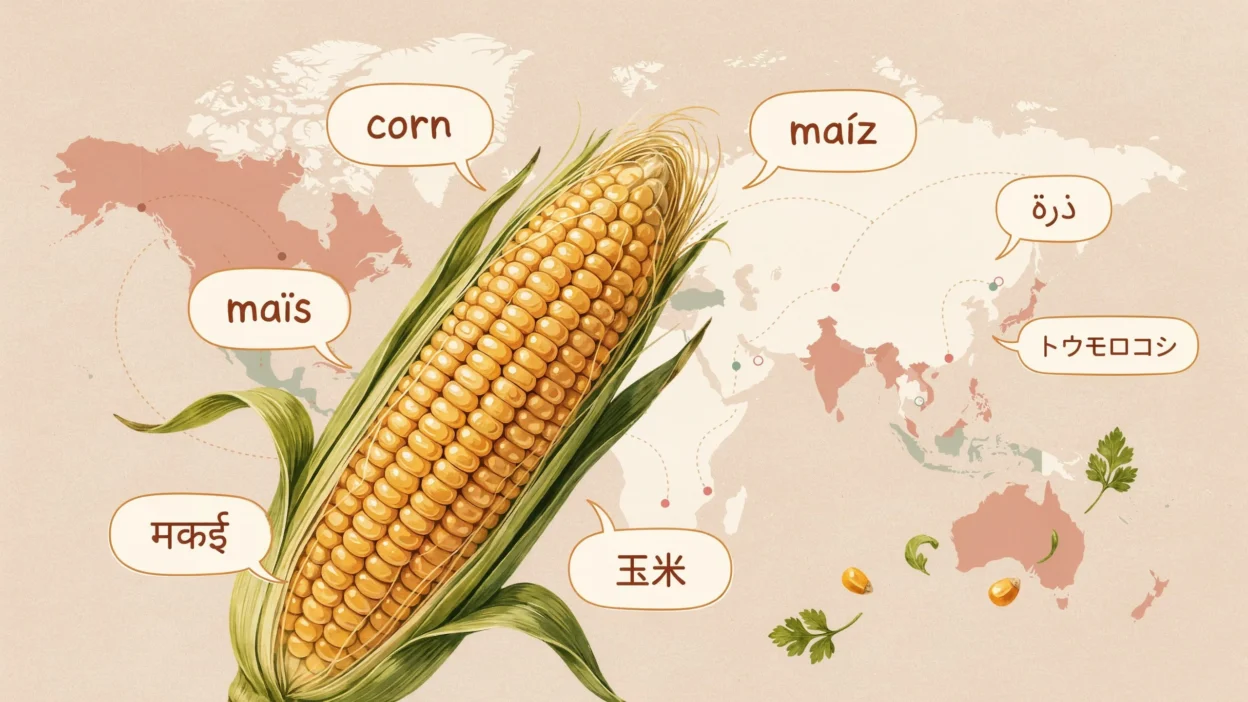
Corn is one of the world’s most familiar foods, but its name changes from language to language. Whether you are learning vocabulary, travelling, or simply curious about food words, discovering corn in different languages is a simple way to explore how people communicate around the world.
In this guide, you will find corn translations, including the correct native phrase, an easy English pronunciation, and a short example sentence. The table also explains the English meaning of each example, making it useful for language learners and anyone searching for corn in different languages in all languages.
How to Say Corn in Different Languages
The English word corn usually refers to the edible grain that grows on a maize plant. In some languages, the same word can also refer to the plant, the grain, or a prepared food such as sweetcorn. The examples below use common everyday expressions for corn or maize.
Pronunciations are simplified for English speakers. They are learning aids rather than exact phonetic transcriptions, so native pronunciation may vary.
Corn in Different Languages
| Language | Native phrase | Easy English pronunciation | Example sentence | English meaning |
| English | Corn | korn | I bought fresh corn. | I bought fresh corn. |
| Spanish | Maíz | mah-EES | Compré maíz fresco. | I bought fresh corn. |
| French | Maïs | mah-EES | J’ai acheté du maïs frais. | I bought fresh corn. |
| German | Mais | myce | Ich habe frischen Mais gekauft. | I bought fresh corn. |
| Italian | Mais | myce | Ho comprato mais fresco. | I bought fresh corn. |
| Portuguese | Milho | MEEL-yoh | Comprei milho fresco. | I bought fresh corn. |
| Dutch | Maïs | myce | Ik heb verse maïs gekocht. | I bought fresh corn. |
| Afrikaans | Mielies | MEE-lee-ees | Ek het vars mielies gekoop. | I bought fresh corn. |
| Swedish | Majs | myce | Jag köpte färsk majs. | I bought fresh corn. |
| Norwegian | Mais | myce | Jeg kjøpte fersk mais. | I bought fresh corn. |
| Danish | Majs | myce | Jeg købte frisk majs. | I bought fresh corn. |
| Finnish | Maissi | MY-ssee | Ostin tuoretta maissia. | I bought fresh corn. |
| Estonian | Mais | myce | Ostsin värsket maisi. | I bought fresh corn. |
| Latvian | Kukurūza | koo-koo-ROO-zah | Es nopirku svaigu kukurūzu. | I bought fresh corn. |
| Lithuanian | Kukurūzai | koo-koo-ROO-zai | Nusipirkau šviežių kukurūzų. | I bought fresh corn. |
| Polish | Kukurydza | koo-koo-RID-zah | Kupiłem świeżą kukurydzę. | I bought fresh corn. |
| Czech | Kukuřice | koo-koo-RZHIT-seh | Koupil jsem čerstvou kukuřici. | I bought fresh corn. |
| Slovak | Kukurica | koo-koo-REET-sah | Kúpil som čerstvú kukuricu. | I bought fresh corn. |
| Slovenian | Koruza | koh-ROO-zah | Kupil sem svežo koruzo. | I bought fresh corn. |
| Croatian | Kukuruz | koo-koo-ROOZ | Kupio sam svježi kukuruz. | I bought fresh corn. |
| Serbian | Кукуруз | koo-koo-ROOZ | Купио сам свеж кукуруз. | I bought fresh corn. |
| Bosnian | Kukuruz | koo-koo-ROOZ | Kupio sam svježi kukuruz. | I bought fresh corn. |
| Bulgarian | Царевица | tsah-reh-VEE-tsah | Купих прясна царевица. | I bought fresh corn. |
| Macedonian | Пченка | PCHEN-kah | Купив свежа пченка. | I bought fresh corn. |
| Russian | Кукуруза | koo-koo-ROO-zah | Я купил свежую кукурузу. | I bought fresh corn. |
| Ukrainian | Кукурудза | koo-koo-ROOD-zah | Я купив свіжу кукурудзу. | I bought fresh corn. |
| Belarusian | Кукуруза | koo-koo-ROO-zah | Я купіў свежую кукурузу. | I bought fresh corn. |
| Greek | Καλαμπόκι | kah-lahm-BOH-kee | Αγόρασα φρέσκο καλαμπόκι. | I bought fresh corn. |
| Albanian | Misër | MEE-zuhr | Bleva misër të freskët. | I bought fresh corn. |
| Romanian | Porumb | poh-ROOMB | Am cumpărat porumb proaspăt. | I bought fresh corn. |
| Hungarian | Kukorica | KOO-koh-ree-tsah | Friss kukoricát vettem. | I bought fresh corn. |
| Turkish | Mısır | muh-SUHR | Taze mısır aldım. | I bought fresh corn. |
| Azerbaijani | Qarğıdalı | gahr-guh-dah-LUH | Təzə qarğıdalı aldım. | I bought fresh corn. |
| Georgian | სიმინდი | see-MEEN-dee | ახალი სიმინდი ვიყიდე. | I bought fresh corn. |
| Armenian | Եգիպտացորեն | yeh-geep-tah-tsoh-REN | Թարմ եգիպտացորեն գնեցի։ | I bought fresh corn. |
| Persian | ذرت | zor-RAT | ذرت تازه خریدم. | I bought fresh corn. |
| Urdu | مکئی | muh-KAI | میں نے تازہ مکئی خریدی۔ | I bought fresh corn. |
| Hindi | मक्का | MAK-kah | मैंने ताज़ा मक्का खरीदा। | I bought fresh corn. |
| Bengali | ভুট্টা | BHOOT-tah | আমি তাজা ভুট্টা কিনেছি। | I bought fresh corn. |
| Punjabi | ਮੱਕੀ | MAK-kee | ਮੈਂ ਤਾਜ਼ੀ ਮੱਕੀ ਖਰੀਦੀ। | I bought fresh corn. |
| Gujarati | મકાઈ | muh-KAI | મેં તાજી મકાઈ ખરીદી. | I bought fresh corn. |
| Marathi | मका | muh-KAH | मी ताजा मका विकत घेतला. | I bought fresh corn. |
| Nepali | मकै | muh-KAI | मैले ताजा मकै किनेँ। | I bought fresh corn. |
| Sinhala | බඩ ඉරිඟු | bahd ee-ree-GOO | මම නැවුම් බඩ ඉරිඟු මිලදී ගත්තා. | I bought fresh corn. |
| Tamil | சோளம் | SOH-lum | நான் புதிய சோளம் வாங்கினேன். | I bought fresh corn. |
| Telugu | మొక్కజొన్న | mok-kuh-JON-nah | నేను తాజా మొక్కజొన్న కొన్నాను. | I bought fresh corn. |
| Kannada | ಜೋಳ | joh-LAH | ನಾನು ತಾಜಾ ಜೋಳವನ್ನು ಖರೀದಿಸಿದೆ. | I bought fresh corn. |
| Malayalam | ചോളം | CHOH-lum | ഞാൻ പുതിയ ചോളം വാങ്ങി. | I bought fresh corn. |
| Odia | ମକା | muh-KAH | ମୁଁ ତାଜା ମକା କିଣିଲି। | I bought fresh corn. |
| Assamese | কুঁহিয়াৰ | koo-hee-YAAR | মই সতেজ কুঁহিয়াৰ কিনিলোঁ। | I bought fresh corn. |
| Chinese (Mandarin) | 玉米 | yoo-MEE | 我买了新鲜玉米。 | I bought fresh corn. |
| Japanese | とうもろこし | toh-moh-roh-KOH-shee | 新鮮なとうもろこしを買いました。 | I bought fresh corn. |
| Korean | 옥수수 | ok-soo-soo | 신선한 옥수수를 샀어요. | I bought fresh corn. |
| Vietnamese | Ngô | ngoh | Tôi mua ngô tươi. | I bought fresh corn. |
| Thai | ข้าวโพด | khao-POHT | ฉันซื้อข้าวโพดสด | I bought fresh corn. |
| Indonesian | Jagung | JAH-goong | Saya membeli jagung segar. | I bought fresh corn. |
| Malay | Jagung | JAH-goong | Saya membeli jagung segar. | I bought fresh corn. |
| Filipino | Mais | myce | Bumili ako ng sariwang mais. | I bought fresh corn. |
| Khmer | ពោត | poht | ខ្ញុំបានទិញពោតស្រស់។ | I bought fresh corn. |
| Lao | ເຂົ້າໂພດ | khao-POHT | ຂ້ອຍຊື້ເຂົ້າໂພດສົດ. | I bought fresh corn. |
| Burmese | ပြောင်းဖူး | pyaung-FOO | လတ်ဆတ်တဲ့ ပြောင်းဖူး ဝယ်ခဲ့တယ်။ | I bought fresh corn. |
| Mongolian | Эрдэнэ шиш | er-DEH-neh sheesh | Би шинэхэн эрдэнэ шиш авсан. | I bought fresh corn. |
| Kazakh | Жүгері | zhoo-geh-REE | Мен жаңа жүгері сатып алдым. | I bought fresh corn. |
| Kyrgyz | Жүгөрү | zhoo-guh-RUH | Мен жаңы жүгөрү сатып алдым. | I bought fresh corn. |
| Uzbek | Makkajoʻxori | mahk-kah-joh-KHOH-ree | Men yangi makkajoʻxori sotib oldim. | I bought fresh corn. |
| Tajik | Ҷуворимакка | joo-voh-ree-MAK-kah | Ман ҷуворимаккаи тару тоза харидам. | I bought fresh corn. |
| Turkmen | Mekgejöwen | mek-geh-JOH-wen | Men täze mekgejöwen satyn aldym. | I bought fresh corn. |
| Arabic | ذرة | DUR-rah | اشتريت ذرة طازجة. | I bought fresh corn. |
| Hebrew | תירס | TEER-ess | קניתי תירס טרי. | I bought fresh corn. |
| Swahili | Mahindi | mah-HEEN-dee | Nilinunua mahindi mabichi. | I bought fresh corn. |
| Amharic | በቆሎ | beh-KOH-loh | ትኩስ በቆሎ ገዛሁ። | I bought fresh corn. |
| Somali | Galley | gah-LAY | Waxaan iibsaday galley cusub. | I bought fresh corn. |
| Zulu | Ummbila | oom-BEE-lah | Ngithenge ummbila omusha. | I bought fresh corn. |
| Xhosa | Umbona | oom-BOH-nah | Ndithenge umbona omtsha. | I bought fresh corn. |
| Malagasy | Katsaka | kah-TSAH-kah | Nividy katsaka vaovao aho. | I bought fresh corn. |
| Māori | Kōnara | KOH-nah-rah | I hokona e au he kōnara hou. | I bought fresh corn. |
Understanding Corn Around the World
Corn is an important food in many cultures. It appears in everyday meals, street food, snacks, and traditional dishes. Learning its name in different languages can help you recognise it on menus, food labels, and market signs.
Corn, Maize, and Sweetcorn
The word maize is often used in British English and in many international contexts. Corn is common in everyday English, while sweetcorn usually refers to the sweet kernels eaten as a vegetable.
The translations in this article generally refer to the grain or food, rather than a specific prepared dish. If you are asking about popcorn, cornmeal, or corn on the cob, the local expression may be different.
How to Use Corn Translations in Real Life
You might use these words when shopping for ingredients, ordering food, or talking about your favourite dishes. A short sentence such as “I bought fresh corn” is a useful way to practise vocabulary.
For example, if you are travelling, knowing the local word for corn can help you recognise it in a market or ask whether a dish contains it. It is also a helpful word to learn alongside other food vocabulary.
Why Learn Corn in Different Languages?
Learning food words is an easy way to build practical vocabulary. Corn is familiar in many countries, so its translations are useful for beginners and language learners.
This list of corn in different languages translations also shows how languages use different sounds and writing systems to express the same everyday idea. Comparing the words can make learning more memorable.
Tips for Learning Corn Translations
- Start with a few languages: Learn the words you are most likely to use.
- Practise the pronunciation: Say each word slowly, then use it in a sentence.
- Learn the native spelling: This helps you recognise the word on menus and labels.
- Use food vocabulary together: Practise words such as rice, bread, fruit, and vegetables.
- Remember the context: Some languages have different words for maize, sweetcorn, or cornmeal.
Conclusion
Learning corn in different languages is a simple and useful way to explore food vocabulary and discover how people around the world communicate. These translations give you a practical starting point for language study, travel, and everyday conversation. Practise a few words at a time, and you will soon recognise corn in many different languages.
FAQs
1. How do you say “corn” in different languages?
You can say “maíz” in Spanish, “maïs” in French, “Mais” in German, “milho” in Portuguese, and “maize” in British English. The exact word depends on the language and the context.
2. What is the word for corn in all languages?
There is no single word used in every language. Each language has its own expression, and some languages may use different terms for corn, maize, or sweetcorn. The table above provides 70 examples.
3. Is corn the same as maize?
In many contexts, yes. Maize is a common international term for the plant and grain, while corn is widely used in everyday English. Sweetcorn usually refers to the sweet kernels eaten as a vegetable.
4. Why is corn useful to learn in different languages?
Corn is a common food, so knowing its name can help with shopping, travel, menus, and everyday conversations. It is also a useful word for building basic food vocabulary.
5. Can I use these corn translations when travelling?
Yes, these common food words can help you recognise corn in markets and restaurants. However, some languages have different words for prepared corn products, so it is useful to check the context.