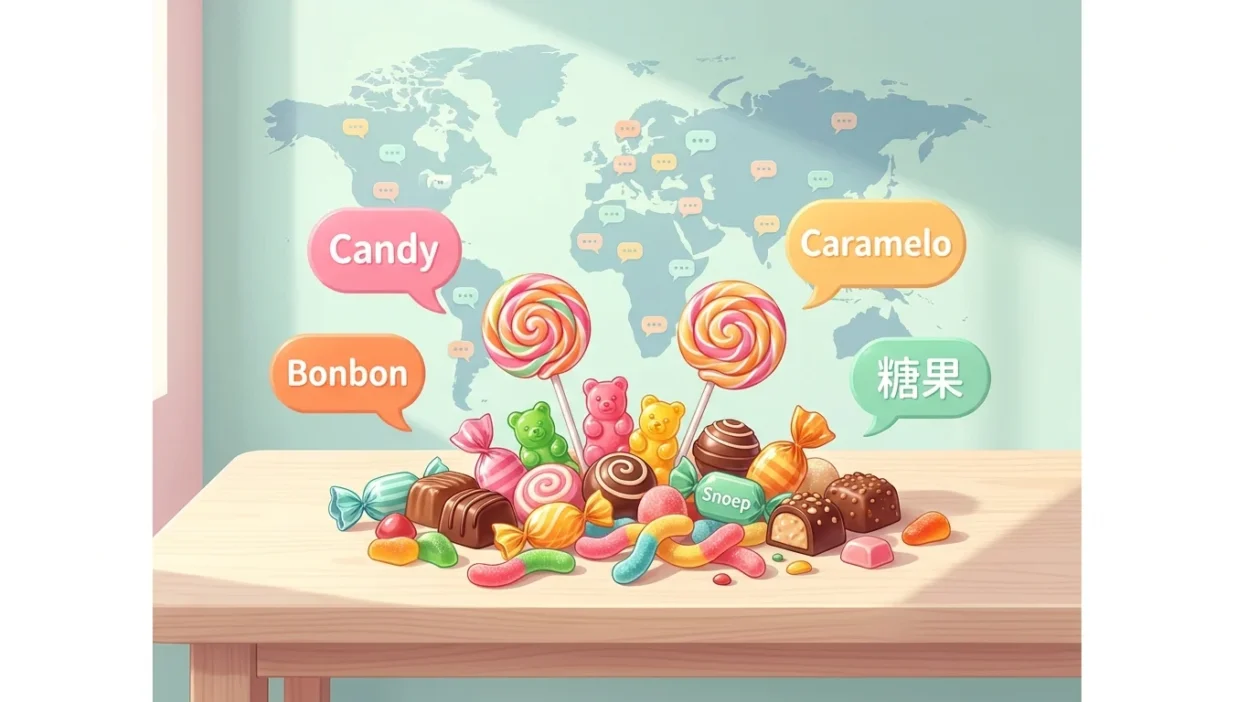
Learning candy in different languages is a sweet way to discover everyday vocabulary, explore food traditions, and make conversations more interesting. Whether you are traveling, learning a new language, or simply curious about how people around the world talk about sweets, this guide gives you useful translations with easy pronunciations and real-life examples.
The word “candy” can mean different things depending on the language. Some languages have a general word for sweets, while others distinguish between hard candy, chocolate, and other treats. This guide focuses mainly on the general meaning of candy or sweets.
If you are searching for candy in different languages in all languages, you will find translations below. Each entry includes the native phrase, an easy English pronunciation, and a short example sentence. These candy in different languages translations are designed to help you understand and use the word naturally.
How to Say Candy in Different Languages
| Language | Native phrase | Easy English pronunciation | Example sentence | English meaning |
| English | Candy | KAN-dee | I bought some candy. | I bought some sweets. |
| Spanish | Caramelo | kah-rah-MEH-loh | Quiero un caramelo. | I want a piece of candy. |
| French | Bonbon | bohn-bohn | J’aime les bonbons. | I like candy. |
| German | Süßigkeit | ZOOS-ig-kite | Ich möchte eine Süßigkeit. | I would like a sweet. |
| Italian | Caramella | kah-rah-MEL-lah | Voglio una caramella. | I want a piece of candy. |
| Portuguese | Doce | DOH-see | Eu quero um doce. | I want a sweet. |
| Dutch | Snoep | snoop | Ik wil snoep. | I want candy. |
| Swedish | Godis | GOO-dis | Jag vill ha godis. | I want candy. |
| Danish | Slik | sleek | Jeg vil have slik. | I want candy. |
| Norwegian | Godteri | goo-TEH-ree | Jeg vil ha godteri. | I want candy. |
| Finnish | Karkki | KAR-kee | Haluan karkkia. | I want candy. |
| Icelandic | Nammi | NAM-mee | Ég vil fá nammi. | I want candy. |
| Irish | Milseán | MIL-shawn | Ba mhaith liom milseán. | I would like a sweet. |
| Welsh | Melysion | meh-LUH-shon | Dw i’n hoffi melysion. | I like sweets. |
| Scottish Gaelic | Siùcairean | SHOO-kee-ruh-n | Tha mi dèidheil air siùcairean. | I like sweets. |
| Basque | Gozoki | goh-SOH-kee | Gozoki bat nahi dut. | I want a sweet. |
| Catalan | Caramel | kah-rah-MEL | Vull un caramel. | I want a piece of candy. |
| Galician | Caramelo | kah-rah-MEH-loh | Quero un caramelo. | I want a piece of candy. |
| Romanian | Bomboană | bom-boh-AH-nuh | Vreau o bomboană. | I want a piece of candy. |
| Polish | Cukierek | tsoo-KYEH-rek | Chcę cukierka. | I want a piece of candy. |
| Czech | Bonbón | bon-BOHN | Chci bonbón. | I want a piece of candy. |
| Slovak | Cukrík | TSOO-kreek | Dám si cukrík. | I’ll have a piece of candy. |
| Slovenian | Bonbon | bon-BON | Rad imam bonbone. | I like candy. |
| Croatian | Bombon | BOM-bon | Želim bombon. | I want a piece of candy. |
| Serbian | Бомбона | bom-BOH-nah | Желим бомбону. | I want a piece of candy. |
| Bosnian | Bombona | bom-BOH-nah | Želim bombonu. | I want a piece of candy. |
| Bulgarian | Бонбон | bon-BON | Искам бонбон. | I want a piece of candy. |
| Macedonian | Бонбона | bom-BOH-nah | Сакам бомбона. | I want a piece of candy. |
| Albanian | Karamele | kah-rah-MEH-leh | Dua një karamele. | I want a piece of candy. |
| Greek | Καραμέλα | kah-rah-MEH-lah | Θέλω μια καραμέλα! | I want a piece of candy! |
| Hungarian | Cukorka | TSOO-kor-kah | Kérek egy cukorkát. | I would like a piece of candy. |
| Estonian | Komm | komm | Ma tahan kommi. | I want candy. |
| Latvian | Konfekte | kon-FEK-teh | Es gribu konfekti. | I want a piece of candy. |
| Lithuanian | Saldainis | sal-DAI-nis | Noriu saldainio. | I want a piece of candy. |
| Russian | Конфета | kon-FYEH-tah | Я хочу конфету. | I want a piece of candy. |
| Ukrainian | Цукерка | tsoo-KER-kah | Я хочу цукерку. | I want a piece of candy. |
| Belarusian | Цукерка | tsoo-KER-kah | Я хачу цукерку. | I want a piece of candy. |
| Armenian | Կոնֆետ | kon-FET | Ես կոնֆետ եմ ուզում։ | I want candy. |
| Georgian | კანფეტი | kan-FEH-tee | მე კანფეტი მინდა! | I want candy! |
| Turkish | Şeker | sheh-KEHR | Bir şeker istiyorum. | I want a piece of candy. |
| Azerbaijani | Konfet | kon-FET | Mən konfet istəyirəm. | I want candy. |
| Kazakh | Кәмпит | kem-PEET | Мен кәмпит қалаймын. | I want candy. |
| Uzbek | Konfet | kon-FET | Men konfet xohlayman. | I want candy. |
| Persian | آبنبات | AAB-nah-baat | من آبنبات میخواهم. | I want candy. |
| Urdu | ٹافی | TAA-fee | مجھے ٹافی چاہیے۔ | I want candy. |
| Hindi | टॉफी | TOH-fee | मुझे टॉफी चाहिए। | I want candy. |
| Bengali | টফি | TOH-fee | আমি টফি চাই। | I want candy. |
| Punjabi | ਟੌਫ਼ੀ | TOH-fee | ਮੈਨੂੰ ਟੌਫ਼ੀ ਚਾਹੀਦੀ ਹੈ। | I want candy. |
| Gujarati | ટોફી | TOH-fee | મારે ટોફી જોઈએ. | I want candy. |
| Marathi | टॉफी | TOH-fee | मला टॉफी हवी आहे. | I want candy. |
| Nepali | मिठाई | mee-THAI | मलाई मिठाई मन पर्छ। | I like sweets. |
| Sinhala | ටොෆි | TOH-fee | මම ටොෆි වලට කැමතියි. | I like candy. |
| Tamil | மிட்டாய் | MIT-taai | எனக்கு மிட்டாய் பிடிக்கும். | I like candy. |
| Telugu | మిఠాయి | mi-THAA-yee | నాకు మిఠాయి ఇష్టం. | I like sweets. |
| Kannada | ಮಿಠಾಯಿ | mi-THAA-yee | ನನಗೆ ಮಿಠಾಯಿ ಇಷ್ಟ. | I like sweets. |
| Malayalam | മിഠായി | mi-thaa-yi | എനിക്ക് മിഠായി ഇഷ്ടമാണ്. | I like sweets. |
| Chinese (Mandarin) | 糖果 | tángguǒ | 我喜欢糖果。 | I like candy. |
| Cantonese | 糖果 | tòhng gwó | 我鍾意食糖果。 | I like eating candy. |
| Japanese | キャンディー | kyan-dī | キャンディーを買いました。 | I bought candy. |
| Korean | 사탕 | sa-tang | 사탕을 샀어요. | I bought candy. |
| Vietnamese | Kẹo | keh-oh | Tôi thích kẹo. | I like candy. |
| Thai | ลูกอม | look-om | ฉันชอบลูกอม | I like candy. |
| Indonesian | Permen | per-men | Saya suka permen. | I like candy. |
| Malay | Gula-gula | goo-lah GOO-lah | Saya suka gula-gula. | I like candy. |
| Filipino | Kendi | KEN-dee | Gusto ko ng kendi. | I like candy. |
| Swahili | Pipi | PEE-pee | Napenda pipi. | I like candy. |
| Afrikaans | Lekkergoed | LEK-er-goot | Ek hou van lekkergoed. | I like candy. |
| Amharic | ከረሜላ | keh-reh-MEH-lah | ከረሜላ እወዳለሁ። | I like candy. |
| Hausa | Alewa | ah-LEH-wah | Ina son alewa. | I like candy. |
| Yoruba | Suukiri | soo-kee-ree | Mo fẹ́ràn suukiri. | I like candy. |
What Does “Candy” Mean in Different Languages?
The English word “candy” usually refers to sweet food made with sugar, often including hard candy, gummies, and other treats. In other languages, the most natural translation may be a word meaning “sweet,” “sweets,” or “sugar treat.”
For example:
- Candy → a general sweet treat.
- Bonbon → a piece of candy in French.
- Snoep → candy or sweets in Dutch.
- Mithai → sweets, often including traditional South Asian desserts.
- 糖果 (tángguǒ) → candy in Mandarin Chinese.
This is why candy in different languages translations are not always one-to-one. The meaning depends on the type of sweet and the language being used.
How to Use “Candy” in Everyday Conversations
You can use these translations when shopping, talking about favorite treats, or offering someone a sweet. Here are a few common examples:
- Asking for candy: “Can I have some candy?”
- Talking about preferences: “I like candy.”
- Buying sweets: “I bought some candy.”
- Offering a treat: “Would you like a piece of candy?”
In many languages, the word changes slightly depending on whether you are talking about one piece, several pieces, or sweets in general.
Candy in Different Languages Around the World
The translations in this guide show how many cultures have their own everyday words for sweet treats. In Europe, you may hear words such as bonbon, snoep, or godis. In South Asia, words like mithai and toffee are common in different contexts. In East Asia, 糖果, キャンディー, and 사탕 are useful examples.
These candy in different languages around the world translations also show that food vocabulary often reflects local traditions. Some languages use a broad word for sweets, while others have separate terms for particular types of candy.
Why Learn Candy in Different Languages?
Learning this simple word can help you:
- Practice everyday vocabulary.
- Order sweets while traveling.
- Understand food labels and conversations.
- Talk about favorite treats with friends.
- Explore how different cultures describe food.
Even a small word like “candy” can make language learning more enjoyable.
Conclusion
Learning candy in different languages is a simple and useful way to expand your vocabulary. Whether you are interested in food, travel, or everyday conversation, these 70 translations can help you recognize and use the word in many languages. Start with a few expressions, practice them in short sentences, and discover how people around the world talk about sweets.
FAQs
What is “candy” in different languages?
“Candy” has different translations depending on the language. Common examples include caramelo in Spanish, bonbon in French, snoep in Dutch, keren in Indonesian, and 糖果 (tángguǒ) in Mandarin Chinese.
How do you say “candy” in different languages?
You can say “candy” in different languages by using the everyday word for sweets or a sweet treat. For example, “caramelo” in Spanish, “bonbon” in French, and “사탕” in Korean.
What is the difference between candy and sweets in different languages?
Some languages use one word for both candy and sweets, while others distinguish between different types of treats. For example, a word may refer to a general sweet, a hard candy, or traditional desserts.
Is “candy” the same in every language?
No. The meaning can vary depending on the language and the type of sweet. Some languages use a broad term for sweets, while others have specific words for candy, toffee, or traditional desserts.
How can I learn more food words in different languages?
You can learn more by studying everyday vocabulary, listening to native speakers, and practicing short conversations. Start with common food words such as “candy,” “chocolate,” “cake,” and “ice cream” in the languages you want to learn.