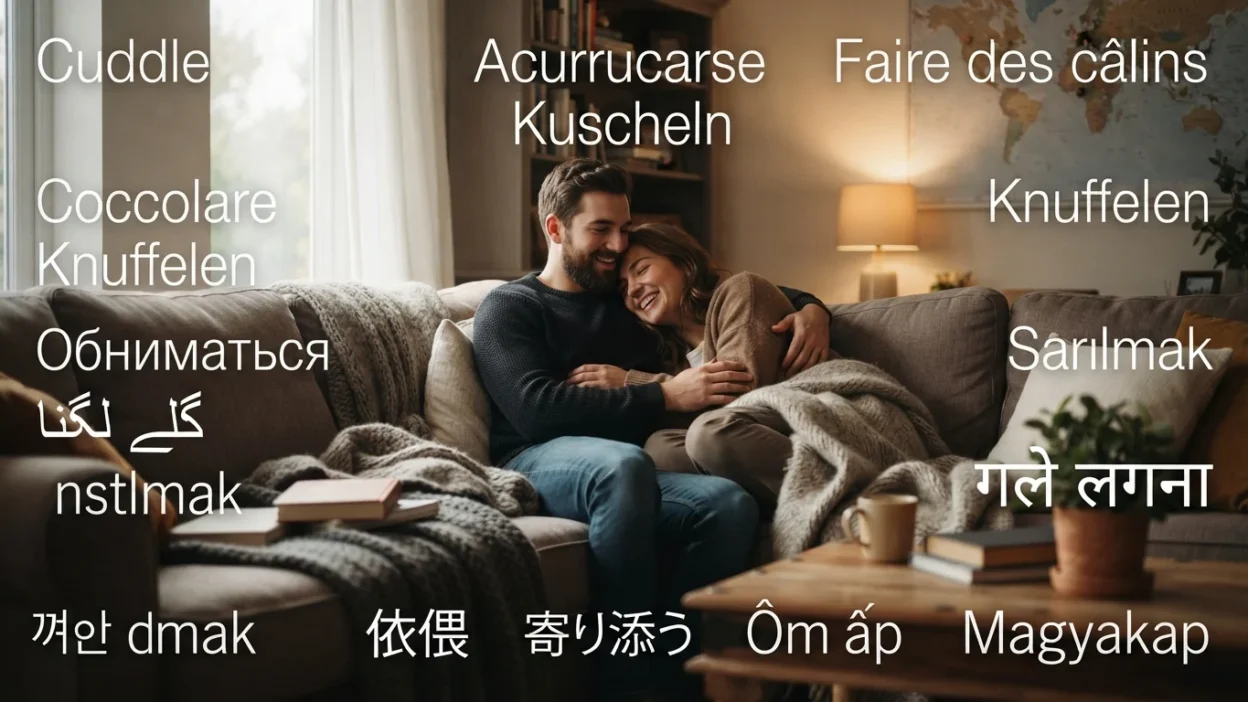
Have you ever wondered how to say “cuddle” in different languages? Cuddling is a warm and affectionate way of showing comfort, closeness, and care. While not every language has one exact word that matches the English verb “cuddle,” most languages have a natural expression for hugging, snuggling, or holding someone affectionately.
In this guide, you will discover cuddle in different languages in all languages, with the native expression, easy English pronunciation, and a short real-life example. This makes the list useful for language learners, couples, families, travelers, writers, and anyone interested in affectionate vocabulary.
Because “cuddle” can mean slightly different things depending on context, the translations below use the closest natural everyday expression for cuddling, snuggling, or holding someone affectionately.
Cuddle in Different Languages
| Language | Native Phrase | Easy English Pronunciation | Example Sentence | English Meaning |
| English | Cuddle | KUD-uhl | I want to cuddle with you. | I want to cuddle with you. |
| Spanish | Acurrucarse | ah-koo-rroo-SAR-seh | Quiero acurrucarme contigo. | I want to cuddle with you. |
| French | Faire des câlins | fair day ka-LAN | J’aime faire des câlins. | I like cuddling. |
| German | Kuscheln | KOOSH-eln | Ich möchte kuscheln. | I want to cuddle. |
| Italian | Coccolare | koh-koh-LAH-reh | Voglio coccolarti. | I want to cuddle you. |
| Portuguese | Aconchegar-se | ah-kon-SHEH-gar-seh | Quero me aconchegar com você. | I want to cuddle with you. |
| Dutch | Knuffelen | KNUF-uh-len | Ik wil knuffelen. | I want to cuddle. |
| Swedish | Myssa | MYS-sah | Jag vill mysa. | I want to cuddle. |
| Danish | Kæle | KAY-leh | Jeg vil gerne kæle. | I would like to cuddle. |
| Norwegian | Kose | KOO-seh | Jeg vil kose. | I want to cuddle. |
| Finnish | Käpertyä | KAP-yer-tyah | Haluan käpertyä viereesi. | I want to snuggle beside you. |
| Icelandic | Kúra | KOO-rah | Mig langar að kúra. | I want to cuddle. |
| Irish | Cuddail | KUD-il | Ba mhaith liom cuddail. | I would like to cuddle. |
| Welsh | Cwtsho | KOOT-shoh | Dw i eisiau cwtsho. | I want to cuddle. |
| Scottish Gaelic | Càilinn | KAH-lin | Tha mi airson dlùthachadh. | I want to snuggle close. |
| Latin | Amplexari | am-plek-SAH-ree | Volo te amplecti. | I want to embrace you. |
| Romanian | A se cuibări | ah seh koo-ee-BAHR-ee | Vreau să mă cuibăresc lângă tine. | I want to snuggle beside you. |
| Greek | Χουχουλιάζω | hoo-hoo-LYAH-zoh | Θέλω να χουχουλιάσω. | I want to cuddle up. |
| Albanian | Përqafohem | per-kah-FO-hem | Dua të përqafohem me ty. | I want to cuddle with you. |
| Basque | Besarkatu | beh-sar-KAH-too | Zurekin besarkatu nahi dut. | I want to cuddle with you. |
| Catalan | Acaronar | ah-kah-roh-NAR | Vull acaronar-te. | I want to cuddle you. |
| Galician | Acaroar | ah-kah-roh-AR | Quero acaroar contigo. | I want to cuddle with you. |
| Polish | Przytulać się | pshi-too-LAHTCH shyeh | Chcę się przytulić. | I want to cuddle. |
| Czech | Mazlit se | MAZ-lit seh | Chci se mazlit. | I want to cuddle. |
| Slovak | Túlať sa | TOO-laht sah | Chcem sa túliť. | I want to cuddle. |
| Slovenian | Crkljati se | TSERK-lyah-tee seh | Rad se crkljam. | I like cuddling. |
| Croatian | Maziti se | MAH-zee-tee seh | Želim se maziti. | I want to cuddle. |
| Serbian | Мазити се | MAH-zee-tee seh | Желим да се мазимо. | I want us to cuddle. |
| Bulgarian | Гушкам се | GOOSH-kam seh | Искам да се гушкаме. | I want us to cuddle. |
| Macedonian | Гушкаме | GOOSH-kah-meh | Сакам да се гушкаме. | I want us to cuddle. |
| Russian | Обниматься | ob-nee-MAHT-sya | Я хочу обниматься. | I want to cuddle. |
| Ukrainian | Обійматися | oh-bee-MAH-ty-sya | Я хочу обійматися. | I want to cuddle. |
| Belarusian | Абдымацца | ab-dih-MAHT-sya | Я хачу абдымацца. | I want to cuddle. |
| Lithuanian | Glamonėtis | glah-moh-NAY-tis | Noriu glamonėtis. | I want to cuddle. |
| Latvian | Mīļoties | MEE-lyoh-ties | Es gribu mīļoties. | I want to cuddle. |
| Estonian | Kallistama | KAH-lis-tah-mah | Ma tahan kallistada. | I want to cuddle. |
| Hungarian | Bújni | BOO-nee | Szeretnék hozzád bújni. | I would like to snuggle up to you. |
| Turkish | Sarılmak | sah-RUL-mahk | Sana sarılmak istiyorum. | I want to cuddle you. |
| Azerbaijani | Qucaqlamaq | goo-JAKH-lah-mahk | Səninlə qucaqlaşmaq istəyirəm. | I want to cuddle with you. |
| Armenian | Գրկախառնվել | grka-khar-NVEL | Ուզում եմ գրկախառնվել։ | I want to cuddle. |
| Georgian | ჩახუტება | cha-khoo-TEH-bah | ჩახუტება მინდა. | I want to cuddle. |
| Persian | در آغوش گرفتن | dar â-GHOOSH geref-TAN | میخواهم تو را در آغوش بگیرم. | I want to hold you in my arms. |
| Arabic | احتضان | ih-ti-DAAN | أريد أن أحتضنك. | I want to hold you close. |
| Hebrew | להתכרבל | le-hit-kar-BEL | אני רוצה להתכרבל. | I want to snuggle up. |
| Urdu | گلے لگنا | galay LAG-na | میں تمہارے ساتھ گلے لگنا چاہتا ہوں۔ | I want to cuddle with you. |
| Hindi | गले लगना | guh-lay LAG-na | मैं तुम्हारे साथ गले लगना चाहता हूँ। | I want to cuddle with you. |
| Bengali | জড়িয়ে ধরা | JO-ri-yeh DHOR-ah | আমি তোমাকে জড়িয়ে ধরতে চাই। | I want to hold you close. |
| Punjabi | ਗਲਵੱਕੜੀ ਪਾਉਣਾ | gal-vak-KREE pa-OO-na | ਮੈਂ ਤੇਰੇ ਨਾਲ ਗਲਵੱਕੜੀ ਪਾਉਣਾ ਚਾਹੁੰਦਾ ਹਾਂ। | I want to cuddle with you. |
| Gujarati | ભેટવું | BHAYT-voo | મારે તમારી સાથે ભેટવું છે. | I want to cuddle with you. |
| Marathi | मिठी मारणे | MI-tee MAAR-nay | मला तुला मिठी मारायची आहे. | I want to hug you. |
| Nepali | अँगालो हाल्नु | AN-ga-loh haal-noo | म तिमीलाई अँगालो हाल्न चाहन्छु। | I want to hold you close. |
| Sinhala | තුරුළු වෙනවා | too-ROO-loh veh-NAH-wah | මට ඔයාට තුරුළු වෙන්න ඕනේ. | I want to cuddle with you. |
| Tamil | அணைத்துக்கொள் | ah-NYTH-too-kol | நான் உன்னை அணைத்துக்கொள்ள விரும்புகிறேன். | I want to cuddle you. |
| Telugu | కౌగిలించుకోవడం | kow-gi-LIN-cho-koh-vah-dam | నేను నిన్ను కౌగిలించుకోవాలనుకుంటున్నాను. | I want to cuddle you. |
| Kannada | ತಬ್ಬಿಕೊಳ್ಳುವುದು | tab-bi-KOL-loo-voo-doo | ನಾನು ನಿನ್ನನ್ನು ತಬ್ಬಿಕೊಳ್ಳಲು ಬಯಸುತ್ತೇನೆ. | I want to cuddle you. |
| Malayalam | കെട്ടിപ്പിടിക്കുക | ket-ti-PI-di-kku-ka | എനിക്ക് നിന്നെ കെട്ടിപ്പിടിക്കണം. | I want to cuddle you. |
| Odia | କୁଣ୍ଢେଇ ଧରିବା | KOON-dhey dhar-EE-ba | ମୁଁ ତୁମକୁ କୁଣ୍ଢେଇ ଧରିବାକୁ ଚାହେଁ। | I want to hold you close. |
| Assamese | সাৱটি ধৰা | SAW-tee dhor-AH | মই তোমাক সাৱটি ধৰিব বিচাৰোঁ। | I want to hold you close. |
| Chinese | 依偎 | YEE-way | 我想和你依偎。 | I want to cuddle with you. |
| Japanese | 寄り添う | yoh-ree-soh-OO | あなたと寄り添いたいです。 | I want to snuggle close to you. |
| Korean | 껴안다 | kkyeo-AN-da | 너를 꼭 껴안고 싶어. | I want to cuddle you. |
| Vietnamese | Ôm ấp | ohm UP | Tôi muốn ôm ấp bạn. | I want to cuddle you. |
| Thai | กอด | GAWT | ฉันอยากกอดคุณ | I want to hug you. |
| Indonesian | Bermanja | ber-MAN-jah | Aku ingin bermanja denganmu. | I want to cuddle affectionately with you. |
| Malay | Bermanja | ber-MAN-jah | Saya mahu bermanja dengan awak. | I want to cuddle affectionately with you. |
| Filipino | Magyakap | mag-YAH-kap | Gusto kong magyakap. | I want to cuddle. |
| Swahili | Kukumbatiana | koo-koom-bah-tee-AH-nah | Nataka kukumbatiana nawe. | I want to cuddle with you. |
| Afrikaans | Knuffel | KNUF-uhl | Ek wil knuffel. | I want to cuddle. |
| Zulu | Ukwangana | oo-kwah-NGAH-nah | Ngifuna ukwanga. | I want to cuddle. |
| Xhosa | Ukuwolana | oo-koo-woh-LAH-nah | Ndifuna ukuwolana nawe. | I want to cuddle with you. |
| Amharic | መተቃቀፍ | meh-teh-TAH-kof | መተቃቀፍ እፈልጋለሁ። | I want to cuddle. |
| Somali | Isku duubid | ISS-koo doo-BID | Waxaan rabaa inaan isku duubno. | I want us to cuddle. |
How to Say Cuddle in Different Languages
If you are searching for how to say cuddle in different languages, there is an important detail to remember: not every language has a single word that perfectly matches the English “cuddle.”
Some languages use words meaning to hug, while others describe snuggling close, holding someone affectionately, or curling up together. For example, Spanish uses acurrucarse, German uses kuscheln, French commonly uses faire des câlins, and Japanese uses 寄り添う (yorisou) for staying close or snuggling together.
This means context matters when choosing the most natural translation.
Cuddle in Different Languages Around the World
Cuddling is a familiar expression of affection in many cultures, but the vocabulary used to describe it varies.
European languages offer words such as kuscheln in German, coccolare in Italian, knuffelen in Dutch, and przytulać się in Polish.
Across Asia, you can find expressions such as 依偎 in Chinese, 寄り添う in Japanese, 껴안다 in Korean, and ôm ấp in Vietnamese.
These differences make cuddle in different languages around the world an interesting example of how languages express emotions and physical closeness.
Cuddle Translations in European Languages
European languages have many expressive words for cuddling and affection.
German kuscheln is commonly associated with cuddling or snuggling. Italian coccolare can express pampering or cuddling affectionately. Spanish acurrucarse refers to curling up or snuggling, while Polish przytulać się describes embracing or cuddling.
The exact meaning can shift slightly depending on the relationship, situation, and sentence.
Cuddle Translations in Asian Languages
Asian languages also have several natural ways to describe affectionate closeness.
Chinese 依偎 (yīwēi) means to lean or snuggle close to someone. Japanese 寄り添う (yorisou) expresses staying close or snuggling beside someone. Korean 껴안다 (kkyeoanda) means to embrace or hold someone closely.
In South Asian languages, expressions involving hugging or embracing are commonly used to communicate the idea of cuddling.
Cuddle vs. Hug: What Is the Difference?
Although cuddle and hug are closely related, they are not always identical.
A hug is usually a brief act of embracing someone. A cuddle often suggests staying close and holding someone for longer, usually in a comfortable or affectionate way.
Because some languages do not distinguish these ideas with separate everyday words, translations may use the closest natural expression for hugging, embracing, or snuggling.
Why Learn Cuddle in Different Languages?
Learning affectionate vocabulary can help you understand everyday conversations and cultural expressions.
It can be useful for:
- Building conversational vocabulary.
- Understanding romantic or family-related expressions.
- Communicating naturally with speakers of another language.
- Reading books, messages, and social conversations.
- Exploring how different cultures express affection.
- Learning useful verbs and phrases.
Conclusion
The word “cuddle” has many interesting translations around the world. Some languages use a direct word for cuddling, while others express the idea through hugging, snuggling, embracing, or staying close.
From acurrucarse in Spanish and kuscheln in German to 依偎 in Chinese and 寄り添う in Japanese, these expressions show how different languages describe warmth, comfort, and affection.
This collection of cuddle in different languages translations is a useful reference for language learners, travelers, writers, and anyone interested in affectionate vocabulary.
FAQs
What is cuddle in different languages?
“Cuddle” can be expressed in many ways. Examples include acurrucarse in Spanish, faire des câlins in French, kuscheln in German, coccolare in Italian, 依偎 in Chinese, and 寄り添う in Japanese.
How do you say cuddle in 10 languages?
You can say acurrucarse in Spanish, faire des câlins in French, kuscheln in German, coccolare in Italian, knuffelen in Dutch, przytulać się in Polish, sarılmak in Turkish, обниматься in Russian, 依偎 in Chinese, and 껴안다 in Korean.
What is cuddle in Asian languages?
Some examples include 依偎 in Chinese, 寄り添う in Japanese, 껴안다 in Korean, ôm ấp in Vietnamese, กอด in Thai, and கட்டிப்பிடித்தல் or related embracing expressions in Tamil.
Is cuddle the same as hug in every language?
No. Some languages have separate words for cuddling, snuggling, and hugging, while others use a broader expression. The most natural translation depends on the context.
Why are cuddle translations different across languages?
Languages describe affection in different ways. Some have a specific word for cuddling, while others use expressions meaning to hug, embrace, snuggle, or stay close to someone.