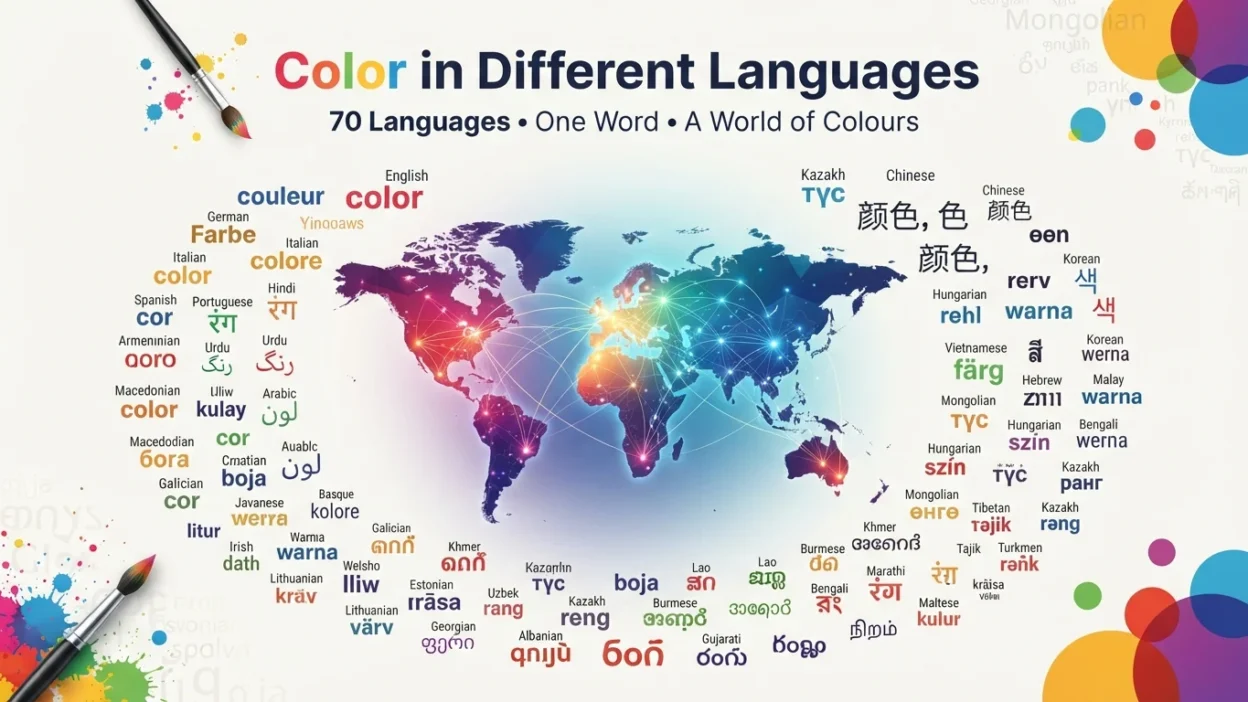
Color is one of the most universal ways people describe the world around them. From the blue of the sky to the green of leaves and the red of a flower, colors help us identify, describe and express what we see every day.
If you want to learn color in different languages, this guide gives you the word for “color” in languages, along with an easy English pronunciation and a short example sentence. It is useful for language learners, travellers, teachers, writers, students and anyone interested in how everyday words change across cultures.
The word “color” is also written as “colour” in British English. Although the spelling is different, the meaning is the same.
Below, you can explore color in different languages in all languages covered in this guide. The table also shows how the word is naturally used in a simple sentence.
Color in Different Languages
| Language | Color in the Language | Easy English Pronunciation | Example Sentence | English Meaning |
| English | color | KUH-lur | I like the color blue. | I like the blue colour. |
| Spanish | color | koh-LOR | Me gusta el color azul. | I like the colour blue. |
| French | couleur | koo-LUR | J’aime la couleur bleue. | I like the colour blue. |
| German | Farbe | FAR-buh | Die Farbe ist schön. | The colour is beautiful. |
| Italian | colore | koh-LOH-reh | Mi piace questo colore. | I like this colour. |
| Portuguese | cor | kor | Eu gosto desta cor. | I like this colour. |
| Dutch | kleur | klur | Ik vind deze kleur mooi. | I think this colour is beautiful. |
| Swedish | färg | fairg | Jag gillar den här färgen. | I like this colour. |
| Norwegian | farge | FAR-geh | Jeg liker denne fargen. | I like this colour. |
| Danish | farve | FAR-vuh | Jeg kan lide denne farve. | I like this colour. |
| Finnish | väri | VAIR-ee | Pidän tästä väristä. | I like this colour. |
| Icelandic | litur | LEE-tur | Mér líkar þessi litur. | I like this colour. |
| Irish | dath | dah | Is maith liom an dath seo. | I like this colour. |
| Welsh | lliw | hlee-oo | Rwy’n hoffi’r lliw hwn. | I like this colour. |
| Polish | kolor | KOH-lor | Lubię ten kolor. | I like this colour. |
| Czech | barva | BAR-va | Líbí se mi tato barva. | I like this colour. |
| Slovak | farba | FAR-ba | Páči sa mi táto farba. | I like this colour. |
| Slovenian | barva | BAR-va | Všeč mi je ta barva. | I like this colour. |
| Croatian | boja | BOH-ya | Sviđa mi se ova boja. | I like this colour. |
| Serbian | боја (boja) | BOH-ya | Sviđa mi se ova boja. | I like this colour. |
| Bosnian | boja | BOH-ya | Sviđa mi se ova boja. | I like this colour. |
| Bulgarian | цвят (tsvyat) | TSVYAT | Харесвам този цвят. | I like this colour. |
| Romanian | culoare | koo-LOA-reh | Îmi place această culoare. | I like this colour. |
| Hungarian | szín | seen | Tetszik ez a szín. | I like this colour. |
| Greek | χρώμα (chróma) | KROH-ma | Μου αρέσει αυτό το χρώμα. | I like this colour. |
| Albanian | ngjyrë | NJYUR-uh | Më pëlqen kjo ngjyrë. | I like this colour. |
| Russian | цвет (tsvet) | TSVYET | Мне нравится этот цвет. | I like this colour. |
| Ukrainian | колір (kolir) | KOH-leer | Мені подобається цей колір. | I like this colour. |
| Belarusian | колер (koler) | KOH-ler | Мне падабаецца гэты колер. | I like this colour. |
| Lithuanian | spalva | SPAHL-va | Man patinka ši spalva. | I like this colour. |
| Latvian | krāsa | KRAA-sa | Man patīk šī krāsa. | I like this colour. |
| Estonian | värv | VAIRV | Mulle meeldib see värv. | I like this colour. |
| Turkish | renk | renk | Bu rengi seviyorum. | I like this colour. |
| Azerbaijani | rəng | RENG | Mən bu rəngi sevirəm. | I like this colour. |
| Georgian | ფერი (peri) | PEH-ree | მე მომწონს ეს ფერი. | I like this colour. |
| Armenian | գույն (guyn) | GOON | Ինձ դուր է գալիս այս գույնը։ | I like this colour. |
| Arabic | لون (lawn) | LAWN | أحب هذا اللون. | I like this colour. |
| Hebrew | צבע (tzeva) | TSEH-va | אני אוהב את הצבע הזה. | I like this colour. |
| Persian | رنگ (rang) | RANG | من این رنگ را دوست دارم. | I like this colour. |
| Urdu | رنگ (rang) | RUNG | مجھے یہ رنگ پسند ہے۔ | I like this colour. |
| Hindi | रंग (rang) | RUNG | मुझे यह रंग पसंद है। | I like this colour. |
| Bengali | রং (rong) | RONG | আমার এই রংটি পছন্দ। | I like this colour. |
| Punjabi | ਰੰਗ (rang) | RUNG | ਮੈਨੂੰ ਇਹ ਰੰਗ ਪਸੰਦ ਹੈ। | I like this colour. |
| Gujarati | રંગ (rang) | RUNG | મને આ રંગ ગમે છે. | I like this colour. |
| Marathi | रंग (rang) | RUNG | मला हा रंग आवडतो. | I like this colour. |
| Nepali | रङ्ग (ranga) | RUNG-ga | मलाई यो रङ्ग मन पर्छ। | I like this colour. |
| Sinhala | වර්ණය (warna) | WAR-nuh | මම මේ වර්ණයට කැමතියි. | I like this colour. |
| Tamil | நிறம் (niRam) | NEE-rum | எனக்கு இந்த நிறம் பிடிக்கும். | I like this colour. |
| Telugu | రంగు (rangu) | RUNG-goo | నాకు ఈ రంగు ఇష్టం. | I like this colour. |
| Kannada | ಬಣ್ಣ (baṇṇa) | BUN-na | ನನಗೆ ಈ ಬಣ್ಣ ಇಷ್ಟ. | I like this colour. |
| Malayalam | നിറം (niRam) | NEE-rum | എനിക്ക് ഈ നിറം ഇഷ്ടമാണ്. | I like this colour. |
| Chinese | 颜色 (yánsè) | YEN-suh | 我喜欢这个颜色。 | I like this colour. |
| Japanese | 色 (iro) | EE-roh | 私はこの色が好きです。 | I like this colour. |
| Korean | 색 (saek) | SAYK | 저는 이 색을 좋아해요. | I like this colour. |
| Vietnamese | màu sắc | mow sak | Tôi thích màu này. | I like this colour. |
| Thai | สี (sǐ) | SEE | ฉันชอบสีนี้ | I like this colour. |
| Indonesian | warna | WAR-na | Saya suka warna ini. | I like this colour. |
| Malay | warna | WAR-na | Saya suka warna ini. | I like this colour. |
| Filipino | kulay | KOO-lay | Gusto ko ang kulay na ito. | I like this colour. |
| Khmer | ពណ៌ (pon) | PON | ខ្ញុំចូលចិត្តពណ៌នេះ។ | I like this colour. |
| Burmese | အရောင် (a-yaung) | UH-YAUNG | ဒီအရောင်ကို ကြိုက်တယ်။ | I like this colour. |
| Mongolian | өнгө (ünge) | OON-geh | Би энэ өнгөнд дуртай. | I like this colour. |
| Swahili | rangi | RANG-ee | Napenda rangi hii. | I like this colour. |
| Zulu | umbala | oom-BAH-la | Ngiyawuthanda lo mbala. | I like this colour. |
| Afrikaans | kleur | klur | Ek hou van hierdie kleur. | I like this colour. |
| Amharic | ቀለም (qelem) | KEH-lem | ይህን ቀለም እወዳለሁ። | I like this colour. |
| Somali | midab | MEE-dab | Waxaan jeclahay midabkan. | I like this colour. |
| Yoruba | àwọ̀ | ah-WOH | Mo fẹ́ràn àwọ̀ yìí. | I like this colour. |
| Hausa | launi | LOW-nee | Ina son wannan launi. | I like this colour. |
| Latin | color | KOH-lor | Hunc colorem amo. | I like this colour. |
What Does “Color” Mean?
“Color” refers to the visual quality that people perceive from light. It helps us describe the appearance of objects, places, clothing, food, nature and many other things.
Common colours include red, blue, green, yellow, orange, purple, pink, brown, black, white and grey.
The word can also be used in a figurative way. For example, someone may say that a story “adds colour” to an experience, meaning that it makes the experience more interesting or vivid.
In British English, the usual spelling is colour, while American English generally uses color.
How Do You Say “Color” in Different Languages?
The answer changes depending on the language.
For example, Spanish uses color, French uses couleur, German uses Farbe, Italian uses colore, and Portuguese uses cor.
In several South Asian languages, including Hindi, Urdu, Bengali, Punjabi, Gujarati and Marathi, related forms of rang are commonly used.
East Asian languages have their own distinct forms. Chinese uses 颜色, Japanese uses 色, and Korean uses 색.
This variety makes color in different languages an interesting example of how everyday vocabulary differs across language families.
Color in Different Languages Around the World
The word for color appears in many different forms around the world.
European languages show a wide range of vocabulary. Some languages have words that look related, such as English “color”, Spanish “color”, Italian “colore” and Latin “color”. Other languages use completely different forms, such as German “Farbe” and French “couleur”.
Across Asia, words such as Hindi रंग, Urdu رنگ, Persian رنگ, Chinese 颜色, Japanese 色 and Korean 색 demonstrate the linguistic diversity of the continent.
African languages also have distinctive words for color. For example, Swahili uses rangi, Zulu uses umbala, Afrikaans uses kleur, and Yoruba uses àwọ̀.
Why Does “Color” Look Different Across Languages?
Languages develop independently over long periods, so the same idea can have completely different words.
Some words have historical connections. English “color”, for example, is related to Latin color through historical language development. Other languages have developed or preserved entirely different vocabulary.
Pronunciation can also change significantly between languages. A word may look familiar when written in Latin script but sound quite different when spoken.
This is why learning color in different languages translations can provide a useful introduction to vocabulary, pronunciation and language families.
Color vs Colour: What Is the Difference?
“Color” and “colour” have exactly the same basic meaning.
Color is the standard spelling in American English, while colour is commonly used in British English and many other varieties of English.
For example:
- American English: The colour of the car is blue.
- British English: The colour of the car is blue.
The pronunciation is essentially the same. The difference is mainly a matter of spelling convention.
How to Use the Word “Color” in Everyday Conversation
The word “color” is commonly used when describing objects and their appearance.
Here are some simple examples:
- What color is your car?
- I like the color of this shirt.
- This room needs more colour.
- Which colour do you prefer?
- The flowers have bright colours.
- The colour of the sky is beautiful.
When learning the word in another language, it is useful to memorise it together with a short sentence rather than learning the word alone.
Common Colour Words to Learn Next
Once you know how to say “color”, you can expand your vocabulary by learning individual colour names.
Some of the most useful are:
- Red
- Blue
- Green
- Yellow
- Orange
- Purple
- Pink
- Brown
- Black
- White
- Grey
- Gold
- Silver
Learning these words alongside “color” can make it easier to describe clothing, objects, food, artwork and places when speaking another language.
Tips for Learning Color Translations
Start with the languages that are most relevant to you. Learning a few words well is usually more useful than memorising a long list without practising them.
Pay attention to pronunciation as well as spelling. Languages such as Chinese, Japanese, Korean and Arabic use writing systems that may be unfamiliar to English speakers.
It can also help to write the word, say it aloud and use it in a simple sentence. Repeating the word in context makes it easier to remember.
Finally, remember that a dictionary translation may have slightly different grammatical forms depending on how the word is used in a sentence.
Color in All Languages: A Quick Overview
There is no single universal word for color. The translation depends on the language, writing system, grammar and historical development of each language.
In some languages, the word may resemble English or another European language. In others, the word may look and sound completely different.
The translations above give you a broad view of how to say color in different languages and show how the same everyday concept is expressed around the world.
Conclusion
Learning color in different languages is a simple way to explore global vocabulary and discover how languages express everyday ideas differently. From Spanish “color” and French “couleur” to Hindi “रंग”, Chinese “颜色” and Japanese “色”, each translation reflects the unique structure and history of its language.
Whether you are studying languages, travelling, teaching or simply exploring words from around the world, these 70 translations provide a useful starting point for understanding colour vocabulary across different cultures.
FAQs
1. How do you say “color” in different languages?
“Color” has different translations depending on the language. Examples include Spanish color, French couleur, German Farbe, Italian colore, Hindi रंग, Chinese 颜色, Japanese 色 and Korean 색.
2. What is the word for color in Spanish?
The Spanish word for color is color. It is pronounced approximately “koh-LOR”.
3. How do you say color in Hindi and Urdu?
In Hindi, color is रंग (rang). In Urdu, it is رنگ (rang). Both words are commonly associated with the idea of colour or hue.
4. What is color called in Chinese and Japanese?
In Chinese, color is 颜色 (yánsè). In Japanese, the common word is 色 (iro).
5. Is “color” or “colour” correct?
Both are correct. Color is the standard American English spelling, while colour is the standard spelling in British English and many other English varieties.