Chicken is one of the most familiar foods and farm animals around the world. Whether you are travelling, learning a new language, ordering food at a restaurant, or simply exploring international vocabulary, knowing how to say chicken in different languages can be surprisingly useful.
The word “chicken” can refer to the bird itself or, depending on the language and context, chicken meat used as food. Because languages make this distinction differently, some translations can have more than one common form.
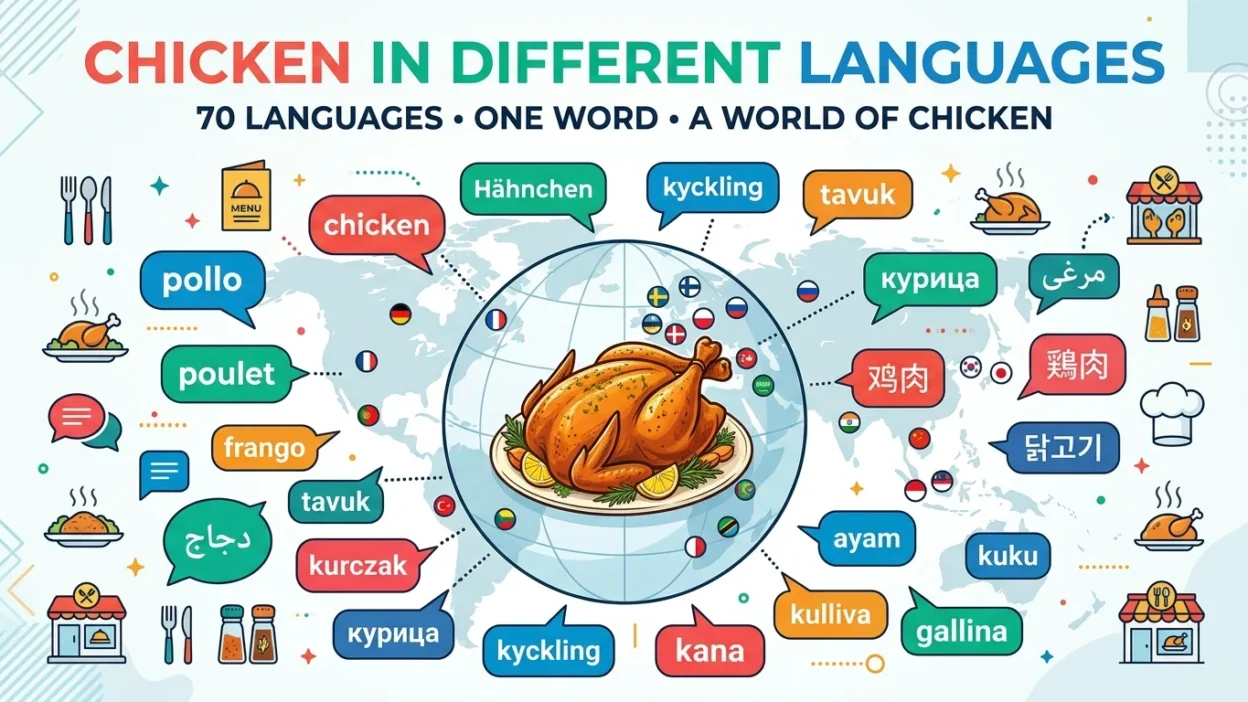
In this guide, you will discover chicken in different languages in all languages covered below, including the native word, an easy English pronunciation, a short everyday sentence, and its English meaning.
Chicken in Different Languages
| Language | Chicken in the Language | Easy English Pronunciation | Example Sentence | English Meaning |
| English | chicken | CHIK-en | I cooked chicken for dinner. | I cooked chicken for dinner. |
| Spanish | pollo | POH-yoh | Comí pollo con arroz. | I ate chicken with rice. |
| French | poulet | poo-LAY | J’aime le poulet grillé. | I like grilled chicken. |
| German | Hähnchen | HEN-shen | Ich esse gern Hähnchen. | I like eating chicken. |
| Italian | pollo | POL-loh | Mi piace il pollo. | I like chicken. |
| Portuguese | frango | FRAN-go | Eu gosto de frango assado. | I like roasted chicken. |
| Dutch | kip | kip | Ik eet vanavond kip. | I am eating chicken tonight. |
| Russian | курица | koo-REE-tsa | Я готовлю курицу. | I am cooking chicken. |
| Ukrainian | курка | KOOR-ka | Я люблю курку. | I love chicken. |
| Polish | kurczak | KOOR-chak | Jem kurczaka na obiad. | I eat chicken for lunch. |
| Czech | kuře | KOO-rzheh | Dnes jím kuře. | I am eating chicken today. |
| Slovak | kurča | KOOR-cha | Varím kurča dnes. | I am cooking chicken today. |
| Hungarian | csirke | CHEER-keh | Szeretem a csirkét. | I like chicken. |
| Romanian | pui | POO-ee | Mănânc pui azi. | I am eating chicken today. |
| Greek | κοτόπουλο | koh-TOH-poo-loh | Μου αρέσει το κοτόπουλο. | I like chicken. |
| Turkish | tavuk | ta-VOOK | Tavuk yiyorum. | I am eating chicken. |
| Arabic | دجاج | da-JAJ | أحب الدجاج. | I like chicken. |
| Hebrew | עוף | ohf | אני אוהב עוף. | I like chicken. |
| Persian | مرغ | MORGH | من مرغ دوست دارم. | I like chicken. |
| Hindi | मुर्गा | MOOR-ga | मैंने मुर्गा पकाया। | I cooked chicken. |
| Urdu | مرغی | MOOR-ghee | میں نے مرغی پکائی۔ | I cooked chicken. |
| Punjabi | ਮੁਰਗ਼ੀ | MOOR-ghee | ਮੈਨੂੰ ਮੁਰਗ਼ੀ ਪਸੰਦ ਹੈ। | I like chicken. |
| Bengali | মুরগি | MOOR-gee | আমি মুরগি খাই। | I eat chicken. |
| Tamil | கோழி | KOH-zhee | நான் கோழி சாப்பிடுகிறேன். | I am eating chicken. |
| Telugu | కోడి | KOH-dee | నేను కోడి తింటాను. | I eat chicken. |
| Kannada | ಕೋಳಿ | KOH-lee | ನಾನು ಕೋಳಿ ತಿನ್ನುತ್ತೇನೆ. | I eat chicken. |
| Malayalam | കോഴി | KOH-zhee | ഞാൻ കോഴി കഴിക്കുന്നു. | I am eating chicken. |
| Sinhala | කුකුල් මස් | KOO-kul mas | මම කුකුල් මස් කනවා. | I eat chicken. |
| Thai | ไก่ | GAI | ฉันกินไก่ | I eat chicken. |
| Vietnamese | gà | gah | Tôi ăn gà. | I eat chicken. |
| Indonesian | ayam | AH-yam | Saya makan ayam. | I eat chicken. |
| Malay | ayam | AH-yam | Saya suka ayam. | I like chicken. |
| Filipino | manok | MA-nok | Kumakain ako ng manok. | I am eating chicken. |
| Chinese | 鸡肉 | jee-ROH | 我喜欢鸡肉。 | I like chicken. |
| Japanese | 鶏肉 | toh-ree-NEE-koo | 鶏肉が好きです。 | I like chicken. |
| Korean | 닭고기 | dalk-GOH-gee | 저는 닭고기를 좋아해요. | I like chicken. |
| Mongolian | тахиа | ta-HEE-ah | Би тахиа иддэг. | I eat chicken. |
| Nepali | कुखुरा | koo-KHOO-ra | मलाई कुखुरा मन पर्छ। | I like chicken. |
| Swahili | kuku | KOO-koo | Ninakula kuku. | I eat chicken. |
| Zulu | inkukhu | in-KOO-koo | Ngidla inkukhu. | I eat chicken. |
| Afrikaans | hoender | HOON-der | Ek eet hoender. | I eat chicken. |
| Somali | digaag | dee-GAAG | Waxaan cunaa digaag. | I eat chicken. |
| Amharic | ዶሮ | DOH-roh | ዶሮ እወዳለሁ። | I like chicken. |
| Yoruba | adìẹ | ah-DEE-yeh | Mo fẹ́ràn adìẹ. | I like chicken. |
| Igbo | okuko | oh-KOO-koh | Ana m eri okuko. | I eat chicken. |
| Hausa | kaza | KA-za | Ina cin kaza. | I eat chicken. |
| Malagasy | akoho | ah-KOH-hoh | Mihinana akoho aho. | I eat chicken. |
| Maori | heihei | HAY-hay | Ka kai au i te heihei. | I eat chicken. |
| Hawaiian | moa | MOH-ah | ʻAi au i ka moa. | I eat chicken. |
| Samoan | moa | MOH-ah | Ou te ʻai moa. | I eat chicken. |
| Fijian | toa | TOH-ah | Au kania toa. | I eat chicken. |
| Estonian | kana | KAH-na | Ma söön kana. | I eat chicken. |
| Latvian | vista | VIS-ta | Es ēdu vistu. | I eat chicken. |
| Lithuanian | vištiena | vish-TEE-eh-na | Aš valgau vištieną. | I eat chicken. |
| Finnish | kana | KAH-na | Syön kanaa. | I eat chicken. |
| Swedish | kyckling | SHOOK-ling | Jag äter kyckling. | I eat chicken. |
| Norwegian | kylling | SHILL-ing | Jeg spiser kylling. | I eat chicken. |
| Danish | kylling | KOO-ling | Jeg spiser kylling. | I eat chicken. |
| Icelandic | kjúklingur | KYOOK-ling-ur | Ég borða kjúkling. | I eat chicken. |
| Basque | oilasko | oy-LAHS-koh | Oilaskoa jaten dut. | I eat chicken. |
| Catalan | pollastre | poh-LYAS-treh | Menjo pollastre. | I eat chicken. |
| Galician | polo | POH-loh | Como polo. | I eat chicken. |
| Irish | sicín | shi-KEEN | Ithim sicín. | I eat chicken. |
| Welsh | cyw iâr | KOO yaar | Rwy’n bwyta cyw iâr. | I eat chicken. |
| Scottish Gaelic | cearc | kyark | Ith mi cearc. | I eat chicken. |
| Albanian | pulë | POO-leh | Ha pulë sot. | I eat chicken today. |
| Serbian | piletina | pee-leh-TEE-na | Jedem piletinu. | I eat chicken. |
| Croatian | piletina | pee-leh-TEE-na | Volim piletinu. | I like chicken. |
| Slovenian | piščanec | PISH-cha-nets | Rad imam piščanca. | I like chicken. |
| Georgian | ქათამი | KA-ta-mee | მე ქათამი მიყვარს. | I like chicken. |
The table uses commonly encountered vocabulary, but some languages distinguish between the bird, a live chicken, and chicken meat. For example, dictionaries may list different forms depending on the intended meaning.
How Do You Say “Chicken” in Different Languages?
The translation of chicken varies widely across languages.
Some European languages have words that may look or sound familiar to learners of related languages. Spanish uses pollo, Italian also uses pollo, Portuguese uses frango, French uses poulet, and Dutch uses kip.
Slavic languages show another interesting pattern. Russian uses курица, Ukrainian uses курка, Polish uses kurczak, Czech uses kuře, and Slovak uses kurča.
In South Asia, you can find a completely different range of words. Hindi uses मुर्गा, Urdu commonly uses مرغی, Bengali uses মুরগি, Punjabi uses ਮੁਰਗ਼ੀ, and Nepali uses कुखुरा.
East and Southeast Asia also have distinctive vocabulary. Chinese uses 鸡肉 for chicken meat, Japanese uses 鶏肉, Korean uses 닭고기, Thai uses ไก่, Vietnamese uses gà, and Indonesian and Malay both commonly use ayam.
Chicken in Different Languages Around the World
Chicken is eaten in many parts of the world, making its vocabulary particularly useful for travellers and language learners.
If you are visiting a restaurant in another country, knowing the local word for chicken can make ordering food much easier. It can also help when reading menus, shopping for ingredients or asking about a particular dish.
The word may also change according to context. A language can have one term for the live bird and another for the meat used in cooking. This is especially important when translating food-related vocabulary.
Chicken as a Bird vs Chicken as Food
English uses the same word, chicken, for both the bird and its meat.
For example:
- “The chicken is walking in the garden.” refers to the animal.
- “I ordered chicken for dinner.” refers to the food.
Other languages may make this distinction more clearly.
For example, Chinese commonly uses 鸡 for the bird and 鸡肉 for chicken meat. Japanese similarly distinguishes 鶏 from 鶏肉.
This is an important point when searching for chicken in different languages translations, because the most appropriate translation depends on what you actually mean.
Chicken Vocabulary for Travelling
Knowing how to say chicken can be especially useful when travelling.
Restaurants, cafés, supermarkets and food markets may use the local language rather than English. A simple word can help you recognise chicken dishes on a menu.
Useful related English phrases include:
- Chicken soup
- Fried chicken
- Grilled chicken
- Roast chicken
- Chicken sandwich
- Chicken rice
- Chicken curry
- Chicken salad
- Chicken wings
- Chicken breast
Learning the local word for chicken alongside these phrases can make food-related conversations much easier.
Why Learn Chicken in Different Languages?
There are several reasons to learn this simple word.
First, it is common vocabulary. Chicken appears frequently in conversations about food, cooking, restaurants and shopping.
Second, it is easy to practise. Once you learn the word, you can immediately create simple sentences such as “I like chicken” or “I am cooking chicken.”
Third, comparing translations can help you understand how languages differ. Some languages have related vocabulary, while others use completely different words.
Finally, it is a practical word for travellers. Knowing basic food vocabulary can make everyday communication more comfortable.
Common Chicken Words in Major Languages
Some of the most recognisable translations include:
- English — chicken
- Spanish — pollo
- French — poulet
- German — Hähnchen
- Italian — pollo
- Portuguese — frango
- Turkish — tavuk
- Arabic — دجاج
- Hindi — मुर्गा
- Urdu — مرغی
- Chinese — 鸡肉
- Japanese — 鶏肉
- Korean — 닭고기
- Thai — ไก่
- Indonesian — ayam
- Swahili — kuku
These examples show how dramatically the same everyday concept can change from one language to another.
How to Remember Chicken Translations
A good way to remember new vocabulary is to connect each word with an image or a sentence.
For example, imagine a plate of grilled chicken while learning the French word poulet. Then say a short sentence using it.
You can also group languages together. Learning Spanish and Italian side by side may help you notice similarities, while comparing English with Japanese or Arabic can show how different language systems can be.
Writing the word down, reading it aloud and using it repeatedly will also improve recall.
Chicken in All Languages: A Quick Guide
There is no single universal translation for chicken. Every language has developed its own vocabulary, and some languages use different terms for the bird and the meat.
The translations in this guide provide a broad overview of chicken in all languages represented here. They are useful for language learners, travellers, food enthusiasts and anyone interested in international vocabulary.
Whether you want to know how to say chicken in different languages, compare chicken translations, or explore how people talk about chicken around the world, this list gives you a practical starting point.
Conclusion
Learning chicken in different languages is a simple way to expand your everyday vocabulary and explore linguistic diversity. From Spanish pollo and French poulet to Hindi मुर्गा, Chinese 鸡肉, Japanese 鶏肉, Indonesian ayam and Swahili kuku, the word takes many fascinating forms around the world.
The next time you travel, order food or study a new language, knowing this simple word can help you communicate more confidently.
FAQs
1. How do you say “chicken” in different languages?
“Chicken” has many different translations. Some common examples are pollo in Spanish and Italian, poulet in French, frango in Portuguese, tavuk in Turkish, ayam in Indonesian and Malay, and kuku in Swahili.
2. What is chicken called in Spanish?
Chicken is commonly called pollo in Spanish. The word is widely used when talking about chicken as food.
3. How do you say chicken in Hindi and Urdu?
In Hindi, common words include मुर्गा (murga) and other context-specific forms. In Urdu, مرغی (murghi) is commonly used for a hen or chicken, while vocabulary can vary depending on whether the speaker means the bird or the meat.
4. What is chicken called in Chinese and Japanese?
In Chinese, 鸡肉 (jīròu) means chicken meat, while 鸡 (jī) refers to the chicken or bird more generally. In Japanese, 鶏肉 (toriniku) means chicken meat, while 鶏 (niwatori) refers to a chicken.
5. Which languages use a similar word for chicken?
Several languages have words that are historically or linguistically related, while others do not. Spanish and Italian both use pollo, Indonesian and Malay use ayam, and Swedish, Norwegian and Danish use closely related forms of kyckling/kylling.