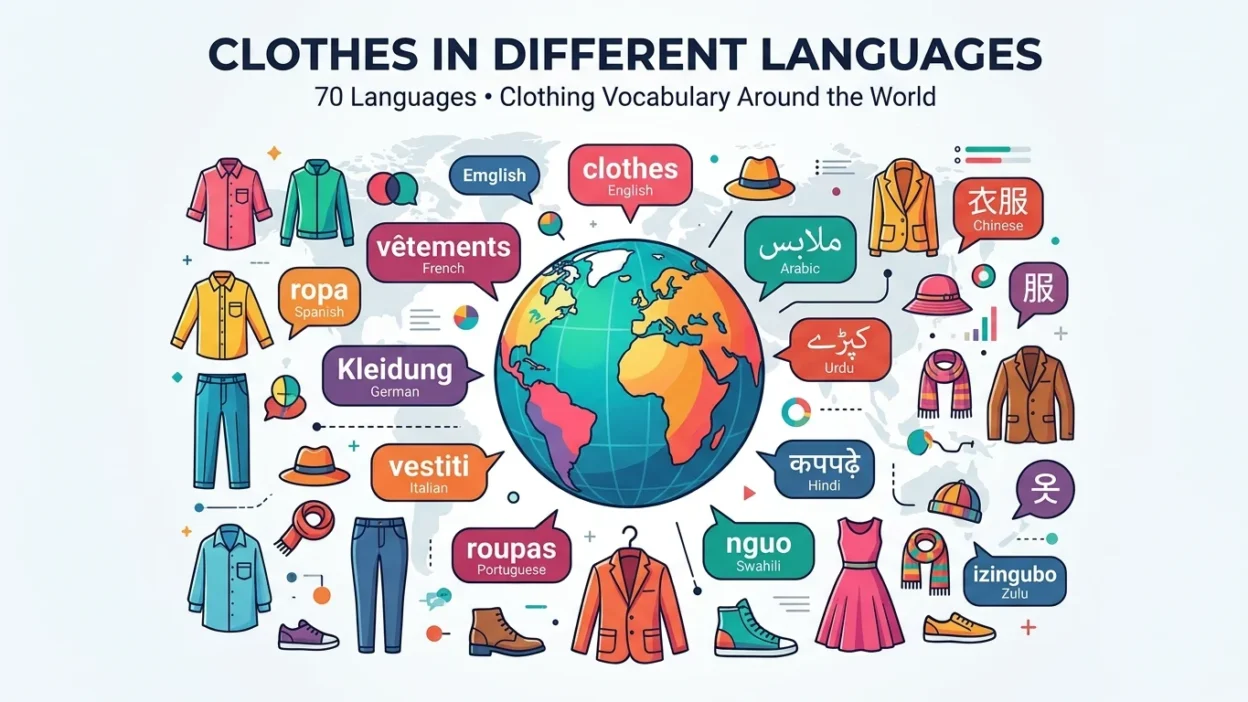
Clothes are part of everyday life in every culture. We wear them for comfort, work, celebrations, travel, sport and personal expression. Because clothing is universal, the word for “clothes” is also a useful vocabulary word to learn when studying a new language.
If you are searching for clothes in different languages, this guide gives you exactly translations, together with easy English pronunciations and short real-life examples. It is designed to make the vocabulary easy to understand, remember and use in everyday conversations.
The translation of “clothes” can vary considerably from one language to another. Some languages use a plural word, while others may use a collective or general term for clothing. The examples below show natural ways to understand and use each word.
Clothes in Different Languages
| Language | Clothes in the Language | Easy English Pronunciation | Example Sentence | English Meaning |
| English | clothes | klohz | My clothes are clean. | My clothes are clean. |
| Spanish | ropa | ROH-pa | Mi ropa está limpia. | My clothes are clean. |
| French | vêtements | vet-MAHN | Mes vêtements sont propres. | My clothes are clean. |
| German | Kleidung | KLY-dung | Meine Kleidung ist sauber. | My clothes are clean. |
| Italian | vestiti | veh-STEE-tee | I miei vestiti sono puliti. | My clothes are clean. |
| Portuguese | roupas | ROH-pas | Minhas roupas estão limpas. | My clothes are clean. |
| Dutch | kleren | KLAY-ren | Mijn kleren zijn schoon. | My clothes are clean. |
| Swedish | kläder | KLAIR-er | Mina kläder är rena. | My clothes are clean. |
| Norwegian | klær | klair | Klærne mine er rene. | My clothes are clean. |
| Danish | tøj | toy | Mit tøj er rent. | My clothes are clean. |
| Finnish | vaatteet | VAA-teht | Vaatteeni ovat puhtaat. | My clothes are clean. |
| Icelandic | föt | fuht | Fötin mín eru hrein. | My clothes are clean. |
| Irish | éadaí | AY-dee | Tá mo chuid éadaí glan. | My clothes are clean. |
| Welsh | dillad | DILL-ad | Mae fy nillad yn lân. | My clothes are clean. |
| Polish | ubrania | oo-BRAH-nya | Moje ubrania są czyste. | My clothes are clean. |
| Czech | oblečení | ob-leh-CHEH-nee | Moje oblečení je čisté. | My clothes are clean. |
| Slovak | oblečenie | ob-leh-CHEH-nyeh | Moje oblečenie je čisté. | My clothes are clean. |
| Slovenian | oblačila | ob-LA-chee-la | Moja oblačila so čista. | My clothes are clean. |
| Croatian | odjeća | OD-yeh-cha | Moja odjeća je čista. | My clothes are clean. |
| Serbian | одећа | oh-DEH-cha | Моја одећа је чиста. | My clothes are clean. |
| Bosnian | odjeća | OD-yeh-cha | Moja odjeća je čista. | My clothes are clean. |
| Bulgarian | дрехи | DREH-hee | Дрехите ми са чисти. | My clothes are clean. |
| Romanian | haine | HAI-neh | Hainele mele sunt curate. | My clothes are clean. |
| Hungarian | ruhák | ROO-hahk | A ruháim tiszták. | My clothes are clean. |
| Greek | ρούχα | ROO-ha | Τα ρούχα μου είναι καθαρά. | My clothes are clean. |
| Albanian | rroba | ROH-ba | Rrobat e mia janë të pastra. | My clothes are clean. |
| Russian | одежда | ah-DYEZH-da | Моя одежда чистая. | My clothes are clean. |
| Ukrainian | одяг | OH-dyah | Мій одяг чистий. | My clothes are clean. |
| Belarusian | адзенне | ah-DZEN-neh | Маё адзенне чыстае. | My clothes are clean. |
| Lithuanian | drabužiai | dra-boo-ZHY-eye | Mano drabužiai švarūs. | My clothes are clean. |
| Latvian | drēbes | DRAY-bes | Manas drēbes ir tīras. | My clothes are clean. |
| Estonian | riided | REE-dehd | Minu riided on puhtad. | My clothes are clean. |
| Turkish | kıyafetler | kuh-ya-FET-ler | Kıyafetlerim temiz. | My clothes are clean. |
| Azerbaijani | paltarlar | pahl-tar-LAR | Paltarlarım təmizdir. | My clothes are clean. |
| Georgian | ტანსაცმელი | tan-SATS-meh-lee | ჩემი ტანსაცმელი სუფთაა. | My clothes are clean. |
| Armenian | հագուստ | ha-GOOST | Իմ հագուստը մաքուր է։ | My clothes are clean. |
| Arabic | ملابس | ma-LA-bis | ملابسي نظيفة. | My clothes are clean. |
| Hebrew | בגדים | be-GA-deem | הבגדים שלי נקיים. | My clothes are clean. |
| Persian | لباسها | le-BAAS-ha | لباسهایم تمیز هستند. | My clothes are clean. |
| Urdu | کپڑے | KAP-ray | میرے کپڑے صاف ہیں۔ | My clothes are clean. |
| Hindi | कपड़े | KAP-ray | मेरे कपड़े साफ हैं। | My clothes are clean. |
| Bengali | কাপড় | KAA-por | আমার কাপড় পরিষ্কার। | My clothes are clean. |
| Punjabi | ਕੱਪੜੇ | KAP-ray | ਮੇਰੇ ਕੱਪੜੇ ਸਾਫ਼ ਹਨ। | My clothes are clean. |
| Gujarati | કપડાં | KUP-daan | મારાં કપડાં સ્વચ્છ છે. | My clothes are clean. |
| Marathi | कपडे | KAP-day | माझे कपडे स्वच्छ आहेत. | My clothes are clean. |
| Nepali | लुगाफाटा | loo-ga-FAA-ta | मेरा लुगाफाटा सफा छ। | My clothes are clean. |
| Sinhala | ඇඳුම් | AN-doom | මගේ ඇඳුම් පිරිසිදුයි. | My clothes are clean. |
| Tamil | ஆடைகள் | AA-dai-gal | என் ஆடைகள் சுத்தமாக உள்ளன. | My clothes are clean. |
| Telugu | బట్టలు | BUT-ta-loo | నా బట్టలు శుభ్రంగా ఉన్నాయి. | My clothes are clean. |
| Kannada | ಬಟ್ಟೆಗಳು | BUT-teh-ga-loo | ನನ್ನ ಬಟ್ಟೆಗಳು ಸ್ವಚ್ಛವಾಗಿವೆ. | My clothes are clean. |
| Malayalam | വസ്ത്രങ്ങൾ | VAS-tra-ngal | എന്റെ വസ്ത്രങ്ങൾ വൃത്തിയുള്ളതാണ്. | My clothes are clean. |
| Chinese | 衣服 | ee-foo | 我的衣服很干净。 | My clothes are clean. |
| Japanese | 服 | fuku | 私の服はきれいです。 | My clothes are clean. |
| Korean | 옷 | ot | 제 옷은 깨끗해요. | My clothes are clean. |
| Vietnamese | quần áo | kwun ow | Quần áo của tôi sạch. | My clothes are clean. |
| Thai | เสื้อผ้า | suea phaa | เสื้อผ้าของฉันสะอาด | My clothes are clean. |
| Indonesian | pakaian | pa-KAI-an | Pakaian saya bersih. | My clothes are clean. |
| Malay | pakaian | pa-KAI-an | Pakaian saya bersih. | My clothes are clean. |
| Filipino | damit | DA-mit | Malinis ang damit ko. | My clothes are clean. |
| Khmer | សម្លៀកបំពាក់ | som-LEE-ak bom-PAK | សម្លៀកបំពាក់របស់ខ្ញុំស្អាត។ | My clothes are clean. |
| Burmese | အဝတ်အစား | uh-WUT uh-SA | ကျွန်မရဲ့ အဝတ်အစားတွေ သန့်ရှင်းတယ်။ | My clothes are clean. |
| Mongolian | хувцас | KHUV-tsas | Миний хувцас цэвэрхэн байна. | My clothes are clean. |
| Swahili | nguo | NGOO-oh | Nguo zangu ni safi. | My clothes are clean. |
| Zulu | izingubo | ee-zee-NGOO-boh | Izingubo zami zihlanzekile. | My clothes are clean. |
| Afrikaans | klere | KLAY-reh | My klere is skoon. | My clothes are clean. |
| Amharic | ልብስ | LIBS | ልብሴ ንጹህ ነው። | My clothes are clean. |
| Somali | dhar | dhar | Dharkaygu waa nadiif. | My clothes are clean. |
| Yoruba | aṣọ | ah-SHAW | Aṣọ mi mọ́. | My clothes are clean. |
| Hausa | tufafi | too-FAH-fee | Tufafina suna da tsabta. | My clothes are clean. |
| Latin | vestimenta | wes-tee-MEN-ta | Vestimenta mea munda sunt. | My clothes are clean. |
How Do You Say “Clothes” in Different Languages?
The word “clothes” changes significantly across languages.
For example, Spanish uses ropa, French uses vêtements, German uses Kleidung, Italian uses vestiti, and Portuguese uses roupas.
In South Asian languages, you may notice related vocabulary such as कपड़े in Hindi, کپڑے in Urdu and ਕੱਪੜੇ in Punjabi.
Asian languages also have distinct everyday terms. Chinese commonly uses 衣服, Japanese uses 服, Korean uses 옷, and Vietnamese uses quần áo.
These differences show why learning clothes in different languages translations can be useful for anyone interested in vocabulary, travel or cross-cultural communication.
Clothes in Different Languages Around the World
Clothing is universal, but the vocabulary used to describe it is not.
European languages contain several different forms. Some words share historical roots, while others developed independently. For example, Italian vestiti and Latin vestimenta have a noticeable historical connection, whereas German Kleidung has a very different form.
Across Asia, there is even greater linguistic diversity. The word for clothes may refer specifically to garments, clothing in general or a collection of things worn on the body.
In Africa, words such as Swahili nguo, Zulu izingubo, Yoruba aṣọ and Hausa tufafi demonstrate the variety of African languages.
Why Is the Word “Clothes” Different in Every Language?
Languages develop through history, culture and contact between communities. As a result, there is no universal word that all languages use for clothing.
Grammar also plays an important role. English normally uses the plural form clothes, while another language may use a singular collective noun or a word that behaves differently grammatically.
The meaning can also depend on context. Some languages distinguish between clothes, garments, clothing and specific types of dress more strongly than English does.
This is why a direct translation does not always work word-for-word in every sentence.
Clothes vs Clothing: What Is the Difference?
In English, clothes and clothing are closely related, but they are not always used in exactly the same way.
Clothes usually refers to the things people wear.
For example:
I need to buy some new clothes.
Clothing is a more general or formal term for garments as a category.
For example:
The shop sells winter clothing.
“Clothes” is especially common in everyday conversation, while “clothing” is often used in formal writing, business and descriptions of products.
Common Types of Clothes in Different Languages
Once you learn the word for clothes, you can expand your vocabulary by learning individual items.
Some useful clothing words include:
- Shirt
- T-shirt
- Trousers
- Jeans
- Dress
- Skirt
- Jacket
- Coat
- Sweater
- Shoes
- Socks
- Hat
- Scarf
- Gloves
- Shorts
- Suit
Learning these words together with the general word for clothes makes it easier to describe what someone is wearing.
How to Use “Clothes” in Everyday Sentences
Learning a word by itself is useful, but learning it in context can make it easier to remember.
Here are some simple English examples:
- My clothes are ready.
- I need clean clothes.
- Where are my clothes?
- These clothes are comfortable.
- I bought new clothes yesterday.
- Please put your clothes away.
- Her clothes are very colourful.
You can then replace the English word with its equivalent in another language and practise the complete sentence.
Clothes in Different Languages for Travellers
Knowing basic clothing vocabulary can be helpful when travelling.
You might need to talk about clothes while shopping, visiting a market, checking into accommodation or asking someone about what to wear.
For example, travellers may want to ask about traditional clothing, winter clothes, formal clothes or suitable clothing for a particular event.
Even if you cannot speak the local language fluently, knowing a few practical words can make everyday communication easier.
Clothes Vocabulary and Culture
Clothing is more than something people wear. It can also communicate culture, tradition, occupation and identity.
Different regions have traditional garments that reflect local history and customs. Religious celebrations, weddings, festivals and national events may also involve particular types of clothing.
This makes clothing vocabulary especially interesting for language learners because one simple word can lead to a much broader exploration of culture.
Tips for Learning Clothes Translations
Start by choosing five or ten languages that interest you instead of trying to memorise all 70 words at once.
Write each word down with its pronunciation and use it in a short sentence. Repetition is more effective when the vocabulary appears in context.
Pay attention to the writing system too. Languages such as Arabic, Hindi, Urdu, Chinese, Japanese, Korean and Georgian use scripts that may look very different from English.
You can also group vocabulary by region. Learning European languages together, followed by South Asian, East Asian and African languages, can help you notice patterns.
Clothes in All Languages: A Quick Summary
There are many ways to express the idea of clothes around the world.
English uses clothes, Spanish uses ropa, French uses vêtements, German uses Kleidung, Arabic uses ملابس, Hindi uses कपड़े, Urdu uses کپڑے, Chinese uses 衣服, Japanese uses 服, Korean uses 옷, and Swahili uses nguo.
The language table above gives you a convenient reference for how to say clothes in different languages and shows how the word can be used in a practical sentence.
Conclusion
Learning clothes in different languages is a simple and useful way to build everyday vocabulary while discovering how languages differ around the world. From European languages to South Asian, East Asian and African languages, each translation provides a small insight into another linguistic system and culture.
Whether you are learning a language, preparing for travel, teaching students or simply exploring international vocabulary, these translations give you a useful starting point for understanding the word “clothes” around the world.
FAQs
1. How do you say “clothes” in different languages?
The translation varies by language. Some common examples are ropa in Spanish, vêtements in French, Kleidung in German, roupas in Portuguese, ملابس in Arabic, कपड़े in Hindi, 衣服 in Chinese and 服 in Japanese.
2. What is “clothes” in Spanish?
The Spanish word for clothes is ropa. It is a very common everyday word used when talking about clothing and garments.
3. How do you say clothes in Hindi and Urdu?
In Hindi, clothes are commonly called कपड़े (kapre). In Urdu, the common word is کپڑے (kapray).
4. What is the word for clothes in Chinese, Japanese and Korean?
Chinese commonly uses 衣服, Japanese uses 服, and Korean uses 옷 for the everyday concept of clothes or clothing.
5. Are “clothes” and “clothing” the same?
They have very similar meanings, but “clothes” usually refers to the garments people wear, while “clothing” is a broader and often more formal term for garments as a category.