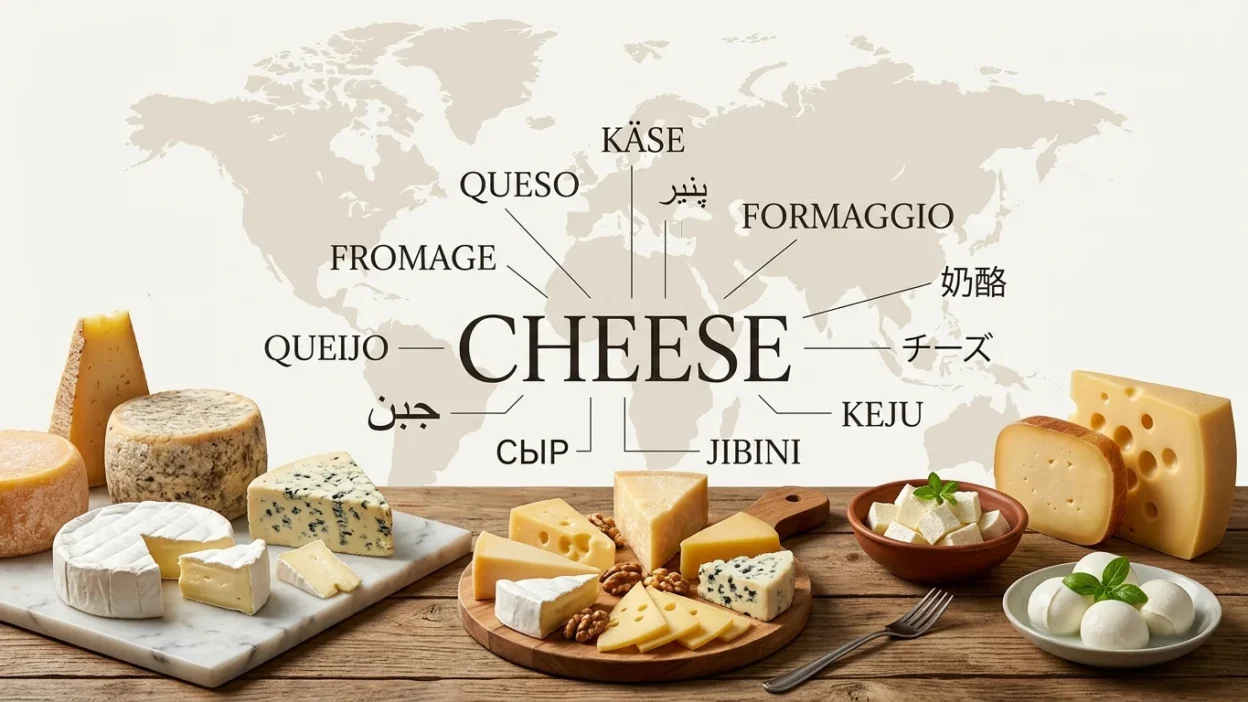
Cheese is one of the most popular foods in the world, enjoyed in everything from sandwiches and pizzas to traditional dishes and festive meals. Although the food is familiar across many cultures, its name changes from one language to another.
If you are searching for cheese in different languages, this guide gives you translations with easy English pronunciations, short real-life examples, and their English meanings. It is useful for language learners, travellers, food lovers, students, and anyone interested in how everyday food words are expressed around the world.
Cheese in Different Languages
| Language | Correct Native Phrase | Easy English Pronunciation | Real-Life Example Sentence | English Meaning |
| English | Cheese | cheez | I like cheese on my sandwich. | I enjoy cheese on my sandwich. |
| Spanish | Queso | KEH-soh | Me gusta el queso. | I like cheese. |
| French | Fromage | froh-MAHZH | J’aime le fromage. | I like cheese. |
| German | Käse | KAY-zuh | Ich esse gerne Käse. | I like eating cheese. |
| Italian | Formaggio | for-MAHD-joh | Mi piace il formaggio. | I like cheese. |
| Portuguese | Queijo | KAY-zhoo | Eu gosto de queijo. | I like cheese. |
| Dutch | Kaas | kahs | Ik hou van kaas. | I love cheese. |
| Swedish | Ost | ohst | Jag tycker om ost. | I like cheese. |
| Norwegian | Ost | oost | Jeg liker ost. | I like cheese. |
| Danish | Ost | ohst | Jeg kan godt lide ost. | I like cheese. |
| Finnish | Juusto | YOO-stoh | Pidän juustosta. | I like cheese. |
| Icelandic | Ostur | OH-stur | Ég borða ost. | I eat cheese. |
| Irish | Cáis | kawsh | Is maith liom cáis. | I like cheese. |
| Scottish Gaelic | Càise | KAH-shuh | Is toil leam càise. | I like cheese. |
| Welsh | Caws | kows | Rwy’n hoffi caws. | I like cheese. |
| Polish | Ser | sair | Lubię ser. | I like cheese. |
| Czech | Sýr | seer | Mám rád sýr. | I like cheese. |
| Slovak | Syr | seer | Mám rád syr. | I like cheese. |
| Slovenian | Sir | seer | Rad imam sir. | I like cheese. |
| Croatian | Sir | seer | Volim sir. | I like cheese. |
| Serbian | Сир | seer | Волим сир. | I like cheese. |
| Bosnian | Sir | seer | Volim sir. | I like cheese. |
| Macedonian | Сирење | SEE-reh-nyeh | Сакам сирење. | I like cheese. |
| Bulgarian | Сирене | see-REH-neh | Обичам сирене. | I love cheese. |
| Romanian | Brânză | BRUN-zuh | Îmi place brânza. | I like cheese. |
| Hungarian | Sajt | shahyt | Szeretem a sajtot. | I like cheese. |
| Greek | Τυρί | tee-REE | Μου αρέσει το τυρί. | I like cheese. |
| Albanian | Djathë | JAH-thuh | Më pëlqen djathi. | I like cheese. |
| Russian | Сыр | seer | Я люблю сыр. | I love cheese. |
| Ukrainian | Сир | seer | Я люблю сир. | I love cheese. |
| Belarusian | Сыр | seer | Я люблю сыр. | I love cheese. |
| Lithuanian | Sūris | SOO-ris | Aš mėgstu sūrį. | I like cheese. |
| Latvian | Siers | see-ers | Man garšo siers. | I like cheese. |
| Estonian | Juust | yoost | Mulle meeldib juust. | I like cheese. |
| Maltese | Ġobon | JOH-bon | Inħobb il-ġobon. | I love cheese. |
| Turkish | Peynir | pay-NEER | Peyniri seviyorum. | I like cheese. |
| Azerbaijani | Pendir | pen-DEER | Mən pendiri sevirəm. | I like cheese. |
| Georgian | ყველი | KVEL-ee | მე ყველი მიყვარს. | I love cheese. |
| Armenian | Պանիր | pah-NEER | Ես սիրում եմ պանիր։ | I love cheese. |
| Persian | پنیر | pah-NEER | من پنیر دوست دارم. | I like cheese. |
| Arabic | جبن | JUBN | أحب الجبن. | I love cheese. |
| Hebrew | גבינה | gvee-NAH | אני אוהב גבינה. | I like cheese. |
| Hindi | पनीर | puh-NEER | मुझे पनीर पसंद है। | I like cheese. |
| Urdu | پنیر | puh-NEER | مجھے پنیر پسند ہے۔ | I like cheese. |
| Bengali | পনির | po-NEER | আমি পনির পছন্দ করি। | I like cheese. |
| Punjabi | ਪਨੀਰ | puh-NEER | ਮੈਨੂੰ ਪਨੀਰ ਪਸੰਦ ਹੈ। | I like cheese. |
| Gujarati | પનીર | puh-NEER | મને પનીર ગમે છે. | I like cheese. |
| Marathi | चीज | cheez | मला चीज आवडते. | I like cheese. |
| Nepali | पनिर | puh-NEER | मलाई पनिर मन पर्छ। | I like cheese. |
| Sinhala | චීස් | cheez | මම චීස් වලට කැමතියි. | I like cheese. |
| Tamil | சீஸ் | cheez | எனக்கு சீஸ் பிடிக்கும். | I like cheese. |
| Telugu | చీజ్ | cheez | నాకు చీజ్ ఇష్టం. | I like cheese. |
| Kannada | ಚೀಸ್ | cheez | ನನಗೆ ಚೀಸ್ ಇಷ್ಟ. | I like cheese. |
| Malayalam | ചീസ് | cheez | എനിക്ക് ചീസ് ഇഷ്ടമാണ്. | I like cheese. |
| Odia | ପନିର | puh-NEER | ମୁଁ ପନିର ପସନ୍ଦ କରେ। | I like cheese. |
| Assamese | পনীৰ | puh-NEER | মোৰ পনীৰ ভাল লাগে। | I like cheese. |
| Chinese (Mandarin) | 奶酪 | nai-LOW | 我喜欢奶酪。 | I like cheese. |
| Japanese | チーズ | CHEE-zoo | 私はチーズが好きです。 | I like cheese. |
| Korean | 치즈 | chee-jeu | 저는 치즈를 좋아해요. | I like cheese. |
| Vietnamese | Phô mai | foh-MY | Tôi thích phô mai. | I like cheese. |
| Thai | ชีส | cheet | ฉันชอบชีส | I like cheese. |
| Indonesian | Keju | KEH-joo | Saya suka keju. | I like cheese. |
| Malay | Keju | KEH-joo | Saya suka keju. | I like cheese. |
| Filipino | Keso | KEH-soh | Gusto ko ang keso. | I like cheese. |
| Mongolian | Бяслаг | BYAS-lag | Би бяслагт дуртай. | I like cheese. |
| Swahili | Jibini | jee-BEE-nee | Ninapenda jibini. | I like cheese. |
| Zulu | Ushizi | oo-SHEE-zee | Ngiyawuthanda ushizi. | I like cheese. |
| Afrikaans | Kaas | kahs | Ek hou van kaas. | I love cheese. |
| Amharic | አይብ | ayb | አይብ እወዳለሁ። | I like cheese. |
| Haitian Creole | Fwomaj | fwoh-MAHZH | Mwen renmen fwomaj. | I love cheese. |
| Esperanto | Fromaĝo | froh-MAH-zho | Mi ŝatas fromaĝon. | I like cheese. |
How to Say Cheese in Different Languages
If you want to know how to say cheese in different languages, the table above provides both the native spelling and an easy pronunciation guide.
Some translations are particularly easy for English speakers to recognise. French uses fromage, Italian uses formaggio, and Spanish uses queso. In several South Asian languages, the word paneer is widely used for a particular type of fresh cheese.
In Japanese, cheese is commonly written as チーズ, while Korean uses 치즈. Both words are borrowed forms that sound similar to the English word.
Cheese Around the World
Cheese has a long culinary history and appears in many different food traditions. The names used for it reflect the linguistic and cultural history of each region.
In Europe, several cheese words have related historical roots. For example, Italian formaggio and French fromage are both familiar examples of how related languages can develop different forms of the same basic food word.
Elsewhere, languages may use a completely different native term or a borrowed word. This is particularly noticeable in languages where modern food vocabulary has been influenced by international cuisine.
Cheese in European Languages
European languages offer some interesting similarities.
Spanish queso, Portuguese queijo, French fromage, Italian formaggio, and German Käse all refer to cheese but sound quite different.
Meanwhile, several Slavic languages use forms related to sir or syr, making their similarities easier to spot.
These differences can make learning food vocabulary an enjoyable way to discover connections between languages.
Cheese in Asian Languages
Asian languages show an equally interesting range of expressions.
Mandarin Chinese uses 奶酪, Japanese uses チーズ, and Korean uses 치즈. Vietnamese commonly uses phô mai, while Indonesian and Malay use keju.
In South Asia, words such as पनीर, پنیر, and পনির are especially interesting because paneer is a well-known fresh cheese used in regional cooking.
Cheese in Different Languages Translations
When searching for cheese in different languages translations, it is useful to remember that the English word “cheese” does not always refer to exactly the same varieties or culinary traditions.
For example, some cultures have traditional fresh cheeses that are very different from aged European cheeses. Therefore, the general word for cheese may be used alongside more specific words for individual varieties.
The table gives the most useful everyday translation for each language rather than attempting to list every type of cheese.
Common Foods Made With Cheese
Cheese is used in countless dishes around the world. Some popular examples include:
- Pizza
- Cheeseburgers
- Grilled cheese sandwiches
- Cheese pasta
- Cheesecake
- Cheese toast
- Salads with cheese
- Cheese sauces
- Stuffed pastries
- Traditional paneer dishes
Learning the word for cheese can therefore help you recognise an important food term when travelling or reading menus in another language.
Why Learn Cheese in Different Languages?
Food vocabulary is one of the easiest areas of language learning to practise in everyday life.
Knowing how to say “cheese” can help when ordering food, shopping, reading menus, talking about recipes, or describing your favourite dishes.
It can also be useful for travellers who want to communicate more confidently in restaurants and local markets.
Tips for Learning Food Words in Other Languages
Start with words that you use regularly. Cheese is a useful example because it appears in menus, recipes, grocery shops, and everyday conversations.
Learn the pronunciation alongside the written word. This makes it easier to recognise and use the term when speaking.
It is also helpful to learn the word in a complete sentence. Instead of memorising only “cheese”, practise a sentence such as “I like cheese” or “I would like some cheese.”
Conclusion
Learning cheese in different languages is a simple way to expand your food vocabulary and explore how different cultures name familiar foods. From queso in Spanish and fromage in French to チーズ in Japanese and 奶酪 in Mandarin Chinese, the translations reveal fascinating differences between languages.
Whether you are a language learner, traveller, food enthusiast, or simply curious about world languages, these translations provide an easy reference for understanding and using the word cheese around the world.
FAQs
1. What is cheese in different languages?
Cheese has many different names around the world. Examples include queso in Spanish, fromage in French, formaggio in Italian, Käse in German, keju in Indonesian, and チーズ in Japanese.
2. How do you say cheese in Spanish?
Cheese in Spanish is queso, pronounced approximately KEH-soh.
3. How do you say cheese in French?
Cheese in French is fromage, pronounced approximately froh-MAHZH.
4. How do you say cheese in Japanese?
Cheese in Japanese is commonly written as チーズ and pronounced approximately CHEE-zoo.
5. How do you say cheese in Hindi and Urdu?
In Hindi, cheese can be written as पनीर (paneer), while Urdu uses پنیر (paneer). The term paneer specifically refers to a fresh cheese commonly used in South Asian cuisine.