Have you ever wondered how to say “change” in different languages? The word “change” can describe transformation, replacement, modification, or the act of becoming different. Because languages handle these meanings differently, the most natural translation can depend on context.
In this guide, we focus primarily on “change” as a verb, meaning to make something different or to become different. You will find the native translation, an easy English pronunciation, and a short example sentence for each language.
This complete list of change in different languages in all languages is useful for language learners, travelers, students, writers, and anyone interested in multilingual vocabulary.
Change in Different Languages
| Language | Native Phrase | Easy English Pronunciation | Example Sentence | English Meaning |
| English | Change | CHAYNJ | People can change. | People can change. |
| Spanish | Cambiar | kahm-BYAR | Las personas pueden cambiar. | People can change. |
| French | Changer | shahn-ZHAY | Les gens peuvent changer. | People can change. |
| German | Ändern | EN-dern | Menschen können sich ändern. | People can change. |
| Italian | Cambiare | kahm-BYAH-reh | Le persone possono cambiare. | People can change. |
| Portuguese | Mudar | moo-DAR | As pessoas podem mudar. | People can change. |
| Dutch | Veranderen | veh-RAHN-duh-ren | Mensen kunnen veranderen. | People can change. |
| Swedish | Förändra | fur-EN-drah | Människor kan förändras. | People can change. |
| Danish | Ændre | EN-druh | Folk kan ændre sig. | People can change. |
| Norwegian | Endre | EN-dreh | Folk kan endre seg. | People can change. |
| Finnish | Muuttaa | MOO-tah | Ihmiset voivat muuttua. | People can change. |
| Icelandic | Breyta | BRAY-tah | Fólk getur breyst. | People can change. |
| Irish | Athraigh | AH-ree | Is féidir le daoine athrú. | People can change. |
| Welsh | Newid | NAY-wid | Gall pobl newid. | People can change. |
| Scottish Gaelic | Atharraich | AH-hah-rich | Faodaidh daoine atharrachadh. | People can change. |
| Latin | Mutare | moo-TAH-reh | Homines mutare possunt. | People can change. |
| Romanian | Schimba | SHKIM-bah | Oamenii se pot schimba. | People can change. |
| Greek | Αλλάζω | ah-LAH-zoh | Οι άνθρωποι μπορούν να αλλάξουν. | People can change. |
| Albanian | Ndryshoj | NDRUH-shoy | Njerëzit mund të ndryshojnë. | People can change. |
| Basque | Aldatu | al-DAH-too | Jendea alda daiteke. | People can change. |
| Catalan | Canviar | kahn-vee-AR | Les persones poden canviar. | People can change. |
| Galician | Cambiar | kahm-BYAR | As persoas poden cambiar. | People can change. |
| Polish | Zmieniać | ZMYEH-nyach | Ludzie mogą się zmieniać. | People can change. |
| Czech | Měnit | MYEH-nit | Lidé se mohou měnit. | People can change. |
| Slovak | Meniť | MEH-neet | Ľudia sa môžu meniť. | People can change. |
| Slovenian | Spreminjati | spreh-mee-NYAH-tee | Ljudje se lahko spreminjajo. | People can change. |
| Croatian | Mijenjati | MYEH-nyah-tee | Ljudi se mogu mijenjati. | People can change. |
| Serbian | Мењати | MEH-nyah-tee | Људи се могу мењати. | People can change. |
| Bulgarian | Променям | pro-meh-NYAM | Хората могат да се променят. | People can change. |
| Macedonian | Менувам | MEH-noo-vam | Луѓето можат да се менуваат. | People can change. |
| Russian | Менять | meh-NYAT | Люди могут меняться. | People can change. |
| Ukrainian | Змінювати | zmee-NYOO-vah-tee | Люди можуть змінюватися. | People can change. |
| Belarusian | Змяняць | ZMYA-nyats | Людзі могуць змяняцца. | People can change. |
| Lithuanian | Keisti | KAY-stee | Žmonės gali keistis. | People can change. |
| Latvian | Mainīt | MYE-nit | Cilvēki var mainīties. | People can change. |
| Estonian | Muutma | MOOT-mah | Inimesed võivad muutuda. | People can change. |
| Hungarian | Változtatni | VAHL-toh-tat-nee | Az emberek változhatnak. | People can change. |
| Turkish | Değiştirmek | day-eesh-TEER-mek | İnsanlar değişebilir. | People can change. |
| Azerbaijani | Dəyişmək | dah-yeesh-MEK | İnsanlar dəyişə bilər. | People can change. |
| Armenian | Փոխել | po-KHEL | Մարդիկ կարող են փոխվել։ | People can change. |
| Georgian | შეცვლა | shets-VLA | ადამიანებს შეუძლიათ შეიცვალონ. | People can change. |
| Persian | تغییر دادن | tagh-YEER dâ-dan | مردم میتوانند تغییر کنند. | People can change. |
| Arabic | يغيّر | yoo-GHAY-yir | يمكن للناس أن يتغيروا. | People can change. |
| Hebrew | לשנות | leh-sha-NOT | אנשים יכולים להשתנות. | People can change. |
| Urdu | بدلنا | bad-LNA | لوگ بدل سکتے ہیں۔ | People can change. |
| Hindi | बदलना | bad-LNA | लोग बदल सकते हैं। | People can change. |
| Bengali | পরিবর্তন করা | por-ee-BOR-ton kora | মানুষ পরিবর্তন করতে পারে। | People can change. |
| Punjabi | ਬਦਲਣਾ | bad-LNA | ਲੋਕ ਬਦਲ ਸਕਦੇ ਹਨ। | People can change. |
| Gujarati | બદલવું | ba-DAL-voo | લોકો બદલાઈ શકે છે. | People can change. |
| Marathi | बदलणे | ba-DAL-nay | लोक बदलू शकतात. | People can change. |
| Nepali | परिवर्तन गर्नु | par-ee-VAR-tan garnu | मानिसहरू परिवर्तन हुन सक्छन्। | People can change. |
| Sinhala | වෙනස් කරනවා | VEH-nas ka-ra-na-WA | මිනිසුන් වෙනස් විය හැකියි. | People can change. |
| Tamil | மாற்று | MAAT-roo | மக்கள் மாறலாம். | People can change. |
| Telugu | మార్చడం | MAAR-cha-dam | ప్రజలు మారవచ్చు. | People can change. |
| Kannada | ಬದಲಾಯಿಸು | ba-da-LA-ee-soo | ಜನರು ಬದಲಾಗಬಹುದು. | People can change. |
| Malayalam | മാറ്റുക | MAA-tuh-ka | ആളുകൾ മാറാം. | People can change. |
| Odia | ବଦଳାଇବା | ba-da-LA-ee-ba | ଲୋକମାନେ ବଦଳି ପାରନ୍ତି। | People can change. |
| Assamese | সলনি কৰা | SO-lo-nee ko-RA | মানুহে সলনি হ’ব পাৰে। | People can change. |
| Chinese | 改变 | GAI-byan | 人可以改变。 | People can change. |
| Japanese | 変える | KAH-eh-roo | 人は変えることができます。 | People can change. |
| Korean | 바꾸다 | BAH-koo-dah | 사람은 바꿀 수 있어요. | People can change. |
| Vietnamese | Thay đổi | TIE doy | Mọi người có thể thay đổi. | People can change. |
| Thai | เปลี่ยน | BPLEE-an | คนเราสามารถเปลี่ยนแปลงได้ | People can change. |
| Indonesian | Mengubah | muh-NGOO-bah | Orang bisa berubah. | People can change. |
| Malay | Mengubah | muh-NGOO-bah | Orang boleh berubah. | People can change. |
| Filipino | Magbago | mag-BAH-goh | Maaaring magbago ang mga tao. | People can change. |
| Swahili | Kubadilika | koo-bah-dee-LEE-kah | Watu wanaweza kubadilika. | People can change. |
| Afrikaans | Verander | fehr-AHN-der | Mense kan verander. | People can change. |
| Zulu | Ukushintsha | oo-koo-SHINT-shah | Abantu bangashintsha. | People can change. |
| Xhosa | Ukutshintsha | oo-koo-TSHINT-shah | Abantu banokutshintsha. | People can change. |
| Amharic | መቀየር | meh-keh-YER | ሰዎች ሊቀየሩ ይችላሉ። | People can change. |
| Somali | Beddelid | behd-DEH-lid | Dadku way is beddeli karaan. | People can change. |
How to Say Change in Different Languages
If you are wondering how to say change in different languages, the translation depends partly on how “change” is being used.
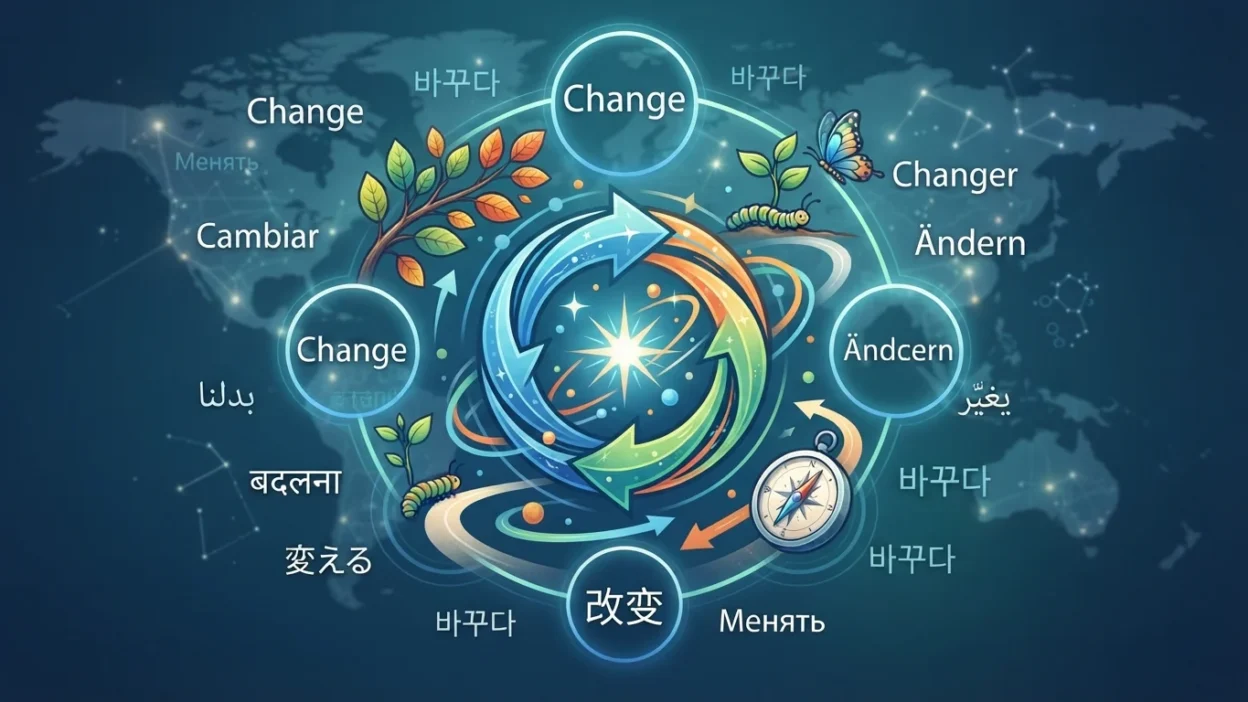
For example, Spanish uses cambiar, French uses changer, German commonly uses ändern, Italian uses cambiare, and Portuguese uses mudar. In Asian languages, Chinese uses 改变, Japanese uses 変える, and Korean uses 바꾸다.
The exact form may change with grammar and context, especially when talking about changing something versus changing oneself.
Change in Different Languages Around the World
The idea of change is universal. People change jobs, plans, habits, opinions, homes, relationships, and routines. Every language therefore needs ways to express transformation and modification.
Looking at change in different languages around the world reveals interesting patterns. Some languages use a single common verb, while others choose different verbs depending on whether a person changes themselves or changes something else.
This makes “change” an especially useful word for language learners.
Change Translations in European Languages
European languages show several interesting vocabulary patterns.
Spanish cambiar, Italian cambiare, and Catalan canviar are closely related. Portuguese mudar is different, while French uses changer. German commonly uses ändern, and Slavic languages have their own related vocabulary.
These differences demonstrate how languages can express the same everyday idea using distinct words and grammatical structures.
Change Translations in Asian Languages
Asian languages provide an even wider range of expressions for “change.”
Chinese uses 改变, Japanese uses 変える, Korean uses 바꾸다, Vietnamese uses thay đổi, and Thai uses เปลี่ยน.
South Asian languages also have distinct forms, including Urdu بدلنا, Hindi बदलना, Punjabi ਬਦਲਣਾ, Bengali পরিবর্তন করা, and Tamil மாற்று.
Change as a Verb vs. Change as a Noun
One important point about change in different languages translations is that English uses “change” as both a verb and a noun.
As a verb, “change” can mean to make something different or to become different.
As a noun, “change” can mean a difference, transformation, or alteration. It can also refer to coins or small amounts of money.
Because these meanings can have different translations, always consider the context when choosing the correct word in another language.
Why Learn Change in Different Languages?
Learning the word “change” in other languages can be useful because it appears frequently in everyday communication.
It can help you:
- Build practical vocabulary.
- Understand conversations and written content.
- Talk about personal or social changes.
- Communicate while traveling.
- Study foreign languages more effectively.
- Compare vocabulary across language families.
- Understand how different languages express transformation.
Conclusion
The word “change” is simple in English but can have several different forms and meanings in other languages. From cambiar in Spanish and changer in French to 改变 in Chinese and بدلنا in Urdu, every language provides its own way to express the idea.
This collection of change in different languages translations is a useful reference for students, travelers, writers, and anyone interested in multilingual vocabulary.
FAQs
What is “change” in different languages?
“Change” has different translations depending on the language and context. Examples include cambiar in Spanish, changer in French, ändern in German, cambiare in Italian, 改变 in Chinese, and بدلنا in Urdu.
How do you say “change” in 10 languages?
You can say cambiar in Spanish, changer in French, ändern in German, cambiare in Italian, mudar in Portuguese, veranderen in Dutch, değiştirmek in Turkish, يغيّر in Arabic, 改变 in Chinese, and 変える in Japanese.
What is the word for change in Asian languages?
Some common translations are बदलना in Hindi, بدلنا in Urdu, 改变 in Chinese, 変える in Japanese, 바꾸다 in Korean, thay đổi in Vietnamese, and เปลี่ยน in Thai.
Is “change” translated the same way in every language?
No. Languages use different words and grammatical structures. The correct translation can also depend on whether “change” means changing something, becoming different, making an alteration, or referring to money.
Why is learning “change” in different languages useful?
“Change” is a common everyday concept, so learning its translation can improve practical vocabulary and help you understand conversations, travel information, foreign-language content, and cultural expressions.