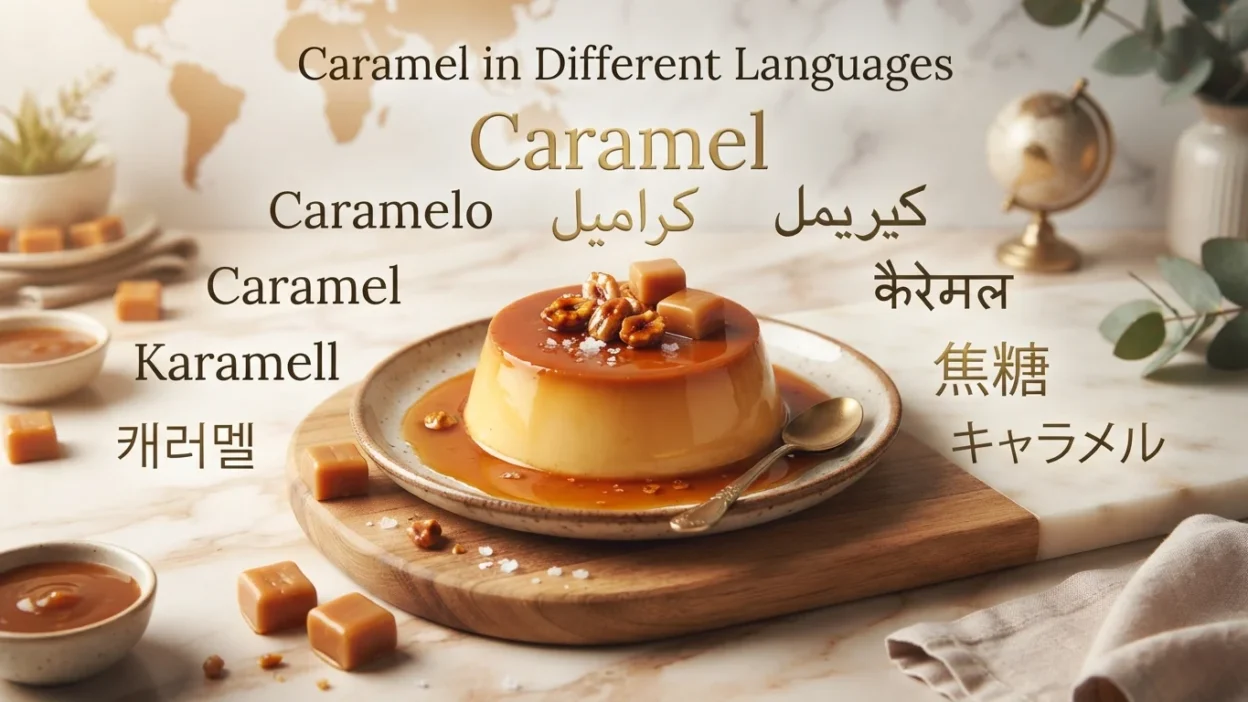
Have you ever wondered how to say caramel in different languages? This delicious word appears in recipes, desserts, candies, coffee drinks, and everyday food conversations across the world.
Although many languages use a word closely related to the English “caramel,” pronunciation, spelling, and usage can vary. Some languages use a direct borrowing, while others have their own traditional expression for caramel or caramelized sugar.
In this guide, you will discover caramel in different languages in all languages, including the native word, easy English pronunciation, and a simple real-life example. It is useful for language learners, travelers, food lovers, students, writers, and anyone interested in international vocabulary.
Caramel in Different Languages
| Language | Native Phrase | Easy English Pronunciation | Example Sentence | English Meaning |
| English | Caramel | KARR-uh-mel | The caramel is sweet. | The caramel is sweet. |
| Spanish | Caramelo | kah-rah-MEH-loh | El caramelo es dulce. | The caramel is sweet. |
| French | Caramel | kah-rah-MEL | Le caramel est délicieux. | The caramel is delicious. |
| German | Karamell | kah-rah-MELL | Das Karamell ist süß. | The caramel is sweet. |
| Italian | Caramello | kah-rah-MEL-loh | Il caramello è dolce. | The caramel is sweet. |
| Portuguese | Caramelo | kah-rah-MEH-loo | O caramelo é doce. | The caramel is sweet. |
| Dutch | Karamel | kah-rah-MEL | De karamel is zoet. | The caramel is sweet. |
| Swedish | Karamell | kah-rah-MELL | Karamellen är söt. | The caramel is sweet. |
| Danish | Karamel | kah-rah-MEL | Karamellen er sød. | The caramel is sweet. |
| Norwegian | Karamell | kah-rah-MELL | Karamellen er søt. | The caramel is sweet. |
| Finnish | Karamelli | kah-rah-MEL-lee | Karamelli on makeaa. | The caramel is sweet. |
| Icelandic | Karamella | kah-rah-MEL-la | Karamellan er sæt. | The caramel is sweet. |
| Irish | Caramal | KAH-rah-mal | Tá caramal milis. | The caramel is sweet. |
| Welsh | Caramel | KAH-rah-mel | Mae caramel yn felys. | The caramel is sweet. |
| Scottish Gaelic | Caramal | KAH-rah-mal | Tha caramal milis. | The caramel is sweet. |
| Latin | Caramelum | kah-rah-MEH-lum | Caramelum dulce est. | The caramel is sweet. |
| Romanian | Caramel | kah-rah-MEL | Caramelul este dulce. | The caramel is sweet. |
| Greek | Καραμέλα | kah-rah-MEH-lah | Η καραμέλα είναι γλυκιά. | The caramel is sweet. |
| Albanian | Karamel | kah-rah-MEL | Karameli është i ëmbël. | The caramel is sweet. |
| Basque | Karamelu | kah-rah-MEH-loo | Karamelua gozoa da. | The caramel is sweet. |
| Catalan | Caramel | kah-rah-MEL | El caramel és dolç. | The caramel is sweet. |
| Galician | Caramelo | kah-rah-MEH-loh | O caramelo é doce. | The caramel is sweet. |
| Polish | Karmel | KAR-mel | Karmel jest słodki. | The caramel is sweet. |
| Czech | Karamel | kah-rah-MEL | Karamel je sladký. | The caramel is sweet. |
| Slovak | Karamel | kah-rah-MEL | Karamel je sladký. | The caramel is sweet. |
| Slovenian | Karamela | kah-rah-MEH-lah | Karamela je sladka. | The caramel is sweet. |
| Croatian | Karamela | kah-rah-MEH-lah | Karamela je slatka. | The caramel is sweet. |
| Serbian | Карамела | kah-rah-MEH-lah | Карамела је слатка. | The caramel is sweet. |
| Bulgarian | Карамел | kah-rah-MEL | Карамелът е сладък. | The caramel is sweet. |
| Macedonian | Карамела | kah-rah-MEH-lah | Карамелата е слатка. | The caramel is sweet. |
| Russian | Карамель | kah-rah-MYEL | Карамель сладкая. | The caramel is sweet. |
| Ukrainian | Карамель | kah-rah-MEL | Карамель солодка. | The caramel is sweet. |
| Belarusian | Карамель | kah-rah-MYEL | Карамель салодкая. | The caramel is sweet. |
| Lithuanian | Karamelė | kah-rah-meh-LEH | Karamelė saldi. | The caramel is sweet. |
| Latvian | Karamele | kah-rah-MEH-leh | Karamele ir salda. | The caramel is sweet. |
| Estonian | Karamell | kah-rah-MELL | Karamell on magus. | The caramel is sweet. |
| Hungarian | Karamell | KAH-rah-mell | A karamell édes. | The caramel is sweet. |
| Turkish | Karamel | kah-rah-MEL | Karamel çok tatlı. | The caramel is very sweet. |
| Azerbaijani | Karamel | kah-rah-MEL | Karamel çox şirindir. | The caramel is very sweet. |
| Armenian | Կարամել | kah-rah-MEL | Կարամելը քաղցր է։ | The caramel is sweet. |
| Georgian | კარამელი | kah-rah-MEH-lee | კარამელი ტკბილია. | The caramel is sweet. |
| Persian | کارامل | kah-rah-MEL | کارامل شیرین است. | The caramel is sweet. |
| Arabic | كراميل | kah-rah-MEEL | الكراميل حلو. | The caramel is sweet. |
| Hebrew | קרמל | KAH-rah-mel | הקרמל מתוק. | The caramel is sweet. |
| Urdu | کیریمل | KAY-rah-mel | کیریمل میٹھا ہے۔ | The caramel is sweet. |
| Hindi | कैरेमल | KAI-ray-mal | कैरेमल मीठा है। | The caramel is sweet. |
| Bengali | ক্যারামেল | KYA-rah-mel | ক্যারামেল মিষ্টি। | The caramel is sweet. |
| Punjabi | ਕੈਰਾਮਲ | KAI-rah-mal | ਕੈਰਾਮਲ ਮਿੱਠਾ ਹੈ। | The caramel is sweet. |
| Gujarati | કારામેલ | KAA-rah-mel | કારામેલ મીઠું છે. | The caramel is sweet. |
| Marathi | कॅरमेल | KAI-rah-mel | कॅरमेल गोड आहे. | The caramel is sweet. |
| Nepali | कारमेल | KAA-rah-mel | कारमेल मिठो छ। | The caramel is sweet. |
| Sinhala | කැරමල් | KAH-rah-mal | කැරමල් රසවත්. | The caramel is tasty. |
| Tamil | கேரமல் | KAY-rah-mal | கேரமல் இனிப்பாக உள்ளது. | The caramel is sweet. |
| Telugu | కారమెల్ | KAA-rah-mel | కారమెల్ తియ్యగా ఉంది. | The caramel is sweet. |
| Kannada | ಕ್ಯಾರಮೆಲ್ | KYA-rah-mel | ಕ್ಯಾರಮೆಲ್ ಸಿಹಿಯಾಗಿದೆ. | The caramel is sweet. |
| Malayalam | കാരമൽ | KAA-rah-mal | കാരമൽ മധുരമാണ്. | The caramel is sweet. |
| Odia | କ୍ୟାରାମେଲ୍ | KYA-rah-mel | କ୍ୟାରାମେଲ୍ ମିଠା ଅଟେ। | The caramel is sweet. |
| Assamese | কেৰামেল | KAY-rah-mel | কেৰামেল মিঠা। | The caramel is sweet. |
| Chinese | 焦糖 | JOW-tahng | 焦糖很甜。 | The caramel is sweet. |
| Japanese | キャラメル | KYA-rah-meh-roo | キャラメルは甘いです。 | The caramel is sweet. |
| Korean | 캐러멜 | KAE-roh-mel | 캐러멜은 달아요. | The caramel is sweet. |
| Vietnamese | Caramel | kah-rah-MEL | Caramel rất ngọt. | The caramel is very sweet. |
| Thai | คาราเมล | KAA-rah-mel | คาราเมลหวานมาก | The caramel is very sweet. |
| Indonesian | Karamel | kah-rah-MEL | Karamelnya manis. | The caramel is sweet. |
| Malay | Karamel | kah-rah-MEL | Karamel itu manis. | The caramel is sweet. |
| Filipino | Karamelo | kah-rah-MEH-loh | Matamis ang karamelo. | The caramel is sweet. |
| Swahili | Karameli | kah-rah-MEH-lee | Karameli ni tamu. | The caramel is sweet. |
| Afrikaans | Karamel | kah-rah-MEL | Die karamel is soet. | The caramel is sweet. |
| Zulu | Ikharameli | ee-kha-rah-MEH-lee | Ikharameli imnandi. | The caramel is delicious. |
| Xhosa | Ikharameli | ee-kha-rah-MEH-lee | Ikharameli imnandi. | The caramel is delicious. |
| Amharic | ካራሜል | kah-rah-MEL | ካራሜሉ ጣፋጭ ነው። | The caramel is sweet. |
| Somali | Karamel | kah-rah-MEL | Karamelku waa macaan. | The caramel is sweet. |
How to Say Caramel in Different Languages
If you are searching for how to say caramel in different languages, you will notice that many languages use a form that resembles the English word.
Spanish uses caramelo, Italian uses caramello, German uses Karamell, and French uses caramel. In several other languages, the word has been adapted to the local spelling and pronunciation.
Chinese is especially interesting because it uses 焦糖, which literally refers to caramelized sugar. This differs from many European languages that use a borrowed form of “caramel.”
Caramel in Different Languages Around the World
The popularity of caramel has made it a familiar food term in many parts of the world. It appears in desserts, sauces, candies, cakes, ice cream, coffee, and confectionery.
When comparing caramel in different languages around the world, you can see how languages adapt food vocabulary. Some preserve a recognizable international form, while others use a word based on the cooking process or traditional terminology.
Caramel Translations in European Languages
European languages contain many variations of the word caramel.
French uses caramel, Spanish and Portuguese use caramelo, Italian uses caramello, German uses Karamell, and Polish uses karmel.
These similarities are useful for language learners because recognizing one form can sometimes make it easier to identify the word in another European language.
Caramel Translations in Asian Languages
Asian languages offer an interesting combination of borrowed vocabulary and native expressions.
Japanese uses キャラメル, Korean uses 캐러멜, while Chinese uses 焦糖. South Asian languages such as Hindi, Urdu, Bengali, Punjabi, and Marathi generally use localized forms of the international word.
This makes caramel in different languages an excellent example of how food vocabulary travels between cultures.
Why Is Caramel Called Different Names?
Caramel is produced by heating sugar until it undergoes caramelization, creating its characteristic color, aroma, and flavor.
As the ingredient became popular internationally, languages developed their own pronunciations and spellings. Some adopted forms close to the French-derived international word, while others created or retained terms connected with caramelized sugar.
This is why caramel translations can look very similar in some languages and completely different in others.
Caramel in Different Languages in All Languages
When looking at caramel in different languages in all languages, one of the most noticeable patterns is the widespread use of related forms.
Words such as caramel, caramello, caramelo, Karamell, karamel, and كراميل share a recognizable sound. However, languages such as Chinese use a structurally different term, demonstrating that there is more than one way to describe the same sweet ingredient.
Why Learn Caramel in Different Languages?
Learning food vocabulary can make communication easier when traveling, ordering desserts, reading menus, or exploring international recipes.
Knowing how to say caramel in another language can also help you:
- Understand foreign food labels.
- Read international dessert menus.
- Communicate while traveling.
- Expand your culinary vocabulary.
- Compare words across languages.
- Learn different writing systems.
- Explore how food terms spread between cultures.
Conclusion
Learning caramel in different languages is a delicious way to explore international vocabulary. From caramelo in Spanish and caramello in Italian to 焦糖 in Chinese and キャラメル in Japanese, the word shows how languages borrow, adapt, and develop food-related vocabulary.
Whether you are a language learner, traveler, food enthusiast, or simply curious about words from around the world, these translations provide a useful reference for discovering how people express “caramel” across different cultures.
FAQs
What is caramel in different languages?
“Caramel” has many similar translations around the world. Examples include caramelo in Spanish, caramello in Italian, Karamell in German, كراميل in Arabic, and キャラメル in Japanese.
How do you say caramel in 10 languages?
You can say caramelo in Spanish, caramel in French, Karamell in German, caramello in Italian, caramelo in Portuguese, karamel in Turkish, كراميل in Arabic, कैरेमल in Hindi, 焦糖 in Chinese, and キャラメル in Japanese.
What is caramel called in Asian languages?
Some examples include 焦糖 in Chinese, キャラメル in Japanese, 캐러멜 in Korean, คาราเมล in Thai, کارامل in Persian, and कैरेमल in Hindi.
Is caramel the same word in every language?
No. Many languages use words that resemble “caramel,” but spelling and pronunciation differ. Some languages, such as Chinese, use a different term based on the concept of caramelized sugar.
Why is caramel translated similarly in many languages?
Caramel became an internationally familiar food ingredient, so many languages adopted or adapted a form of the word. This is why similar versions appear across numerous European, Asian, and other languages.