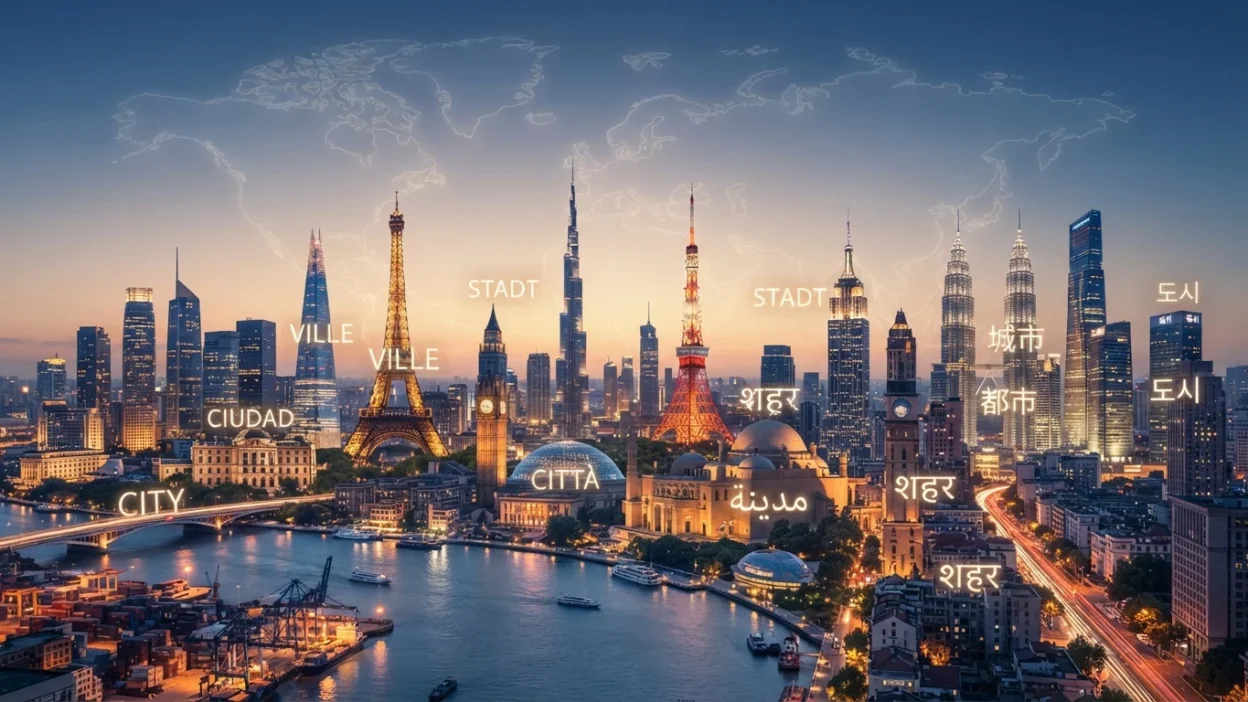
Have you ever wondered how to say “city” in different languages? The word is simple, but its translation changes significantly across cultures and writing systems.
From ciudad in Spanish and ville in French to مدينة in Arabic and 城市 in Chinese, every language has its own way to describe an urban place where people live, work, and gather.
This guide explores city in different languages in all languages with native translations, easy English pronunciations, and short real-life examples. Whether you are learning a new language, traveling, studying geography, or simply exploring international vocabulary, this list makes it easy to compare city in different languages translations.
City in Different Languages
The table below provides 70 ways to say “city” around the world. Each translation includes pronunciation and a simple example sentence.
| Language | Native Phrase | Easy English Pronunciation | Example Sentence | English Meaning |
| English | City | SIT-ee | The city is busy today. | The city is busy today. |
| Spanish | Ciudad | see-oo-DAD | La ciudad es grande. | The city is large. |
| French | Ville | VEEL | La ville est belle. | The city is beautiful. |
| German | Stadt | SHTAHT | Die Stadt ist groß. | The city is large. |
| Italian | Città | chit-TAH | La città è bella. | The city is beautiful. |
| Portuguese | Cidade | see-DAH-jee | A cidade é grande. | The city is large. |
| Dutch | Stad | STAHT | De stad is druk. | The city is busy. |
| Swedish | Stad | STAHD | Staden är stor. | The city is large. |
| Danish | By | BOO | Byen er stor. | The city is large. |
| Norwegian | By | BEE | Byen er vakker. | The city is beautiful. |
| Finnish | Kaupunki | KOW-poon-kee | Kaupunki on suuri. | The city is large. |
| Icelandic | Borg | PORG | Borgin er stór. | The city is large. |
| Irish | Cathair | KAH-hir | Tá an chathair mór. | The city is large. |
| Welsh | Dinas | DEE-nas | Mae’r ddinas yn fawr. | The city is large. |
| Scottish Gaelic | Baile | BAH-lyuh | Tha am baile mòr. | The city is large. |
| Latin | Urbs | OORBS | Urbs magna est. | The city is large. |
| Romanian | Oraș | oh-RASH | Orașul este mare. | The city is large. |
| Greek | Πόλη | POH-lee | Η πόλη είναι μεγάλη. | The city is large. |
| Albanian | Qytet | CHOO-yet | Qyteti është i madh. | The city is large. |
| Basque | Hiri | EE-ree | Hiria handia da. | The city is large. |
| Catalan | Ciutat | see-oo-TAT | La ciutat és gran. | The city is large. |
| Galician | Cidade | see-DAH-deh | A cidade é grande. | The city is large. |
| Polish | Miasto | MYA-stoh | Miasto jest duże. | The city is large. |
| Czech | Město | MYES-toh | Město je velké. | The city is large. |
| Slovak | Mesto | MES-toh | Mesto je veľké. | The city is large. |
| Slovenian | Mesto | MES-toh | Mesto je veliko. | The city is large. |
| Croatian | Grad | GRAHD | Grad je velik. | The city is large. |
| Serbian | Град | GRAHD | Град је велики. | The city is large. |
| Bulgarian | Град | GRAHT | Градът е голям. | The city is large. |
| Macedonian | Град | GRAHT | Градот е голем. | The city is large. |
| Russian | Город | GOH-rut | Город большой. | The city is large. |
| Ukrainian | Місто | MEES-toh | Місто велике. | The city is large. |
| Belarusian | Горад | HO-rat | Горад вялікі. | The city is large. |
| Lithuanian | Miestas | MYES-tas | Miestas yra didelis. | The city is large. |
| Latvian | Pilsēta | PIL-seh-ta | Pilsēta ir liela. | The city is large. |
| Estonian | Linn | LIN | Linn on suur. | The city is large. |
| Hungarian | Város | VAA-rosh | A város nagy. | The city is large. |
| Turkish | Şehir | sheh-HEER | Şehir çok büyük. | The city is very large. |
| Azerbaijani | Şəhər | sheh-HER | Şəhər böyükdür. | The city is large. |
| Armenian | Քաղաք | kah-GHAHK | Քաղաքը մեծ է։ | The city is large. |
| Georgian | ქალაქი | kah-LAH-kee | ქალაქი დიდია. | The city is large. |
| Persian | شهر | SHAH-r | شهر بزرگ است. | The city is large. |
| Arabic | مدينة | ma-DEE-nah | المدينة كبيرة. | The city is large. |
| Hebrew | עיר | EER | העיר גדולה. | The city is large. |
| Urdu | شہر | SHEH-r | شہر بہت بڑا ہے۔ | The city is very large. |
| Hindi | शहर | SHA-har | शहर बड़ा है। | The city is large. |
| Bengali | শহর | SHO-hor | শহরটি বড়। | The city is large. |
| Punjabi | ਸ਼ਹਿਰ | SHEH-har | ਸ਼ਹਿਰ ਵੱਡਾ ਹੈ। | The city is large. |
| Gujarati | શહેર | SHA-her | શહેર મોટું છે. | The city is large. |
| Marathi | शहर | SHA-har | शहर मोठे आहे. | The city is large. |
| Nepali | शहर | SHA-har | शहर ठूलो छ। | The city is large. |
| Sinhala | නගරය | NA-ga-ra-ya | නගරය විශාලයි. | The city is large. |
| Tamil | நகரம் | NA-ga-ram | நகரம் பெரியது. | The city is large. |
| Telugu | నగరం | NA-ga-ram | నగరం పెద్దది. | The city is large. |
| Kannada | ನಗರ | NA-ga-ra | ನಗರ ದೊಡ್ಡದಾಗಿದೆ. | The city is large. |
| Malayalam | നഗരം | NA-ga-ram | നഗരം വലുതാണ്. | The city is large. |
| Odia | ସହର | SA-ha-ra | ସହର ବଡ଼। | The city is large. |
| Assamese | চহৰ | SO-hor | চহৰখন ডাঙৰ। | The city is large. |
| Chinese | 城市 | CHUNG-shuh | 这座城市很大。 | This city is large. |
| Japanese | 都市 | TOH-shee | この都市は大きいです。 | This city is large. |
| Korean | 도시 | DOH-shee | 이 도시는 큽니다. | This city is large. |
| Vietnamese | Thành phố | TAHN foh | Thành phố rất lớn. | The city is very large. |
| Thai | เมือง | MEU-ang | เมืองนี้ใหญ่ | This city is large. |
| Indonesian | Kota | KOH-tah | Kota ini besar. | This city is large. |
| Malay | Bandar | BAN-dar | Bandar ini besar. | This city is large. |
| Filipino | Lungsod | LOONG-sod | Malaki ang lungsod. | The city is large. |
| Swahili | Jiji | JEE-jee | Jiji ni kubwa. | The city is large. |
| Afrikaans | Stad | STAHT | Die stad is groot. | The city is large. |
| Zulu | Idolobha | ee-doh-LOH-bha | Idolobha likhulu. | The city is large. |
| Xhosa | Isixeko | ee-see-KEH-koh | Isixeko sikhulu. | The city is large. |
| Amharic | ከተማ | ke-TEH-ma | ከተማዋ ትልቅ ናት። | The city is large. |
| Somali | Magaalo | ma-GAA-lo | Magaaladu way weyn tahay. | The city is large. |
How to Say City in Different Languages
If you are searching for how to say city in different languages, the answer depends on the language and region.
For example, “city” is ciudad in Spanish, ville in French, Stadt in German, città in Italian, and cidade in Portuguese. In Asian languages, you will find forms such as 城市 in Chinese, 都市 in Japanese, and 도시 in Korean.
These differences make everyday vocabulary especially interesting for language learners.
City in Different Languages Around the World
Cities exist in almost every part of the world, but the word used to describe them changes from language to language.
In Europe, words such as ciudad, ville, Stadt, città, miasto, grad, and город demonstrate the wide variety of European vocabulary.
Across Asia, languages use completely different scripts and sounds. Chinese uses 城市, Japanese uses 都市, Korean uses 도시, and Arabic uses مدينة.
Exploring city in different languages around the world is therefore not only a vocabulary exercise but also a way to discover different writing systems and linguistic traditions.
City in Different Languages in Europe
European languages offer many fascinating translations for “city.” Romance languages often have forms related to Latin roots, while Slavic, Germanic, and other language families use different vocabulary.
Spanish uses ciudad, French uses ville, Italian uses città, Romanian uses oraș, Polish uses miasto, and Croatian uses grad.
These differences show why learning individual vocabulary words is important even when languages share geographic or historical connections.
City in Different Languages in Asia
Asia contains thousands of languages and several major writing systems. As a result, there are many different ways to express the idea of a city.
Hindi uses शहर, Urdu uses شہر, Arabic uses مدينة, Chinese uses 城市, Japanese uses 都市, Korean uses 도시, and Vietnamese uses thành phố.
Learning these terms can be especially useful for travelers and students interested in Asian languages and cultures.
Why Learn City in Different Languages?
Learning the word “city” in other languages can be useful in everyday situations.
- It helps expand your vocabulary.
- It is useful when traveling internationally.
- It makes foreign-language maps and signs easier to understand.
- It can help with geography and language studies.
- It introduces learners to different writing systems.
- It helps compare vocabulary across language families.
Conclusion
The word “city” may describe the same basic concept around the world, but its translation varies widely between languages. From ciudad and ville to مدينة, 城市, and 都市, each language has its own unique expression.
This collection of city in different languages translations is a useful reference for language learners, travelers, students, and anyone curious about words from around the world.
FAQs
What is “city” in different languages?
“City” has many translations. Examples include ciudad in Spanish, ville in French, Stadt in German, città in Italian, مدينة in Arabic, 城市 in Chinese, and 都市 in Japanese.
How do you say “city” in 10 languages?
You can say ciudad in Spanish, ville in French, Stadt in German, città in Italian, cidade in Portuguese, stad in Dutch, şehir in Turkish, مدينة in Arabic, 城市 in Chinese, and 도시 in Korean.
What is the word for city in Asian languages?
Some common translations include शहर in Hindi, شہر in Urdu, 城市 in Chinese, 都市 in Japanese, 도시 in Korean, thành phố in Vietnamese, and เมือง in Thai.
Is the word “city” the same in every language?
No. Every language has its own word or expression for a city. Some languages may have similar words because they share historical roots, while others use completely different terms.
Why should I learn “city” in different languages?
Learning the word “city” in different languages is useful for vocabulary building, travel, geography, language study, and understanding foreign maps, signs, and conversations.