Have you ever wondered how to say cinder in different languages? The English word cinder can describe a small piece of partly burned coal or wood, a glowing or burned fragment left after a fire, and, in some contexts, material left behind by burning or industrial processes. Because languages divide these meanings differently, the most natural translation can vary by context.
If you are searching for how to say cinder in different languages, exploring cinder translations, or learning how this word is expressed around the world, this guide gives you a practical multilingual reference.
One important point is that cinder does not always have one exact one-word equivalent. In some languages, the closest term means ember, while in others it means ash, burned residue, or charred material. The table below uses the closest everyday term for the fire-related meaning of cinder.
Cinder in Different Languages
| Language | Native Phrase | Easy English Pronunciation | Example Sentence | English Meaning |
| Afrikaans | sintel | SIN-tel | ’n Sintel het uit die vuur geval. | A cinder fell from the fire. |
| Albanian | prush | PROOSH | Një prush ra nga zjarri. | A cinder fell from the fire. |
| Arabic | جمرة | JAM-rah | سقطت جمرة من النار. | A cinder fell from the fire. |
| Armenian | անթեղ | an-TEGH | Անթեղը ընկավ կրակից։ | The cinder fell from the fire. |
| Azerbaijani | köz | KYOZ | Oddan bir köz düşdü. | A cinder fell from the fire. |
| Basque | txingar | cheen-GAR | Txingar bat erori da sutatik. | A cinder fell from the fire. |
| Belarusian | вугалёк | voo-ga-LYOK | Вугалёк выпаў з агню. | A cinder fell from the fire. |
| Bengali | অঙ্গার | ON-gaar | আগুন থেকে একটি অঙ্গার পড়ল। | A cinder fell from the fire. |
| Bosnian | žar | ZHAR | Žar je pao iz vatre. | A cinder fell from the fire. |
| Bulgarian | жар | ZHAR | Една жар падна от огъня. | A cinder fell from the fire. |
| Catalan | brasa | BRAH-sa | Una brasa va caure del foc. | A cinder fell from the fire. |
| Chinese (Mandarin) | 余烬 | yoo-JEEN | 一块余烬从火里掉了下来。 | A cinder fell from the fire. |
| Croatian | žar | ZHAR | Žar je pao iz vatre. | A cinder fell from the fire. |
| Czech | žhavý uhlík | ZHAH-vee OO-gleek | Žhavý uhlík vypadl z ohně. | A hot cinder fell from the fire. |
| Danish | glød | GLURD | En glød faldt fra bålet. | A cinder fell from the fire. |
| Dutch | sintel | SIN-tel | Een sintel viel uit het vuur. | A cinder fell from the fire. |
| Estonian | süsi | SOO-see | Süsi kukkus tulest välja. | A cinder fell from the fire. |
| Finnish | hiili | HEE-lee | Hiili putosi tulesta. | A cinder fell from the fire. |
| French | braise | BREHZ | Une braise est tombée du feu. | A cinder fell from the fire. |
| Galician | brasa | BRA-sa | Unha brasa caeu do lume. | A cinder fell from the fire. |
| Georgian | ნაკვერცხალი | nak-ver-TSKHA-lee | ნაკვერცხალი ცეცხლიდან ჩამოვარდა. | A cinder fell from the fire. |
| German | Glutstück | GLOOT-shtook | Ein Glutstück fiel aus dem Feuer. | A cinder fell from the fire. |
| Greek | καύτρα | KAF-tra | Μια καύτρα έπεσε από τη φωτιά. | A cinder fell from the fire. |
| Gujarati | અંગાર | un-GAAR | આગમાંથી એક અંગાર પડ્યો. | A cinder fell from the fire. |
| Haitian Creole | chabon cho | sha-BON sho | Yon chabon cho tonbe nan dife a. | A hot cinder fell from the fire. |
| Hebrew | גחלת | GAH-heh-let | גחלת נפלה מהאש. | A cinder fell from the fire. |
| Hindi | अंगारा | un-GAA-raa | आग से एक अंगारा गिरा। | A cinder fell from the fire. |
| Hungarian | parázs | PAH-razh | Egy parázs kiesett a tűzből. | A cinder fell from the fire. |
| Icelandic | glóð | GLOTH | Glóð féll úr eldinum. | A cinder fell from the fire. |
| Indonesian | bara | BAH-ra | Bara jatuh dari api. | A cinder fell from the fire. |
| Irish | brí | bree | Thit brí ón tine. | A cinder fell from the fire. |
| Italian | brace | BRAH-cheh | Una brace è caduta dal fuoco. | A cinder fell from the fire. |
| Japanese | 燃えさし | moe-eh-SHAH-shee | 燃えさしが火から落ちた。 | A cinder fell from the fire. |
| Kannada | ಕೆಂಡ | KEN-da | ಬೆಂಕಿಯಿಂದ ಒಂದು ಕೆಂಡ ಬಿತ್ತು. | A cinder fell from the fire. |
| Kazakh | шоқ | SHOK | Оттан бір шоқ түсті. | A cinder fell from the fire. |
| Korean | 불씨 | bool-SEE | 불씨가 불에서 떨어졌어요. | A cinder fell from the fire. |
| Latin | favilla | fa-WIL-la | Favilla e foco cecidit. | A cinder fell from the fire. |
| Latvian | kvēle | KVEH-leh | No uguns nokrita kvēle. | A cinder fell from the fire. |
| Lithuanian | žarija | zha-REE-ya | Iš ugnies nukrito žarija. | A cinder fell from the fire. |
| Macedonian | жар | ZHAR | Една жар падна од огнот. | A cinder fell from the fire. |
| Malay | bara | BAH-ra | Bara jatuh dari api. | A cinder fell from the fire. |
| Maltese | ġamar | JAH-mar | Ġamar waqa’ min-nar. | A cinder fell from the fire. |
| Marathi | निखारा | nee-KHAA-ra | आगीतून एक निखारा पडला. | A cinder fell from the fire. |
| Mongolian | цог | TSOG | Галаас цог унав. | A cinder fell from the fire. |
| Nepali | अंगार | un-GAAR | आगबाट एउटा अंगार खस्यो। | A cinder fell from the fire. |
| Norwegian | glo | GLOO | En glo falt fra bålet. | A cinder fell from the fire. |
| Persian | اخگر | AKH-gar | یک اخگر از آتش افتاد. | A cinder fell from the fire. |
| Polish | żar | ZHAR | Żar spadł z ognia. | A cinder fell from the fire. |
| Portuguese | brasa | BRAH-za | Uma brasa caiu do fogo. | A cinder fell from the fire. |
| Punjabi | ਅੰਗਾਰ | un-GAAR | ਅੱਗ ਵਿੱਚੋਂ ਇੱਕ ਅੰਗਾਰ ਡਿੱਗਿਆ। | A cinder fell from the fire. |
| Romanian | jar | ZHAR | Un jar a căzut din foc. | A cinder fell from the fire. |
| Russian | уголёк | oo-ga-LYOK | Уголёк упал из огня. | A cinder fell from the fire. |
| Serbian | жар | ZHAR | Жар је пао из ватре. | A cinder fell from the fire. |
| Slovak | žeravý uhlík | ZHEH-ra-vee OO-gleek | Žeravý uhlík vypadol z ohňa. | A hot cinder fell from the fire. |
| Slovenian | žerjavica | zheh-RYA-vee-tsa | Žerjavica je padla iz ognja. | A cinder fell from the fire. |
| Spanish | carbonilla | kar-boh-NEE-ya | Una carbonilla cayó del fuego. | A cinder fell from the fire. |
| Swahili | kaa | KAH-ah | Kaa ilianguka kutoka motoni. | A cinder fell from the fire. |
| Swedish | glöd | GLURD | En glöd föll från elden. | A cinder fell from the fire. |
| Tamil | கனல் | ka-NAL | நெருப்பிலிருந்து ஒரு கனல் விழுந்தது. | A cinder fell from the fire. |
| Telugu | నిప్పురవ్వ | nip-poo-RAHV-va | మంట నుండి ఒక నిప్పురవ్వ పడింది. | A cinder fell from the fire. |
| Thai | ถ่านคุ | taan-KOO | ถ่านคุตกจากไฟ | A cinder fell from the fire. |
| Turkish | kor | KOR | Ateşten bir kor düştü. | A cinder fell from the fire. |
| Ukrainian | жаринка | zha-RYN-ka | Жаринка впала з вогню. | A cinder fell from the fire. |
| Urdu | انگارہ | ang-GAA-ra | آگ سے ایک انگارہ گرا۔ | A cinder fell from the fire. |
| Uzbek | cho‘g‘ | CHOG | Olovdan bir cho‘g‘ tushdi. | A cinder fell from the fire. |
| Vietnamese | than hồng | tan HONG | Một than hồng rơi khỏi đống lửa. | A cinder fell from the fire. |
| Welsh | sindr | SIN-dr | Syrthiodd sindr o’r tân. | A cinder fell from the fire. |
| Yiddish | גליטער | GLI-ter | א גליטער איז געפאַלן פֿון פֿײַער. | A cinder fell from the fire. |
| Zulu | amalahle | a-ma-LAH-leh | Ilahle lawela emlilweni. | A cinder fell from the fire. |
How to Say Cinder in Different Languages
If you are looking for how to say cinder in different languages, you will notice that there is no single translation pattern across the world. Some languages use a word closer to ember, while others use a term associated with burned material, ash, coal, or glowing charcoal.
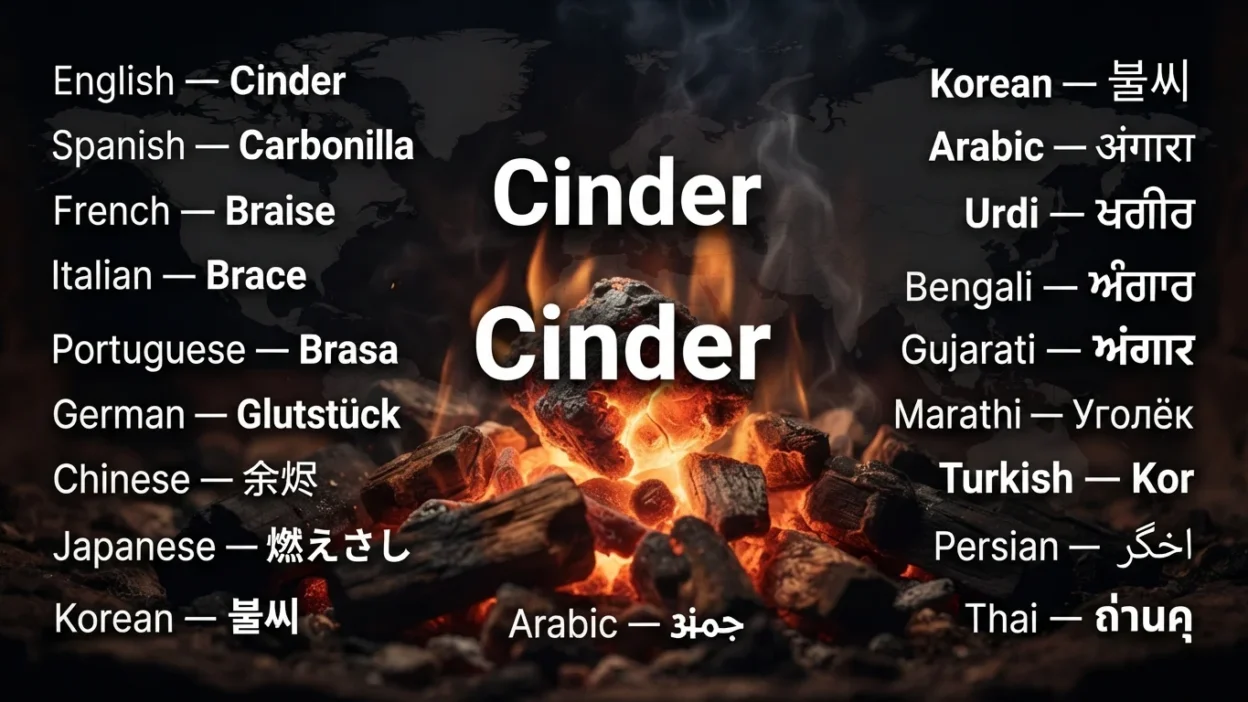
For example, French uses braise, Italian uses brace, Portuguese uses brasa, Spanish commonly uses carbonilla for the partly burned-material sense, and German can use Glutstück for a glowing piece of material. Japanese uses 燃えさし (moegashi) for a partially burned remnant.
This difference is important when searching for cinder in different languages translations, because translating the word without considering context can produce a word that means ash rather than cinder.
Cinder in Different Languages Around the World
The concept of a cinder exists wherever people use fire, wood, charcoal, or coal. However, languages often categorize the remains of a fire differently.
In South Asian languages, words such as अंगारा, انگارہ, and ਅੰਗਾਰ are associated with a glowing ember or cinder. In several European languages, related words may describe glowing material, burned residue, or embers.
In East Asia, languages can also distinguish between ash and a remaining burning fragment. This makes cinder in different languages around the world an interesting example of how vocabulary reflects everyday experiences with fire.
Cinder Translations in European Languages
European languages show many different approaches to the word cinder.
French uses braise, Italian uses brace, Portuguese uses brasa, and Spanish can use carbonilla for a partly burned combustible material. German has Glutstück, while Dutch can use sintel.
Russian uses уголёк for a small coal or ember-like piece, while Polish, Serbian, Croatian, and several neighboring Slavic languages commonly use forms related to žar, meaning glowing embers or heat.
Cinder in Different Asian Languages
Asian languages offer especially interesting examples of fire-related vocabulary.
Hindi uses अंगारा, Urdu uses انگارہ, Punjabi uses ਅੰਗਾਰ, and Nepali uses अंगार. These terms are closely associated with a glowing ember or cinder.
Japanese uses 燃えさし, Korean uses 불씨, Chinese uses 余烬, and Persian uses اخگر. These words demonstrate how the same English concept can be expressed using different ideas related to burning, glowing, or remaining material.
Cinder vs. Ash: What Is the Difference?
Cinder and ash are related but are not always identical.
A cinder is generally a piece of material that has been partly or mostly burned but has not completely turned into ash. It may remain dark, glowing, or capable of further burning. Ash is the fine residue left after combustion.
This distinction matters when translating cinder in different languages, because some languages may use separate words for a glowing ember, burned material, and ash, while others may use broader terms depending on context.
Cinder vs. Ember: Are They the Same?
The words cinder and ember can overlap in meaning, but they are not always perfect synonyms.
An ember is usually a glowing or still-burning piece of coal, wood, or other combustible material. A cinder can refer to a partly burned piece that may or may not still be glowing.
For this reason, several languages use their local word for ember as the closest natural translation of cinder in everyday fire-related contexts.
Common Uses of the Word Cinder
The word cinder can appear in several contexts. Common examples include:
- A cinder from a fireplace
- A cinder from a campfire
- Burning coal cinders
- Cinders left after a fire
- Cinder scattered by a furnace
- Volcanic cinders
- Cinder used as a material in older construction contexts
The exact meaning should always be understood from the sentence.
Why Learn Cinder in Different Languages?
Learning cinder in different languages can be useful for language students, writers, translators, travelers, and people interested in vocabulary related to nature and fire.
It is also an interesting word because direct translation is not always straightforward. Understanding whether a speaker means ember, ash, burned material, slag, or volcanic material can help you select a more accurate translation.
Quick Cinder Translations in Popular Languages
Here is a quick reference for popular cinder in different languages translations:
- English: Cinder
- Spanish: Carbonilla
- French: Braise
- Italian: Brace
- Portuguese: Brasa
- German: Glutstück
- Chinese: 余烬
- Japanese: 燃えさし
- Korean: 불씨
- Arabic: جمرة
- Hindi: अंगारा
- Urdu: انگارہ
- Punjabi: ਅੰਗਾਰ
- Russian: Уголёк
- Turkish: Kor
- Persian: اخگر
Cinder Names in South Asian Languages
South Asian languages have several expressive words for glowing or partially burned material.
Hindi uses अंगारा, Urdu uses انگارہ, and Punjabi uses ਅੰਗਾਰ. Bengali uses অঙ্গার, Gujarati uses અંગાર, Marathi uses निखारा, and Nepali uses अंगार.
Tamil uses கனல், while Telugu uses నిప్పురవ్వ. These terms can refer to a glowing coal, ember, spark, or cinder depending on context.
This makes South Asian vocabulary especially useful when exploring cinder in different languages in all languages.
Conclusion
The word cinder has a surprisingly wide range of translations because languages do not always divide the concepts of cinder, ember, ash, and burned material in exactly the same way.
From carbonilla in Spanish and braise in French to brace in Italian, Glutstück in German, 燃えさし in Japanese, अंगारा in Hindi, and انگارہ in Urdu, these translations show how different languages describe the remains of fire.
Whether you are learning vocabulary, studying translations, writing about fire, or searching for cinder in different languages around the world, this 70-language reference gives you a useful starting point.
FAQs
What is cinder in different languages?
Cinder has different translations depending on the exact meaning. Common examples include carbonilla in Spanish, braise in French, brace in Italian, Glutstück in German, 燃えさし in Japanese, and انگارہ in Urdu.
How do you say cinder in Spanish?
For the partly burned-material sense, Spanish commonly uses carbonilla, pronounced approximately kar-boh-NEE-ya. In some contexts, brasa or ceniza may be more appropriate depending on whether the meaning is ember or ash.
What is cinder called in Hindi and Urdu?
In Hindi, a common word for a glowing ember or cinder is अंगारा (angāra). In Urdu, the corresponding word is انگارہ (angāra).
How do you say cinder in different languages?
Some examples are braise in French, brace in Italian, brasa in Portuguese, carbonilla in Spanish, Glutstück in German, 余烬 in Chinese, 燃えさし in Japanese, अंगारा in Hindi, and kor in Turkish.
Is cinder the same as ash?
No. A cinder is usually a partly burned piece of material that remains after combustion, while ash is the fine residue left after burning. The two concepts can overlap in some translations, so context is important.