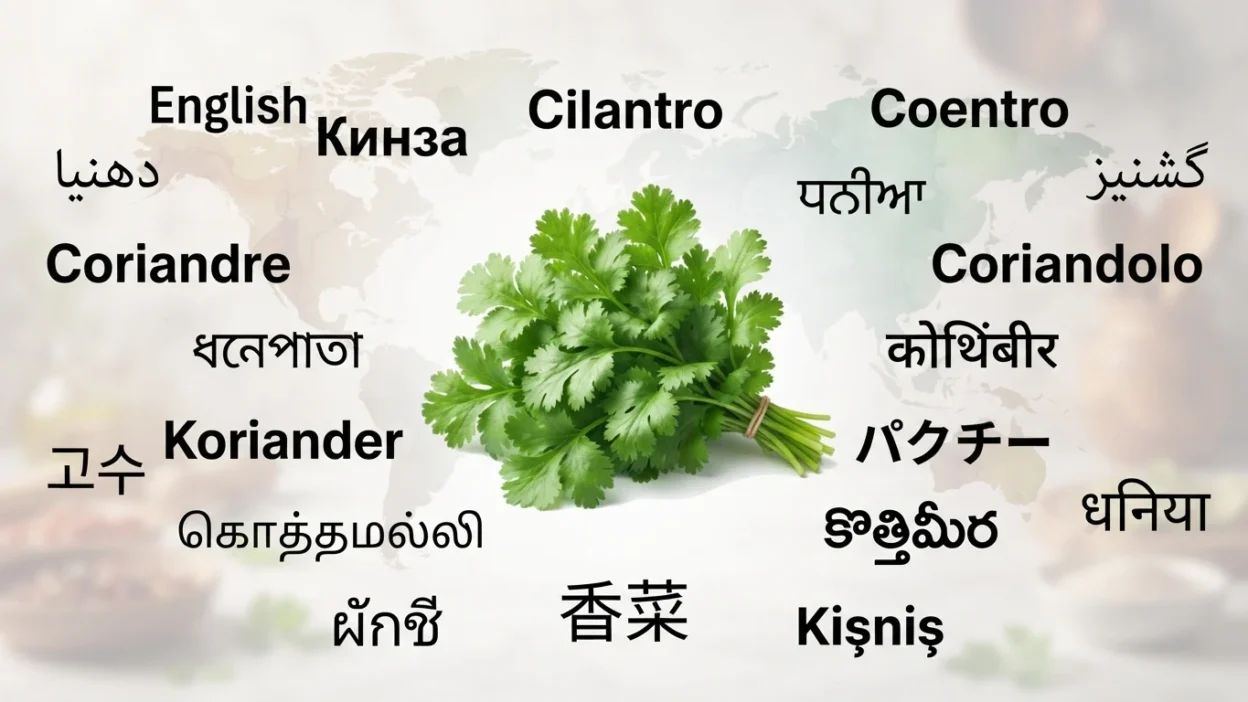
Have you ever wondered how to say cilantro in different languages? This fresh green herb is an essential ingredient in many cuisines, from Mexican salsa and Indian chutneys to Thai dishes and Middle Eastern recipes. But the word used for cilantro changes from one language to another.
One important detail is that cilantro and coriander can refer to different parts of the same plant depending on the variety of English being used. In American English, “cilantro” usually means the fresh leaves and stems, while “coriander” commonly refers to the dried seeds. In many countries, however, one word may be used for the plant or its leaves more generally.
Whether you are searching for how to say cilantro in different languages, exploring cilantro translations, or learning how this popular herb is known around the world, this guide provides a useful multilingual reference.
In this guide, you’ll discover cilantro in different languages in all translations, including the native word, easy English pronunciation, a short real-life example sentence, and the English meaning of each example.
Cilantro in Different Languages
| Language | Native Phrase | Easy English Pronunciation | Example Sentence | English Meaning |
| Afrikaans | koljander | koh-lee-AHN-der | Ek voeg koljander by die slaai. | I add cilantro to the salad. |
| Albanian | koriandër | koh-ree-AHN-der | Shtoj koriandër në sallatë. | I add cilantro to the salad. |
| Arabic | كزبرة خضراء | kiz-BAR-ah KHAD-rah | أضيف الكزبرة الخضراء إلى السلطة. | I add cilantro to the salad. |
| Armenian | համեմ | ha-MEM | Ես համեմ եմ ավելացնում աղցանին։ | I add cilantro to the salad. |
| Azerbaijani | keşniş | kesh-NEESH | Salata keşniş əlavə edirəm. | I add cilantro to the salad. |
| Basque | martorri | mar-TOR-ree | Martorria entsaladari gehitzen diot. | I add cilantro to the salad. |
| Belarusian | каляндра | ka-LYAN-dra | Я дадаю каляндру ў салату. | I add cilantro to the salad. |
| Bengali | ধনেপাতা | dho-neh-PA-ta | আমি সালাদে ধনেপাতা দিই। | I add cilantro to the salad. |
| Bosnian | korijander | koh-ree-YAN-der | Dodajem korijander u salatu. | I add cilantro to the salad. |
| Bulgarian | кориандър | koh-ree-AN-dur | Добавям кориандър към салатата. | I add cilantro to the salad. |
| Catalan | coriandre | koh-ree-AHN-dreh | Afegeixo coriandre a l’amanida. | I add cilantro to the salad. |
| Chinese (Mandarin) | 香菜 | shyang-tsai | 我在沙拉里加香菜。 | I add cilantro to the salad. |
| Croatian | korijander | koh-ree-YAN-der | Dodajem korijander u salatu. | I add cilantro to the salad. |
| Czech | koriandr | koh-ree-AHN-druh | Přidávám koriandr do salátu. | I add cilantro to the salad. |
| Danish | koriander | koh-ree-AN-der | Jeg tilsætter koriander til salaten. | I add cilantro to the salad. |
| Dutch | koriander | koh-ree-AHN-der | Ik voeg koriander aan de salade toe. | I add cilantro to the salad. |
| Estonian | koriander | koh-ree-AHN-der | Lisan salatile koriandrit. | I add cilantro to the salad. |
| Finnish | korianteri | koh-ree-AHN-teh-ree | Lisään korianteria salaattiin. | I add cilantro to the salad. |
| French | coriandre | koh-ree-AHN-druh | J’ajoute de la coriandre à la salade. | I add cilantro to the salad. |
| Galician | cilantro | seen-TLAH-dro | Engado cilantro á ensalada. | I add cilantro to the salad. |
| Georgian | ქინძი | keen-dzee | სალათს ქინძს ვამატებ. | I add cilantro to the salad. |
| German | Koriander | koh-ree-AHN-der | Ich gebe Koriander in den Salat. | I add cilantro to the salad. |
| Greek | κόλιανδρος | KOH-lee-an-dros | Προσθέτω κόλιανδρο στη σαλάτα. | I add cilantro to the salad. |
| Gujarati | ધાણા | dhaa-naa | હું સલાડમાં ધાણા ઉમેરું છું. | I add cilantro to the salad. |
| Haitian Creole | koryandè | koh-ryan-DEH | Mwen ajoute koryandè nan salad la. | I add cilantro to the salad. |
| Hebrew | כוסברה | koos-BAH-rah | אני מוסיף כוסברה לסלט. | I add cilantro to the salad. |
| Hindi | धनिया | dhuh-NEE-ya | मैं सलाद में धनिया डालता हूँ। | I add cilantro to the salad. |
| Hungarian | koriander | koh-ree-AHN-der | Koriandert teszek a salátába. | I add cilantro to the salad. |
| Icelandic | kóríander | KOH-ree-an-der | Ég bæti kóríander við salatið. | I add cilantro to the salad. |
| Indonesian | ketumbar | kuh-TOOM-bar | Saya menambahkan ketumbar ke salad. | I add cilantro to the salad. |
| Irish | lus an choire | luss un KHIR-eh | Cuirim lus an choire sa sailéad. | I add cilantro to the salad. |
| Italian | coriandolo | koh-ree-AN-doh-lo | Aggiungo coriandolo all’insalata. | I add cilantro to the salad. |
| Japanese | パクチー | pa-koo-CHEE | サラダにパクチーを入れます。 | I add cilantro to the salad. |
| Kannada | ಕೊತ್ತಂಬರಿ ಸೊಪ್ಪು | kot-tam-ba-ree sop-poo | ನಾನು ಸಲಾಡಿಗೆ ಕೊತ್ತಂಬರಿ ಸೊಪ್ಪು ಹಾಕುತ್ತೇನೆ. | I add cilantro to the salad. |
| Kazakh | кинза | KEEN-za | Мен салатқа кинза қосамын. | I add cilantro to the salad. |
| Korean | 고수 | go-soo | 샐러드에 고수를 넣어요. | I add cilantro to the salad. |
| Latin | coriandrum | koh-ree-AN-droom | Coriandrum in acetaria addo. | I add cilantro to the salad. |
| Latvian | koriandrs | koh-ree-AHN-drs | Es pievienoju koriandru salātiem. | I add cilantro to the salad. |
| Lithuanian | kalendra | ka-LEN-dra | Į salotas dedu kalendros. | I add cilantro to the salad. |
| Macedonian | коријандер | koh-ree-YAN-der | Додавам коријандер во салатата. | I add cilantro to the salad. |
| Malay | daun ketumbar | dah-oon kuh-TOOM-bar | Saya menambah daun ketumbar ke dalam salad. | I add cilantro to the salad. |
| Maltese | kosbor | KOSS-bor | Inżid il-kosbor mal-insalata. | I add cilantro to the salad. |
| Marathi | कोथिंबीर | koh-thim-BEER | मी सॅलडमध्ये कोथिंबीर घालतो. | I add cilantro to the salad. |
| Mongolian | яншуй | YAN-shoo-ee | Би салатанд яншуй нэмдэг. | I add cilantro to the salad. |
| Nepali | धनियाँ | dhuh-NEE-ya | म सलादमा धनियाँ हाल्छु। | I add cilantro to the salad. |
| Norwegian | koriander | koh-ree-AHN-der | Jeg tilsetter koriander i salaten. | I add cilantro to the salad. |
| Persian | گشنیز | gosh-NEEZ | من به سالاد گشنیز اضافه میکنم. | I add cilantro to the salad. |
| Polish | kolendra | koh-LEN-drah | Dodaję kolendrę do sałatki. | I add cilantro to the salad. |
| Portuguese | coentro | koh-EN-troo | Eu adiciono coentro à salada. | I add cilantro to the salad. |
| Punjabi | ਧਨੀਆ | dhuh-NEE-aa | ਮੈਂ ਸਲਾਦ ਵਿੱਚ ਧਨੀਆ ਪਾਉਂਦਾ ਹਾਂ। | I add cilantro to the salad. |
| Romanian | coriandru | koh-ree-AHN-droo | Adaug coriandru în salată. | I add cilantro to the salad. |
| Russian | кинза | keen-ZA | Я добавляю кинзу в салат. | I add cilantro to the salad. |
| Serbian | korijander | koh-ree-YAN-der | Dodajem korijander u salatu. | I add cilantro to the salad. |
| Slovak | koriander | koh-ree-AHN-der | Pridávam koriander do šalátu. | I add cilantro to the salad. |
| Slovenian | koriander | koh-ree-AHN-der | Solati dodam koriander. | I add cilantro to the salad. |
| Spanish | cilantro | seen-TLAH-dro | Añado cilantro a la ensalada. | I add cilantro to the salad. |
| Swahili | giligilani | gee-lee-gee-LAH-nee | Ninaongeza giligilani kwenye saladi. | I add cilantro to the salad. |
| Swedish | koriander | koh-ree-AHN-der | Jag tillsätter koriander i salladen. | I add cilantro to the salad. |
| Tamil | கொத்தமல்லி | kot-tha-MAL-lee | நான் சாலட்டில் கொத்தமல்லி சேர்க்கிறேன். | I add cilantro to the salad. |
| Telugu | కొత్తిమీర | kot-tha-MEE-ra | నేను సలాడ్లో కొత్తిమీర వేస్తాను. | I add cilantro to the salad. |
| Thai | ผักชี | pak-CHEE | ฉันใส่ผักชีในสลัด | I add cilantro to the salad. |
| Turkish | kişniş | kish-NEESH | Salataya kişniş ekliyorum. | I add cilantro to the salad. |
| Ukrainian | кінза | KEEN-za | Я додаю кінзу в салат. | I add cilantro to the salad. |
| Urdu | دھنیا | dhuh-NEE-ya | میں سلاد میں دھنیا ڈالتا ہوں۔ | I add cilantro to the salad. |
| Uzbek | kashnich | kash-NEECH | Men salatga kashnich qo‘shaman. | I add cilantro to the salad. |
| Vietnamese | rau mùi | zow moo-ee | Tôi thêm rau mùi vào món salad. | I add cilantro to the salad. |
| Welsh | coriander | koh-ree-AN-der | Rwy’n ychwanegu coriander at y salad. | I add cilantro to the salad. |
| Yiddish | קאָריאַנדער | koh-ree-AN-der | איך לייג צו קאָריאַנדער צום סאַלאַט. | I add cilantro to the salad. |
| Zulu | ikoriyanda | ee-koh-ree-YAN-da | Ngifaka ikoriyanda esaladini. | I add cilantro to the salad. |
How to Say Cilantro in Different Languages
If you are searching for how to say cilantro in different languages, you will notice that many languages use a word related to coriander, while others have a distinctive local culinary term.
For example, cilantro is cilantro in Spanish, coentro in Portuguese, coriandre in French, coriandolo in Italian, Koriander in German, 香菜 (xiāngcài) in Mandarin Chinese, パクチー (pakuchī) in Japanese, and 고수 (gosu) in Korean.
The terminology can be especially interesting because the same plant may be described differently depending on the country and whether the speaker is referring specifically to the fresh leaves or the coriander plant more generally.
Cilantro in Different Languages Around the World
Cilantro is used in cuisines across Asia, Latin America, Europe, Africa, and the Middle East. As a result, it has many regional names.
In South Asia, you may hear dhaniya or related forms. Spanish-speaking countries commonly use cilantro, while Portuguese uses coentro. In China, 香菜 is widely used for the fresh herb, while Japan commonly uses パクチー.
These differences make cilantro in different languages around the world an interesting topic for food lovers, travelers, cooks, and language learners.
Cilantro Translations in European Languages
Many European languages use words that are historically connected to the plant’s name.
French uses coriandre, Italian uses coriandolo, German uses Koriander, Polish uses kolendra, Romanian uses coriandru, and Portuguese uses coentro.
Spanish and Galician are particularly straightforward because cilantro is commonly used in both languages for the fresh herb.
Cilantro in Different Asian Languages
Asian languages have some of the most recognizable regional names for cilantro.
Hindi, Nepali, and Urdu commonly use forms related to dhaniya. Punjabi uses ਧਨੀਆ, Bengali uses ধনেপাতা, and Marathi uses कोथिंबीर.
Mandarin Chinese uses 香菜, Japanese uses パクチー, and Korean uses 고수. Thai uses ผักชี, while Vietnamese commonly uses rau mùi.
These differences show how culinary vocabulary can develop uniquely within each food culture.
Cilantro vs. Coriander: What Is the Difference?
The words cilantro and coriander can sometimes cause confusion.
In American English, cilantro generally refers to the fresh green leaves and stems of the coriander plant. Coriander often refers to the dried seeds used as a spice.
However, British English and many other varieties of English commonly use coriander for the fresh leaves as well. In other languages, one word may cover the plant, leaves, or spice depending on context.
So when researching cilantro in different languages translations, it is important to consider the regional meaning of the word.
Common Foods That Use Cilantro
Cilantro is a versatile herb used in many dishes around the world. Common examples include:
- Salsa
- Chutney
- Curries
- Soups
- Salads
- Tacos
- Rice dishes
- Noodle dishes
- Fresh herb sauces
- Garnishes
Its fresh flavor makes it especially popular in dishes where herbs are added near the end of cooking.
Why Learn Cilantro in Different Languages?
Learning food vocabulary is one of the most practical ways to improve your language skills.
The word cilantro can be useful when shopping for ingredients, ordering food, reading recipes, traveling, or talking about cooking. Knowing the local word can also help you understand menus and ingredient lists more easily.
For food lovers, learning cilantro in different languages is also a fun way to explore the relationship between language and cuisine.
Quick Cilantro Translations in Popular Languages
If you need a quick reference, here are some popular cilantro in different languages translations:
- English: cilantro
- Spanish: cilantro
- Portuguese: coentro
- French: coriandre
- Italian: coriandolo
- German: Koriander
- Chinese: 香菜
- Japanese: パクチー
- Korean: 고수
- Hindi: धनिया
- Urdu: دھنیا
- Punjabi: ਧਨੀਆ
- Turkish: kişniş
- Thai: ผักชี
- Vietnamese: rau mùi
- Russian: кинза
Cilantro Names in South Asian Languages
South Asia has an especially rich vocabulary for this popular herb.
Hindi uses धनिया, Urdu uses دھنیا, and Punjabi uses ਧਨੀਆ. Bengali uses ধনেপাতা, which specifically emphasizes the leaves. Marathi uses कोथिंबीर, while Tamil uses கொத்தமல்லி and Telugu uses కొత్తిమీర.
These regional differences are useful to know because the herb is a major ingredient in many South Asian dishes.
Conclusion
Cilantro is a small herb with a surprisingly large vocabulary. Across languages, you can find many different names, from cilantro in Spanish and coentro in Portuguese to coriandre in French, 香菜 in Chinese, パクチー in Japanese, and ધનિયા in South Asian languages.
Whether you are learning a language, exploring international cuisine, preparing a recipe, or searching for cilantro in different languages in all languages, these translations provide a convenient starting point.
FAQs
What is cilantro in different languages?
Cilantro has many names around the world. Some common translations include cilantro in Spanish, coentro in Portuguese, coriandre in French, coriandolo in Italian, Koriander in German, 香菜 in Chinese, and 고수 in Korean.
How do you say cilantro in Spanish?
In Spanish, cilantro is cilantro, pronounced approximately seen-TLAH-dro. For example, “Añado cilantro a la ensalada” means “I add cilantro to the salad.”
What is cilantro called in Hindi and Urdu?
In Hindi, cilantro is commonly called धनिया (dhaniya). In Urdu, it is دھنیا (dhaniya). Both terms are widely used for the fresh herb in South Asian cooking.
How do you say cilantro in different languages?
Cilantro can be called coentro in Portuguese, coriandre in French, coriandolo in Italian, Koriander in German, 香菜 in Chinese, パクチー in Japanese, 고수 in Korean, and kişniş in Turkish.
Is cilantro the same as coriander?
Cilantro and coriander come from the same plant. In American English, “cilantro” usually means the fresh leaves and stems, while “coriander” often refers to the dried seeds. In British English and many other regions, “coriander” can also refer to the fresh leaves.